
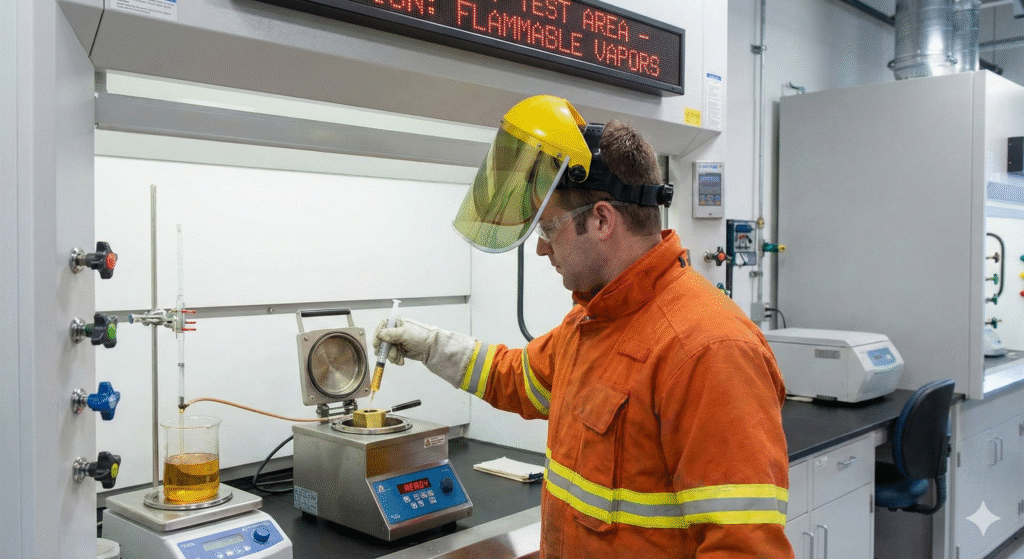
What Is Flash Point?
Flash point is the lowest temperature at which a liquid produces enough vapor to ignite briefly when an external flame or spark is applied.
In simple terms, it is the temperature at which a liquid becomes “fire-ready” for a moment.
At the flash point:
- The liquid itself does not burn
- The vapor above the liquid ignites briefly
- If the ignition source is removed, the flame usually goes out
This is why flash point is different from continuous burning.
How to Understand Flash Point in Real Life
Liquids do not burn directly.
They must first evaporate into vapor, and the vapor is what actually burns.
As temperature increases:
- The liquid releases more vapor
- At a certain temperature, there is just enough vapor to ignite
- That temperature is called the flash point
Think of flash point as the moment when a liquid becomes capable of “flashing” into fire if a spark or flame is introduced.
Simple Flash Point Examples
Petrol (Gasoline)
- Flash point: approximately –43°C
- Petrol releases flammable vapor even in very cold conditions
- At normal room temperature, petrol is already far above its flash point
- This is why a small spark can cause instant ignition
Diesel
- Flash point: approximately 52°C to 96°C
- At room temperature, diesel usually does not ignite easily
- A match held near diesel at ambient conditions will normally not cause fire
- However, diesel can ignite when:
- Heated
- Sprayed as a fine mist
- Exposed to very hot surfaces
Kerosene
- Flash point: approximately 38°C to 72°C
- Less hazardous than petrol but more hazardous than diesel
- In hot environments, kerosene vapors can become flammable
Flash Point vs Fire Point (Common Confusion)
These two terms are often misunderstood.
- Flash Point: Temperature at which vapor ignites briefly
- Fire Point: Temperature at which the liquid continues to burn after ignition
In short:
- Flash point = can catch fire
- Fire point = will keep burning
Why the Term “Flash Point” Exists
The concept of flash point was developed to measure and compare fire risk in liquids.
Historically, many fires and explosions occurred because people did not understand:
- Which liquids were highly dangerous
- At what temperatures liquids became a fire hazard
By defining flash point, safety professionals gained a scientific basis to:
- Classify flammable liquids
- Establish safe storage and handling rules
- Design safer industrial and workplace environments
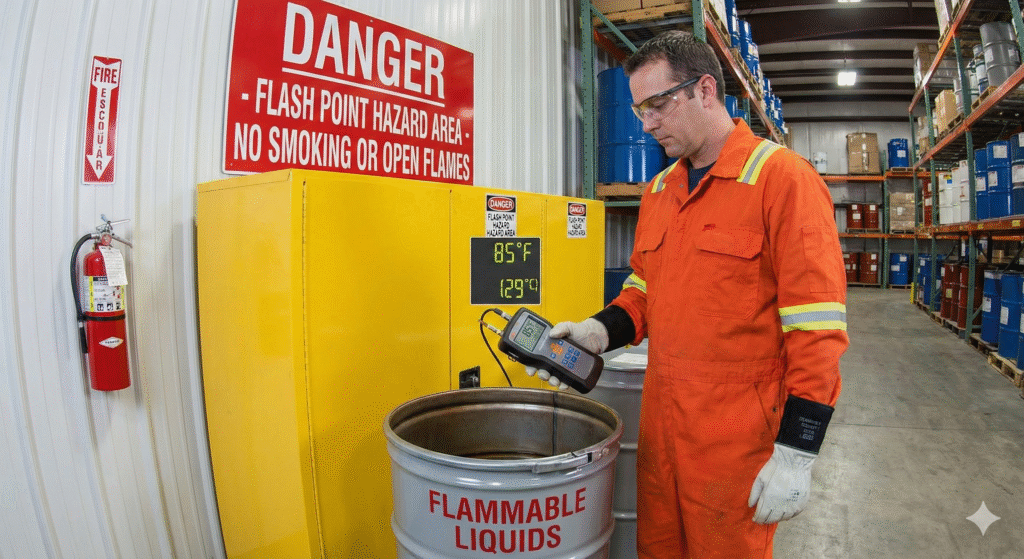
Why Flash Point Is Important in Safety
1. Hazard Classification
Liquids are classified based on flash point:
- Low flash point → Highly flammable
- High flash point → Less flammable
This classification is used in:
- Safety Data Sheets (SDS)
- Fire and building codes
- Chemical labeling systems
- Transport regulations
2. Safe Storage and Handling
Flash point determines:
- Maximum safe storage temperature
- Ventilation requirements
- Whether indoor storage is allowed
- Need for fire-rated storage cabinets
For example:
- Petrol requires strict controls because it is always above its flash point in normal weather
- Diesel requires fewer controls but still needs ignition and heat management
3. Fire Risk Assessment
In HSE and industrial safety, flash point helps identify fire hazards in:
- Workshops and maintenance areas
- Fuel storage facilities
- Laboratories
- Process plants
It influences decisions on:
- Hot work permits
- Electrical area classification
- Emergency response planning
4. Transportation and Legal Compliance
International standards such as ADR, IMDG, OSHA, and NFPA use flash point to determine:
- Packaging requirements
- Hazard labeling
- Transport conditions
Failure to comply can result in:
- Fire accidents
- Legal penalties
- Shutdown of operations
Common Misunderstandings About Flash Point
“If a liquid is below its flash point, it is safe.”
Not entirely true. Risk is reduced, but ignition can still occur in conditions such as spraying, confined spaces, or contact with hot surfaces.
“Flash point means the liquid will ignite by itself.”
Incorrect. Flash point requires an external ignition source. Self-ignition occurs at the auto-ignition temperature, which is much higher.
In One Sentence
Flash point is the lowest temperature at which a liquid releases enough vapor to briefly ignite when a flame or spark is present, making it one of the most critical indicators of fire risk in safety management.