
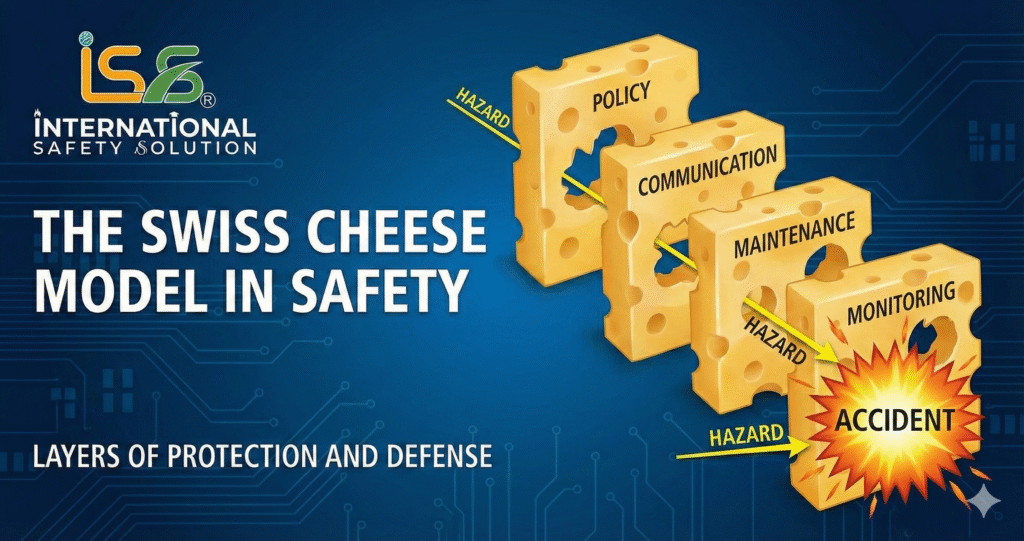
In high-risk industries such as oil and gas, construction, aviation, healthcare, and manufacturing, accidents rarely occur due to a single mistake. Most major incidents are the result of multiple system failures occurring simultaneously. The Swiss Cheese Model is one of the most widely accepted safety management models used globally to explain this reality and support risk assessment, audits, and gap analysis.
The Swiss Cheese Model was developed in the early 1990s by Professor James Reason, a British psychologist and leading expert on human error and organizational safety. Through extensive research into industrial disasters, aviation crashes, and healthcare incidents, Reason demonstrated that human error is unavoidable and that blaming individuals does not prevent future accidents. Instead, failures within systems and organizational defenses are the true root causes of catastrophic events.
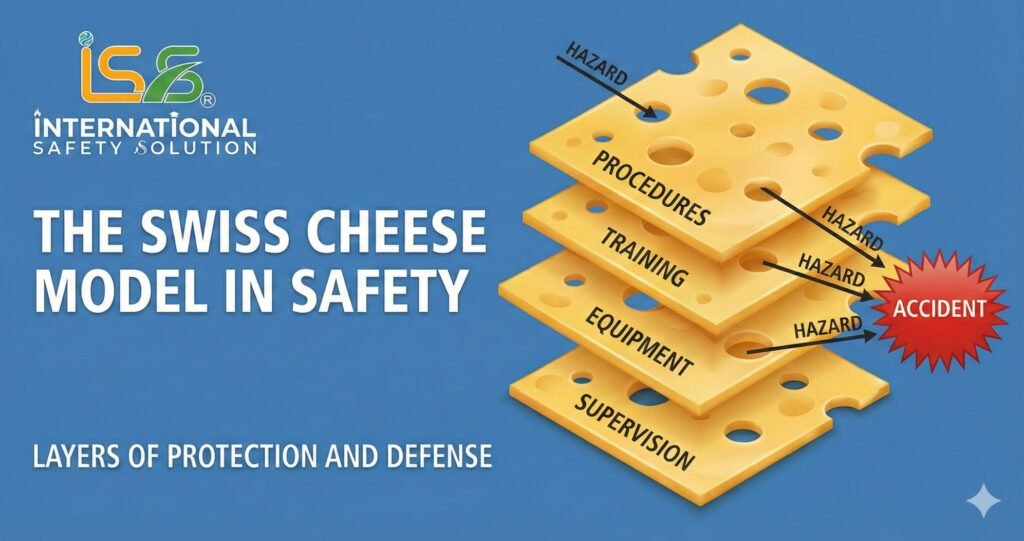
The model represents an organization’s safety defenses as multiple slices of Swiss cheese arranged in a line. Each slice symbolizes a layer of protection, including policies and procedures, engineering controls, training and competence, supervision, maintenance systems, emergency preparedness, and personal protective equipment. These layers are designed to prevent hazards from reaching people and causing harm.
The holes in each slice represent weaknesses or failures within those defenses. These weaknesses may be caused by poor design, inadequate training, lack of supervision, unsafe behaviors, management decisions, or resource limitations. While a single hole does not usually result in an accident, serious incidents occur when the holes in multiple layers align, allowing hazards to pass through every defense.
The core principle of the Swiss Cheese Model is that accidents are not caused by one failure but by a combination of active failures and latent conditions across an organization. This understanding shifts the focus from individual blame to system improvement, encouraging organizations to strengthen controls at every level.
One of the most important applications of the Swiss Cheese Model is in safety audits and gap analysis. Auditors use the model to examine whether safety barriers exist, whether they are effective, and where gaps or weaknesses are present. This approach aligns closely with management system standards such as ISO 45001 for occupational health and safety, ISO 9001 for quality management, ISO 14001 for environmental management, and NEBOSH and IOSH audit frameworks.
In audit gap analysis, each safety layer is treated as a separate audit area. Auditors review leadership commitment, risk assessments, engineering controls, training records, operational procedures, supervision practices, maintenance systems, emergency preparedness, and PPE usage. Gaps may include missing procedures, poor implementation, lack of documentation, damaged equipment, or insufficient training.
Auditors prefer the Swiss Cheese Model because it provides a structured and logical way to explain risk. It highlights systemic weaknesses, discourages over-reliance on single controls, and supports risk-based thinking. The model allows auditors to clearly communicate that although controls may exist, they are ineffective when weaknesses are present across multiple layers.
For example, during an ISO 45001 audit in a manufacturing facility, an organization may have risk assessments in place, but incomplete training records, damaged machine guarding, and inconsistent supervision. While each issue alone may seem manageable, together they form aligned gaps that significantly increase the risk of a serious accident—exactly as illustrated by the Swiss Cheese Model.
Beyond audits, the model strengthens safety culture by promoting proactive prevention rather than reactive correction. It encourages organizations to continuously improve systems, learn from near misses, and reinforce multiple layers of defense to protect workers, assets, and operations.
Conclusion
The Swiss Cheese Model, developed by James Reason, is not just an accident theory—it is a powerful safety management and audit framework. By revealing hidden system weaknesses and supporting structured gap analysis, the model helps organizations move beyond blame and toward sustainable, system-based safety performance. Strong safety outcomes are achieved when multiple effective barriers work together, not when organizations rely on a single line of defense.