
The Life Safety Code Every HSE Professional Must Understand
In occupational health and safety practice, fire protection is not limited to extinguishers and alarms. True life safety is about safe building design, controlled evacuation, and protection of occupants during fire or emergency situations. This is where National Fire Protection Association (NFPA) developed one of the most important safety codes in the world:
🔥 NFPA 101 – Life Safety Code
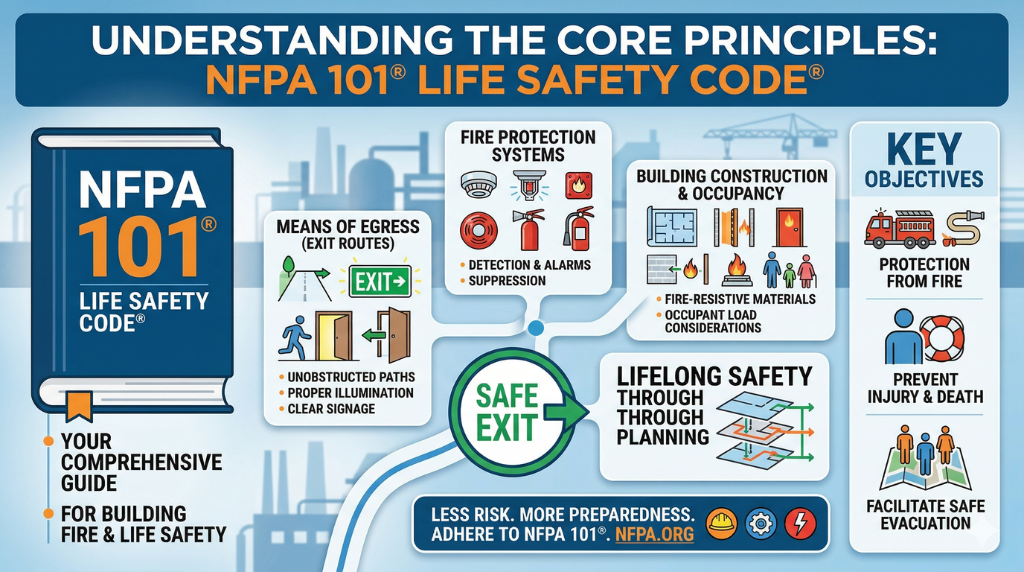
1️⃣ What is NFPA 101? NFPA 101, commonly called the Life Safety Code, is a comprehensive fire protection standard focused on protecting human life from fire, smoke, and panic hazards inside buildings. Unlike installation-focused electrical codes, NFPA 101 concentrates on:
- Means of egress (safe exits)
- Occupant load management
- Fire resistance construction
- Emergency lighting
- Fire protection systems
- Building occupancy classification
The core objective is simple: Ensure people can escape safely during an emergency.
2️⃣ What is the Role of NFPA 101? NFPA 101 plays a strategic role in life safety engineering and HSE management.
🔹 A. Regulating Means of Egress The code defines:
- Number of exits required
- Exit width calculations
- Maximum travel distance
- Door swing direction
- Staircase requirements This prevents deadly stampede conditions and blocked evacuation routes.
🔹 B. Occupancy-Based Safety Requirements NFPA 101 classifies buildings into occupancy types such as:
- Healthcare facilities
- Educational institutions
- Industrial occupancies
- Assembly buildings
- Residential buildings Each occupancy type has different evacuation and fire protection requirements because risk profiles differ.
🔹 C. Fire Protection System Requirements The code defines when buildings must have:
- Automatic sprinkler systems
- Fire alarm systems
- Smoke detection
- Emergency lighting
- Fire-rated walls and doors It ensures layered protection — detection, containment, and evacuation.
🔹 D. Minimizing Panic & Human Behavior Risk Fire incidents often lead to panic rather than direct flame exposure. NFPA 101 addresses:
- Exit signage visibility
- Corridor illumination
- Stairway enclosure
- Smoke compartmentation This reduces confusion and chaos during emergencies.
3️⃣ Where Does NFPA 101 Apply? NFPA 101 is widely adopted in:
- United States (state and local jurisdictions)
- Hospitals and healthcare facilities
- Industrial plants
- High-rise buildings
- Educational institutions
- Shopping malls and assembly halls
- Oil & gas facilities
- International projects referencing NFPA standards
Many countries adopt NFPA codes either fully or partially in their building regulations. It is often used alongside:
- NFPA 70 (Electrical Code)
- NFPA 72 (Fire Alarm Code)
- International Building Codes (IBC)
4️⃣ Why NFPA 101 is Important for HSE Professionals As an HSE professional, NFPA 101 is not just a fire engineering document — it is a risk control framework.
🔹 A. Risk Assessment Support When conducting fire risk assessment, NFPA 101 provides benchmarks for:
- Exit adequacy
- Occupant density
- Emergency lighting levels
- Compartmentation compliance It allows you to measure gap analysis against recognized standards.
🔹 B. Audit & Inspection Reference During safety audits, you must verify:
- Exit routes are unobstructed
- Fire doors are functional
- Emergency lights are tested
- Staircases meet width requirements
- Assembly points are adequate NFPA 101 gives technical justification for findings.
🔹 C. Legal & Compliance Protection In case of fire incidents, investigations examine:
- Was building design compliant?
- Were evacuation routes sufficient?
- Was occupant load exceeded?
- Were emergency systems operational? Using NFPA 101 as a reference strengthens compliance defensibility.
🔹 D. Emergency Planning & Drills Evacuation drill planning depends on:
- Travel distance
- Exit capacity
- Flow rate calculation
- Stair discharge capacity NFPA 101 helps in calculating evacuation time and crowd movement safety.
5️⃣ Real-World Lessons from Past Disasters Historically, many fire disasters occurred due to:
- Locked exits
- Insufficient staircases
- Overcrowded assembly areas
- Poor emergency lighting These failures are exactly what NFPA 101 aims to prevent. Modern life safety codes evolved because of tragic incidents where building design failed occupants.
6️⃣ How NFPA 101 Integrates into HSE Practice For an HSE professional, NFPA 101 supports: ✔ Fire Risk Assessment: Provides measurable compliance criteria. ✔ Facility Inspection: Offers structural and system-level inspection benchmarks. ✔ Safety Training: Helps educate staff about exit routes and evacuation behavior. ✔ Design Review: Assists in reviewing new construction or modification projects. ✔ Compliance Documentation: Strengthens audit reports with recognized international references.
7️⃣ Key Technical Areas HSE Must Understand in NFPA 101
- Means of Egress Design
- Exit Width Calculation Formula
- Travel Distance Limits
- Fire Resistance Ratings
- Smoke Compartmentation
- Occupancy Hazard Classification
- Emergency Lighting Duration Requirements
- Staircase Pressurization in High-Rise Buildings
8️⃣ Professional Conclusion NFPA 101 is not only a fire code — it is a life protection engineering system. For an HSE professional, understanding NFPA 101 means:
- Protecting occupants from fire and panic
- Ensuring structural compliance
- Improving evacuation efficiency
- Reducing legal exposure
- Enhancing fire safety management systems
It transforms fire safety from reactive response to proactive life protection strategy.
One Response
Sir.request for Free notes.thanks.