
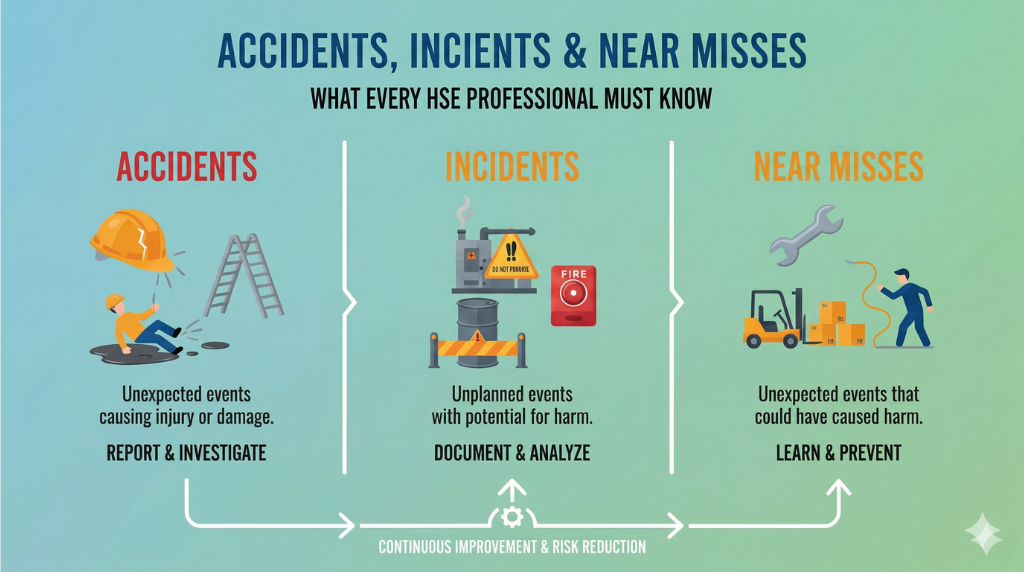
In Occupational Health, Safety and Environment (HSE) management, the terms incident, near miss, and accident are frequently used. Although they are related, they have distinct meanings in professional safety practice. Misunderstanding these terms can affect reporting, investigation, and preventive controls.
This article explains each concept clearly, using technical terminology and practical examples.
1️⃣ What is an Incident?
🔹 Definition
An incident is any unplanned, undesired event that disrupts normal operations and has the potential to cause injury, illness, damage, or loss.
It is a broad term used in safety management systems.
Technically speaking:
An incident is an event arising out of or in the course of work that may or may not result in injury or damage.
Hazard Identification, Risk Assessment and Control (HIRAC) – Simple Guide to Workplace Safety
In Occupational Health, Safety, and Environment (HSE) practice, HIRAC is the backbone of workplace safety. It helps prevent incidents, near misses, and accidents by identifying hazards, assessing risks, and applying control measures systematically.
This guide explains HIRAC in simple terms with practical examples, including the Hierarchy of Controls.
1️⃣ Hazard Identification (H)
✅ Simple Definition
Hazard Identification is the process of finding anything in the workplace that could cause harm.
A hazard can cause:
Injury
Illness
Property damage
Environmental harm
🔎 Example Scenario
Activity: Worker cutting metal using a grinder.
Hazards identified:
Flying metal sparks
Rotating grinding wheel
Noise exposure
Electrical cable on floor
Hazard Identified: Flying sparks and sharp metal pieces.
Key Question: “What can go wrong?”
2️⃣ Risk Assessment (RA)
✅ Simple Definition
Risk Assessment evaluates how likely the hazard is to cause harm and how severe the harm could be.
Formula:
Risk = Likelihood × Severity
🔎 Example Scenario
Hazard: Flying metal sparks
Likelihood: High
Severity: Serious eye injury
Risk Level: High
Hazard: Electrical cable on floor
Likelihood: Medium
Severity: Minor injury
Risk Level: Medium
Key Question: “How bad and how likely?”
3️⃣ Control Measures (C) – Using Hierarchy of Controls
Control measures reduce or eliminate hazards. The most effective method is always at the source, not just protecting workers.
🔺 Five Levels of the Hierarchy of Controls
Elimination – Remove the hazard completely
Substitution – Replace with a safer alternative
Engineering Controls – Isolate people from the hazard
Administrative Controls – Change work procedures and behavior
Personal Protective Equipment (PPE) – Protect the worker
🔹 Applying Hierarchy of Controls (Grinding Example)
Hazard: Flying metal sparks
Level | Control Action | Example
Elimination | Remove hazard completely | Use pre-cut metal sheets instead of manual grinding
Substitution | Replace hazard with safer option | Use low-speed cutting tool instead of high-speed grinder
Engineering | Isolate hazard | Install spark guard shield; machine guard; cable management
Administrative | Change behavior | Safe work procedures; training; toolbox talks
PPE | Protect worker | Safety goggles; face shield; ear plugs; gloves
Notice: PPE is the least effective and should be used after higher-level controls.
🔹 Another Example (Oil Spill Incident)
Incident: Worker slips on oil spilled on workshop floor.
Level | Control Action | Example
Elimination | Stop leak permanently | Fix machine seal causing oil leak
Substitution | Use safer alternative | Replace slippery oil with less slippery lubricant
Engineering | Isolate hazard | Drip tray, anti-slip flooring, proper drainage
Administrative | Procedures & training | Housekeeping SOP, warning signs, training
PPE | Personal protection | Anti-slip safety shoes, gloves
4️⃣ Complete HIRAC Flow (Step-by-Step)
1️⃣ Identify Hazard → Find potential sources of harm
2️⃣ Assess Risk → Evaluate likelihood and severity
3️⃣ Apply Control Measures → Use Hierarchy of Controls
4️⃣ Reassess Risk → Ensure residual risk is low before starting work
5️⃣ Why HIRAC with Hierarchy is the Backbone of Safety
Prevents incidents and accidents
Reduces near misses
Controls unsafe acts and unsafe conditions
Strengthens safety culture
Ensures compliance with international safety standards (ILO, OSHA)
Without HIRAC, safety is reactive.
With HIRAC, safety is proactive and preventive.
6️⃣ Professional Takeaway
Hazard Identification: Find the danger
Risk Assessment: Measure the danger
Control Measures: Reduce or eliminate the danger using the Hierarchy of Controls
In HSE practice: No work should start without HIRAC.
This approach transforms workplace safety from reactive to proactive, making accidents avoidable and near misses manageable.