
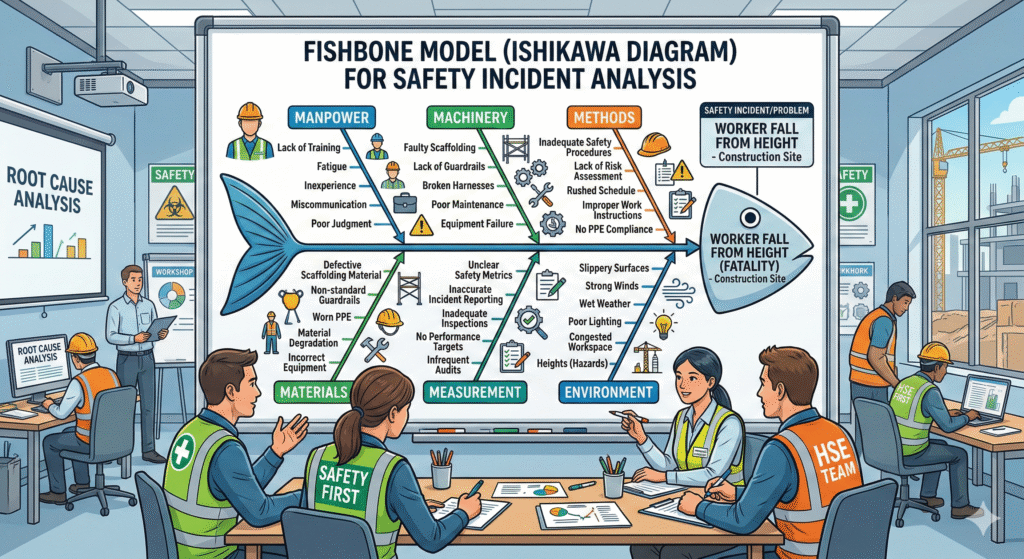
The Fishbone Diagram (also called Ishikawa Diagram or Cause-and-Effect Diagram) is a structured Root Cause Analysis (RCA) tool used to systematically identify, categorize, and analyze contributing factors of a failure event. In high-risk industries such as construction, manufacturing, and occupational safety, the Fishbone model prevents superficial conclusions and forces investigation into systemic weaknesses. The collapse of Rana Plaza (24 April 2013, Bangladesh), which killed over 1,100 workers, is a classic case where multi-layered root causes existed beyond the visible structural failure.
🔍 Application of Fishbone Diagram to Rana Plaza
🎯 Problem Statement (Fish Head):
“Collapse of Rana Plaza Building causing mass fatalities and injuries.”
The spine of the fish represents the problem, while the major bones represent categories of causes. The most commonly used framework in industrial RCA is the 6M Model: Man, Machine, Method, Material, Measurement, Mother Nature (Environment).
📌 Explanation of 6M with Rana Plaza Case Analysis
1️⃣ Man (Human Factors)
Focus: Competency, behavior, supervision, and decision-making.
Root Causes: Building owner ignored evacuation warnings. Workers were forced to enter despite visible structural cracks. Lack of qualified structural engineers overseeing modifications. Poor safety culture and absence of worker empowerment. Inadequate regulatory enforcement personnel.
Technical Insight: Failure of leadership accountability and ethical decision-making significantly contributed to risk exposure.
2️⃣ Machine (Equipment & Tools)
Focus: Machinery, equipment vibration, operational systems.
Root Causes: Heavy industrial sewing machines installed on floors not designed for dynamic loads. Backup generators placed on upper floors created excessive vibration. Continuous operation of equipment amplified structural stress.
Technical Insight: Dynamic load effects were not considered in structural design capacity.
3️⃣ Method (Process & Procedures)
Focus: Work procedures, policies, SOPs, compliance systems.
Root Causes: Unauthorized vertical extension of the building (additional floors added illegally). Conversion of commercial building into industrial use without structural reassessment. No formal structural safety audit conducted. No emergency evacuation protocol effectively implemented.
Technical Insight: Absence of structured risk assessment and structural integrity review.
4️⃣ Material (Construction Materials)
Focus: Quality and suitability of materials used.
Root Causes: Substandard construction materials suspected. Weak concrete strength relative to design load. Inadequate reinforcement steel bars.
Technical Insight: Material quality control failures reduced load-bearing capacity.
5️⃣ Measurement (Inspection & Monitoring)
Focus: Audits, inspections, monitoring systems.
Root Causes: Lack of routine structural inspections. Failure to act on visible cracks identified one day before collapse. Poor documentation and compliance tracking. No third-party structural certification after building modification.
Technical Insight: Ineffective monitoring and regulatory oversight allowed hazards to escalate.
6️⃣ Mother Nature (Environment)
Focus: Environmental and external conditions.
Root Causes: Soil conditions may not have supported additional structural load. Vibrational amplification due to generator and machinery. High occupancy load exceeding design capacity.
Technical Insight: Environmental load factors and occupancy stress exceeded original structural design parameters.
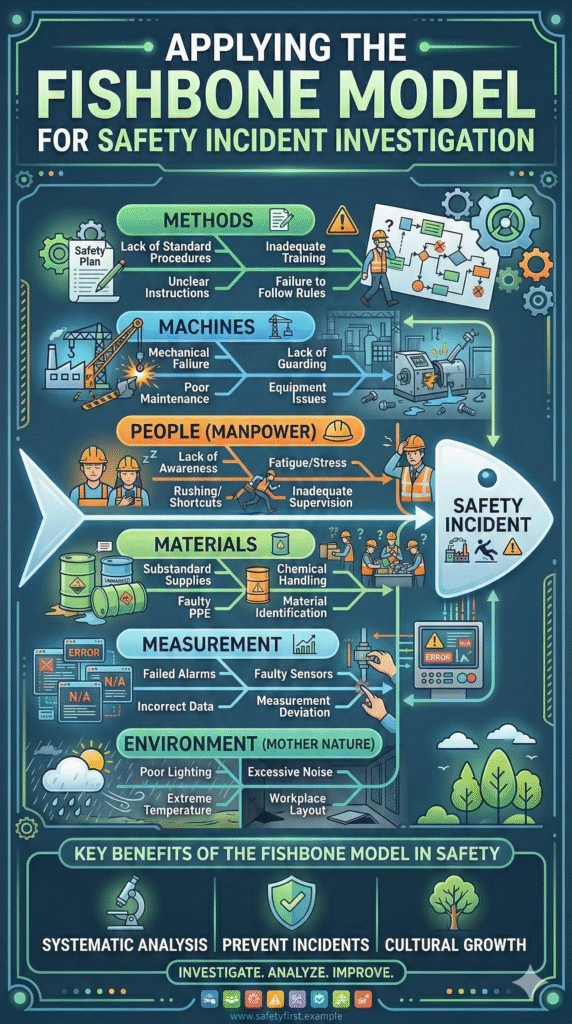
🧠 Key Systemic Root Causes Identified
Using the Fishbone model reveals that the collapse was not a single technical failure but a systemic governance failure involving poor building code enforcement, corruption and negligence, lack of structural risk assessment, economic pressure overriding safety, and weak occupational safety governance.
📊 Why Fishbone is Effective for Major Incidents
✔ Prevents blame on only one factor
✔ Encourages multi-disciplinary investigation
✔ Supports legal and regulatory reform
✔ Helps develop preventive controls
✔ Aligns with Safety Management Systems (SMS)
🏗 HSE Lessons Learned
Always conduct structural risk assessments before operational change. Enforce permit-to-operate systems for high-risk modifications. Strengthen regulatory compliance audits. Promote worker stop-work authority. Integrate RCA tools like Fishbone into accident investigation procedures.
📌 Conclusion
The Fishbone (6M) model demonstrates that the Rana Plaza collapse was not merely a structural issue — it was a failure across human, procedural, material, monitoring, environmental, and governance dimensions. Root Cause Analysis using the 6M framework transforms accident investigation from reactive reporting to proactive prevention.