
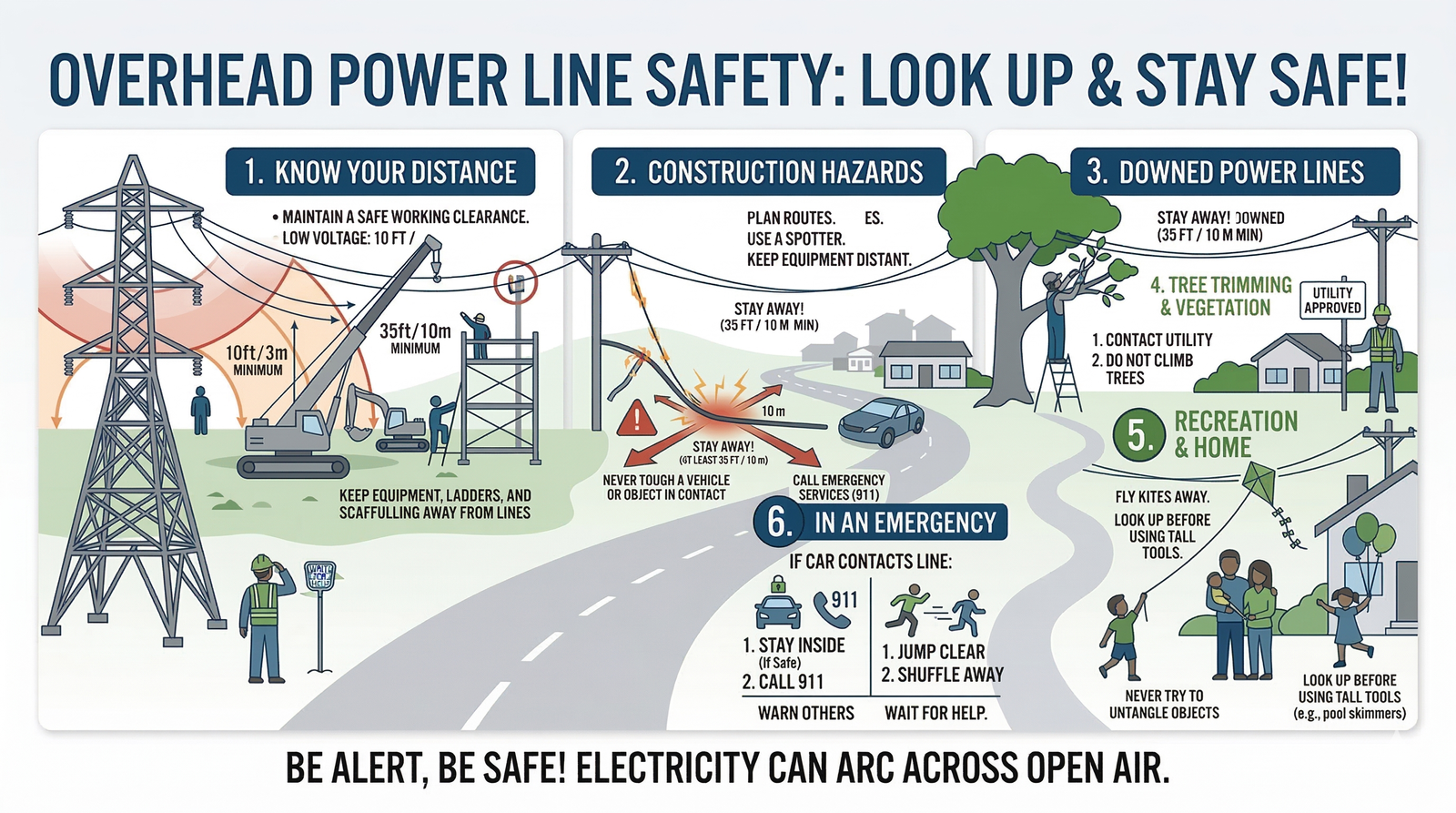
Essential Guidance for Construction & Industrial Worksites
Overhead power lines are one of the most dangerous hazards on construction sites, warehouses, factories, and maintenance areas. Contact with energized lines can cause electrocution, severe burns, fires, equipment damage, or fatalities.
Many serious incidents occur when workers operate cranes, dump trucks, scaffolding, ladders, or excavators near power lines without maintaining the required clearance.
Because electricity can arc (jump) through air, workers do not need to touch the line directly to be electrocuted. Maintaining a safe distance is therefore critical.
Why Safe Distance is Important
Maintaining proper clearance helps to:
• Prevent electrical shock and electrocution
• Avoid electrical arcing from high-voltage lines
• Protect workers, equipment, and structures
• Comply with international safety standards such as OSHA and NFPA
• Reduce risk during construction, lifting operations, and maintenance work
Minimum Safe Distance from Overhead Power Lines
| Voltage Level | Minimum Safe Distance |
| Up to 50 kV | 10 ft (3 m) |
| 50 kV – 200 kV | 15 ft (4.5 m) |
| 200 kV – 350 kV | 20 ft (6 m) |
| 350 kV – 500 kV | 25 ft (7.5 m) |
| 500 kV – 750 kV | 35 ft (10.5 m) |
| 750 kV – 1000 kV | 45 ft (13.5 m) |
These distances apply to workers, vehicles, cranes, lifting equipment, scaffolding, ladders, and dump trucks with raised beds.
Equipment That Must Maintain Clearance
Common equipment involved in overhead line incidents includes:
• Mobile cranes
• Boom trucks
• Concrete pumps
• Dump trucks
• Excavators
• Scaffolding systems
• Long metal ladders
• Steel reinforcement bars (rebars)
Even a small movement of equipment can reduce clearance and cause electrical contact.
Common Hazards Near Overhead Power Lines
Electrical Arcing
High-voltage electricity can jump through air without direct contact.
Equipment Contact
Cranes or dump trucks may accidentally touch the line.
Induced Voltage
Metal equipment near high-voltage lines can become energized.
Falling Lines
Damaged poles or strong winds can cause power lines to fall.