
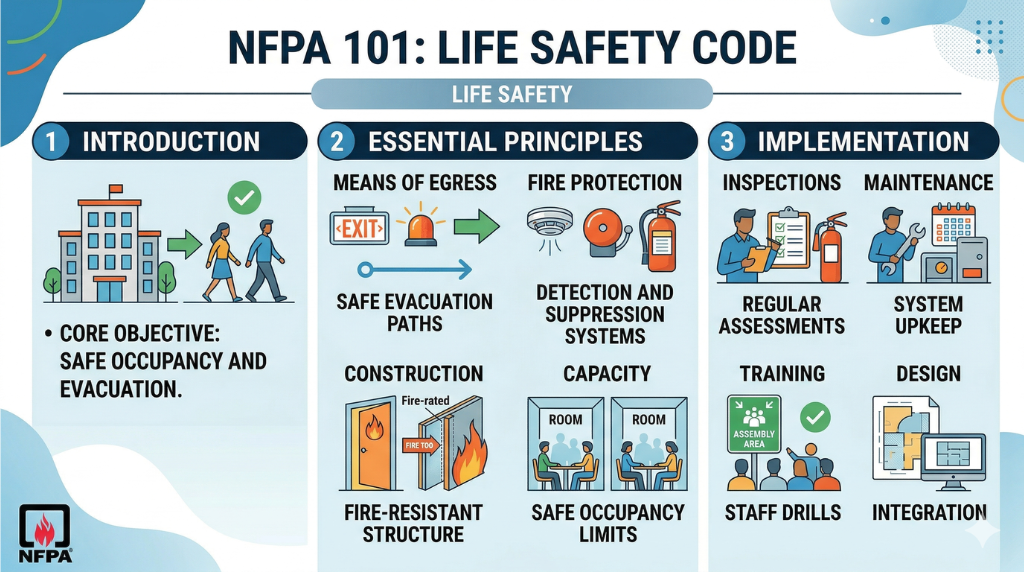
Introduction
The NFPA 101 – Life Safety Code is one of the most important fire safety standards developed by the National Fire Protection Association (NFPA). It focuses on protecting human life from fire, smoke, and toxic gases through proper building design, construction, and operation.
Unlike other fire codes that mainly focus on systems like sprinklers, NFPA 101 emphasizes safe evacuation and occupant protection.
History of NFPA 101
NFPA 101 was developed after the tragic Triangle Shirtwaist Factory fire (1911), which exposed serious gaps in fire safety and exit design.
- First published in 1927
- Regularly updated to meet modern safety challenges
- Widely adopted across industries worldwide
Purpose of NFPA 101
The main objective of NFPA 101 is to protect human life during fire emergencies.
It ensures:
✔ Safe evacuation of occupants
✔ Reduced risk of injuries and fatalities
✔ Control of fire, smoke, and toxic gases
✔ Prevention of panic during emergencies
Scope of NFPA 101
NFPA 101 applies to both new and existing buildings, including:
- Industrial facilities
- Hospitals and healthcare units
- Schools and universities
- Commercial buildings
- Residential occupancies
It covers design, construction, operation, and maintenance requirements for life safety.
Key Components of NFPA 101
1. Means of Egress (Chapter 7)
This is the core of NFPA 101 and focuses on safe escape routes.
It includes:
- Exit routes and corridors
- Stairways and doors
- Exit capacity
Key requirements:
- Minimum exit width
- Limited travel distance
- Doors must open easily from inside
- Emergency lighting must work for at least 90 minutes
👉 In simple terms: People must be able to escape quickly and safely.
2. Fire Protection Features (Chapter 8)
These are passive safety elements that control fire spread.
They include:
- Fire-resistant walls
- Smoke barriers
- Protected shafts and staircases
- Compartmentation
These features help contain fire and smoke within specific areas.
3. Fire Protection Systems (Chapter 9)
These are active systems used to detect and control fire.
They include:
- Fire alarm systems
- Sprinkler systems
- Smoke detectors
- Emergency lighting
These systems provide early warning and response.
4. Occupancy Classification
Buildings are classified based on their use, such as:
- Assembly (malls, halls)
- Educational (schools)
- Healthcare (hospitals)
- Industrial
- Residential
Each category has specific safety requirements depending on risk levels.
5. Emergency Planning & Procedures
NFPA 101 requires proper emergency preparedness, including:
- Evacuation plans
- Fire drills
- Staff training
- Emergency response procedures
This ensures people know what to do during an emergency.
6. Inspection, Testing, and Maintenance
Regular checks are mandatory to ensure safety systems function properly.
This includes:
- Fire alarm testing
- Emergency lighting inspection
- Exit route clearance
- System maintenance
Poor maintenance is considered a serious violation.
Important Technical Requirements
Exit Requirements:
- Number of exits depends on occupant load
- Exits must be clearly marked and illuminated
- Exit paths must remain unobstructed
Occupant Load:
- Determines exit capacity
- Based on building size and usage
Emergency Lighting:
- Activates within 10 seconds of power failure
- Must provide at least 90 minutes backup
Common NFPA 101 Violations
Safety professionals often observe:
❌ Blocked exits
❌ Locked emergency doors
❌ Non-functional emergency lights
❌ Overcrowding beyond limits
❌ Poor maintenance of systems
These issues directly compromise life safety.
NFPA 101 vs Other Codes
- NFPA 101: Life safety and evacuation
- NFPA 13: Sprinkler systems
- NFPA 72: Fire alarm systems
- IBC/IFC: Building construction
👉 NFPA 101 serves as the overall life safety framework.
Importance for HSE Professionals
NFPA 101 is essential for safety officers and engineers because it:
- Guides real-world evacuation planning
- Supports risk assessment
- Ensures international compliance
- Improves workplace safety culture
Modern Updates & Trends
Recent editions of NFPA 101 include:
- Performance-based design approaches
- Improved high-rise safety requirements
- Integration of smart fire protection systems
- Focus on human behavior during emergencies