
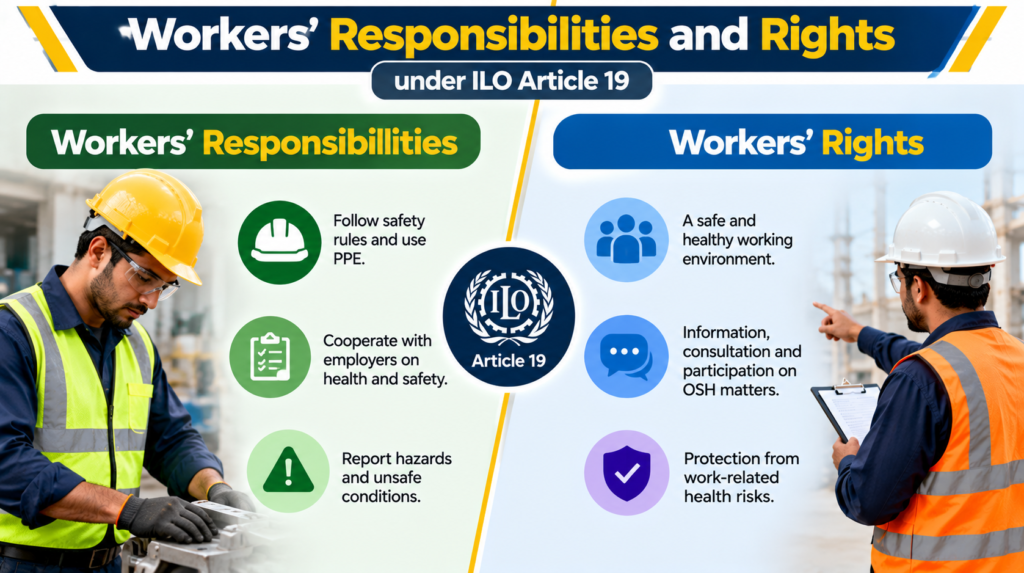
1. Introduction: Workers’ Responsibilities
Workers’ Responsibilities: A safe and healthy workplace needs everyone to take part. Workers’ Responsibilities and Rights under Article 19 explains what workers should do and what rights they have in relation to occupational safety and health.
The main message is easy: workers should work safely, follow instructions, use the protection provided and report hazards. They should also receive safety information and training and be able to speak about safety matters.
| Key message Safety improves when workers and employers cooperate and deal with problems before someone is hurt. |
2. Workers’ Responsibilities:
Workers have an important role in keeping the workplace safe. Their main responsibilities include:
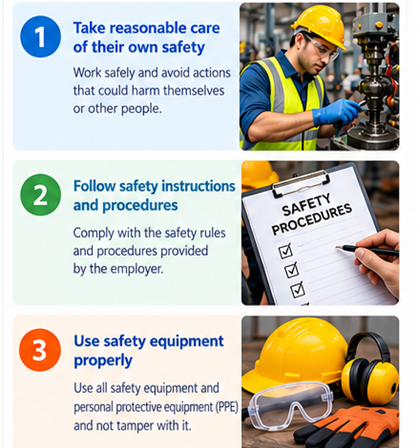
• Take reasonable care of their own health and safety.
• Avoid actions that could harm other people.
• Follow the safety instructions and procedures given by the employer.
• Use personal protective equipment (PPE) and other safety equipment correctly.
• Do not misuse, remove or damage equipment provided for protection.
Practical example
If a task requires gloves, safety glasses and a hard hat, the worker should wear them correctly. Safety equipment should not be removed just because the job looks quick or easy.
| Remember Use the safe method every time. |
3. Reporting Hazards, Accidents and Ill Health:
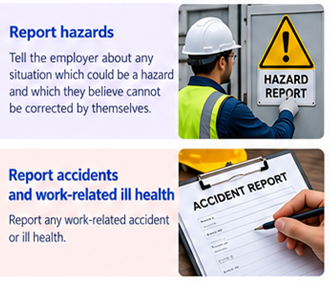
Workers should report safety problems instead of ignoring them. Early reporting gives the employer a chance to correct the problem before it causes more harm.
• Report any situation that may be a hazard and cannot safely be corrected by the worker.
• Report damaged machines, tools or protective equipment.
• Report work-related accidents.
• Report work-related ill health.
• Give clear information to the supervisor or employer so the problem can be investigated.
Practical example
A worker notices a damaged cable near a work area. The worker keeps away from the danger, warns other people and reports it to the supervisor. The cable can then be repaired or isolated.
| Simple rule See a hazard -> report it -> let the responsible person make it safe. |
4. Workers’ Rights:
Article 19 is not only about responsibilities. Workers and their representatives also have important rights that help them take part in workplace safety.
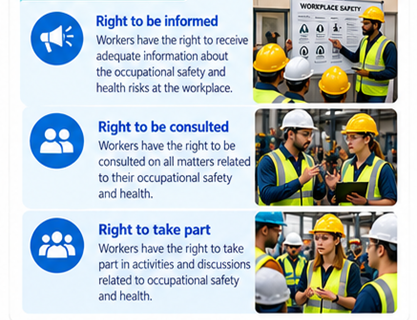
• The right to receive adequate information about workplace safety and health measures.
• The right to receive appropriate occupational safety and health training.
• The right to be consulted about safety and health matters connected with their work.
• The right to ask questions and raise safety concerns.
• The right to take part in safety and health activities through the workplace arrangements provided.
Why these rights matter
Workers need to understand the risks around them. Clear information, useful training and consultation help workers make safer decisions and report problems earlier.
| Easy meaning Know the risk. Learn the safe way. Ask questions. Speak up about safety. |
5. Serious and Imminent Danger:
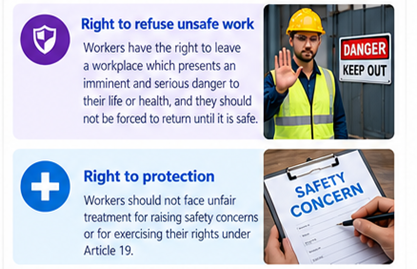
Sometimes a worker may reasonably believe that a work situation presents an imminent and serious danger to life or health. In that situation, the danger should not be ignored.
• The worker should report the situation immediately to the supervisor.
• The concern should be checked and necessary action should be taken.
• Workers should not be required to return while the imminent and serious danger continues.
• Work should continue only when the dangerous situation has been dealt with.
Practical example
A worker sees a badly damaged machine guard and believes the machine could cause an immediate serious injury. The worker reports the danger at once. The machine should be made safe before workers are required to return to that dangerous situation.
| Important Reporting serious danger quickly can prevent a major accident. |
6. Putting Article 19 into Daily Practice:
Article 19 works best when safety becomes part of normal daily work. Workers, representatives, supervisors and employers should communicate clearly and act when a problem is found.
• Follow safe working procedures.
• Use the protection and safety equipment provided.
• Report hazards, accidents and work-related ill health.
• Take part in safety information, training and consultation.
• Raise serious dangers immediately and do not ignore unsafe conditions.
7. Conclusion:
Article 19 gives a clear message about workplace safety. Workers have responsibilities to take reasonable care, follow safety procedures, use safety equipment properly and report hazards or work-related harm. They also have important rights to information, training, consultation and protection when serious danger exists.
When workers and employers cooperate, safety problems can be found earlier and action can be taken before an accident happens. This helps create a safer and healthier workplace for everyone.
| Final takeaway Work safely. Use protection. Report hazards. Learn the risks. Speak up when something is unsafe. |