
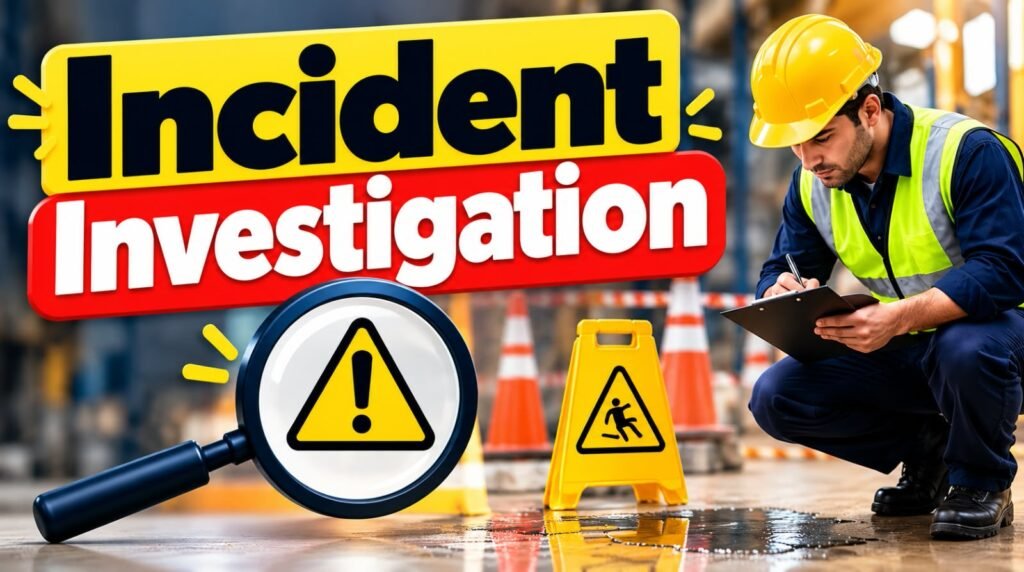
Introduction (Incident Investigation):
Incident investigation is an important part of workplace health and safety. It helps organisations understand why accidents and incidents happen and how similar incidents can be prevented in the future. The main purpose of an investigation is not to blame workers but to identify hazards, unsafe conditions and root causes.
What is Incident Investigation?
Incident investigation is a systematic process of collecting information, examining evidence and identifying the immediate and root causes of an incident or accident in the workplace.
It involves finding out what happened, how it happened, why it happened and what corrective actions are required to prevent recurrence.
Reasons for Incident Investigation:
There are several important reasons for investigating workplace incidents.
1. To Identify Immediate and Root Causes:
Incidents are usually caused by unsafe acts, unsafe conditions or underlying problems. Investigation helps identify these causes so they can be eliminated.
2. To Identify Corrective Actions to Prevent Recurrence:
One of the main reasons for investigation is to identify corrective actions that can prevent similar incidents from happening again.
3. To Record the Facts of the Incident:
Investigation helps collect and document factual evidence, witness statements and other important information for future reference.
4. For Legal Reasons:
Employers have legal responsibilities to investigate and report certain workplace incidents. Proper investigation helps organisations meet these legal requirements.
5. For Claim Management:
If an employee makes a compensation claim, the investigation report helps the employer and insurance company examine the incident and determine liability.
6. For Staff Morale:
Failure to investigate incidents can negatively affect workers’ morale and safety culture. Investigations show employees that the organisation values their health and safety.
7. To Review and Update Risk Assessments:
Incident investigations can identify weaknesses in existing risk assessments. These assessments should be reviewed and updated to improve workplace safety.
8. For Disciplinary Purposes:
Sometimes an investigation may identify unacceptable behaviour or violations of safety rules. Appropriate disciplinary action may be required, although the main focus should remain on prevention rather than blame.
9. For Data-Gathering Purposes:
Incident investigation provides useful data and statistics. This information helps organisations identify accident trends, patterns and areas requiring safety improvements.

Techniques of Incident Investigation:
Different techniques are used to identify the root causes of workplace incidents. Two commonly used techniques are:
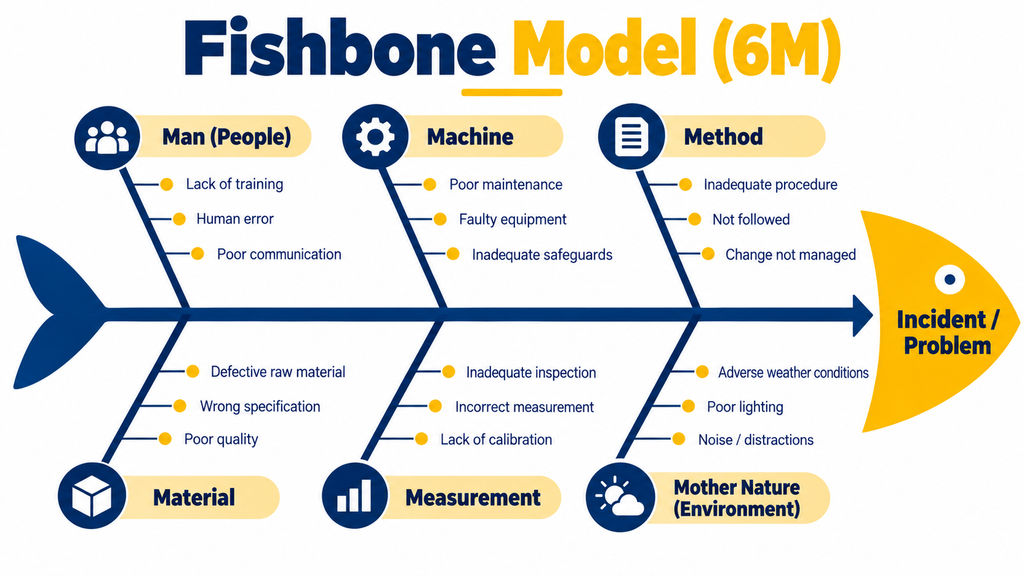
1. Fishbone Diagram (Cause-and-Effect Diagram):
The Fishbone Diagram, also known as the Ishikawa Diagram, is a technique used to identify possible causes of an incident.
It represents the incident at the head of the fish, while different branches show contributing factors such as people, equipment, methods, materials and environment.
Example: If a worker slips while performing landscaping activities, possible causes may include wet ground, poor housekeeping, unsuitable footwear or lack of supervision.
This technique helps investigators examine multiple causes and identify the underlying problems.
2. Five Whys (5 Whys) Technique:
The 5 Whys technique is a simple investigation method used to identify the root cause of an incident by repeatedly asking the question “Why?”
Example:
– Why 1: Why did the worker slip? Because the ground was wet.
– Why 2: Why was the ground wet? Because water had accumulated.
– Why 3: Why had water accumulated? Because of poor drainage.
– Why 4: Why was the drainage poor? Because the drainage system was blocked.
– Why 5: Why was it blocked? Because regular maintenance was not carried out.
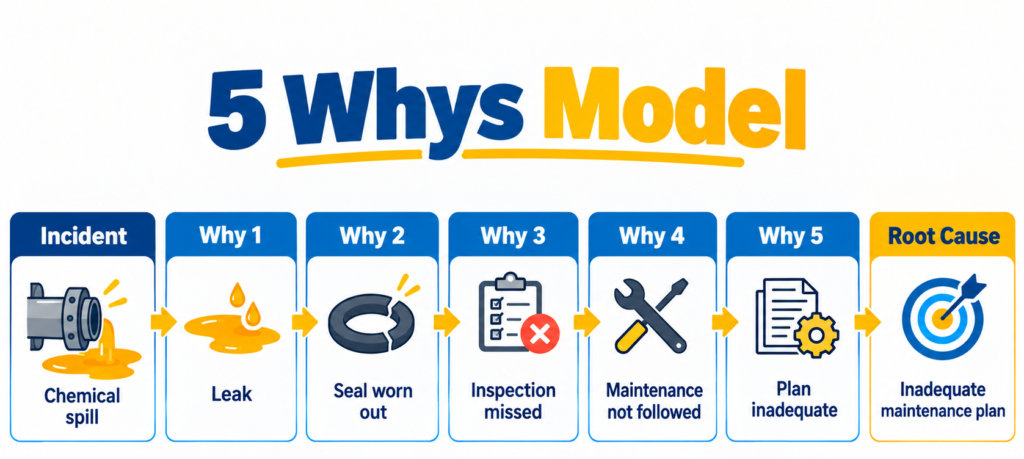
Root Cause: Lack of regular drainage maintenance.
This technique helps investigators move beyond immediate causes and identify underlying issues so that effective corrective actions can be taken.
Conclusion:
Incident investigation plays a vital role in maintaining a safe working environment. It helps organisations identify root causes, prevent recurrence, fulfil legal responsibilities and improve safety performance. Techniques such as the Fishbone Diagram and 5 Whys provide simple and effective ways to investigate incidents and develop preventive measures.