
1. Introduction
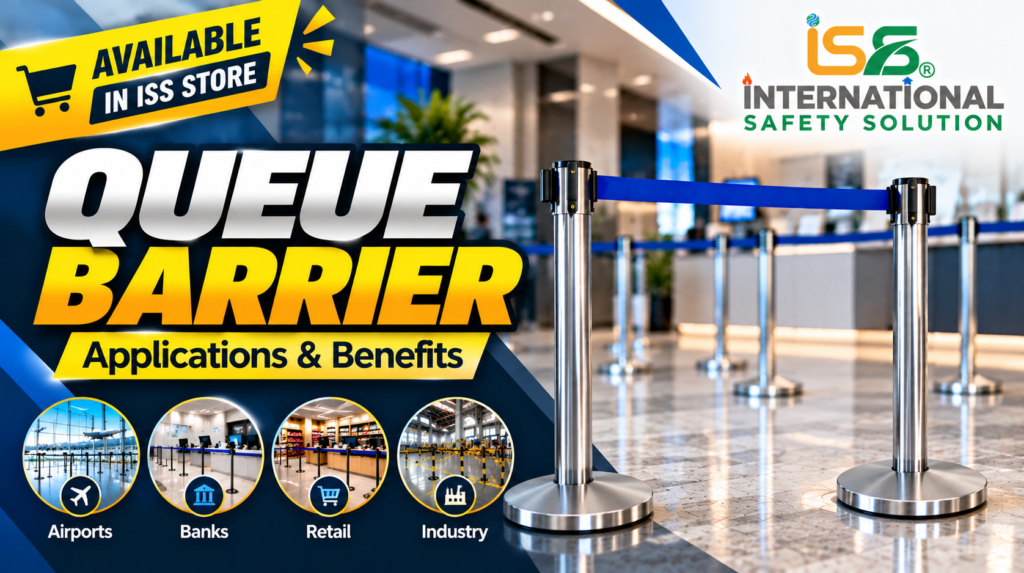
Queue barriers are essential safety and crowd management tools designed to control pedestrian movement, organize waiting lines, and guide people through designated areas.
They are widely used in manufacturing plants, warehouses, factories, hospitals, airports, shopping malls, banks, and commercial facilities.
In industrial environments, queue barriers also support workplace safety by guiding employees, contractors, and visitors away from designated restricted areas and helping maintain organized pedestrian routes.
🛒 QUEUE BARRIERS – AVAILABLE AT ISS STORE
International Safety Solution (ISS) provides workplace safety products to support organized and safer working environments.
Safety Today | Strong & Secure Tomorrow
2. What Is a Queue Barrier?
A queue barrier is a portable or fixed crowd-guidance system consisting of posts connected by retractable belts, ropes, chains, or rigid panels.
Main purposes:
- Organize queues and pedestrian movement.
- Guide visitors through designated routes.
- Identify temporary access restrictions.
- Reduce confusion and congestion.
- Support organized workplace operations.

Queue barriers are primarily guidance devices. They should not be mistaken for protective industrial barriers designed to resist vehicle impacts or prevent access to dangerous machinery.
3. Types of Queue Barriers
| Type | Example Picture | Description & Applications |
|---|---|---|
| A. Retractable Belt Barriers |  | Extendable belts connecting portable posts. Easy to reposition. Used in: Factories, airports, banks, and reception areas. |
| B. Rope Queue Barriers |  | Decorative ropes connected between metal posts. Used in: Hotels, VIP areas, exhibitions, and corporate events. |
| C. Chain Barriers |  | Plastic or metal chains used to mark temporary boundaries and low-risk restricted areas. Used in: Warehouses, factories, and maintenance zones. |
| D. Metal Crowd Control Barriers |  | Interlocking metal barriers designed for pedestrian guidance and crowd management. Used in: Outdoor events, public gatherings, and entry points. |
4. Industrial Applications of Queue Barriers:
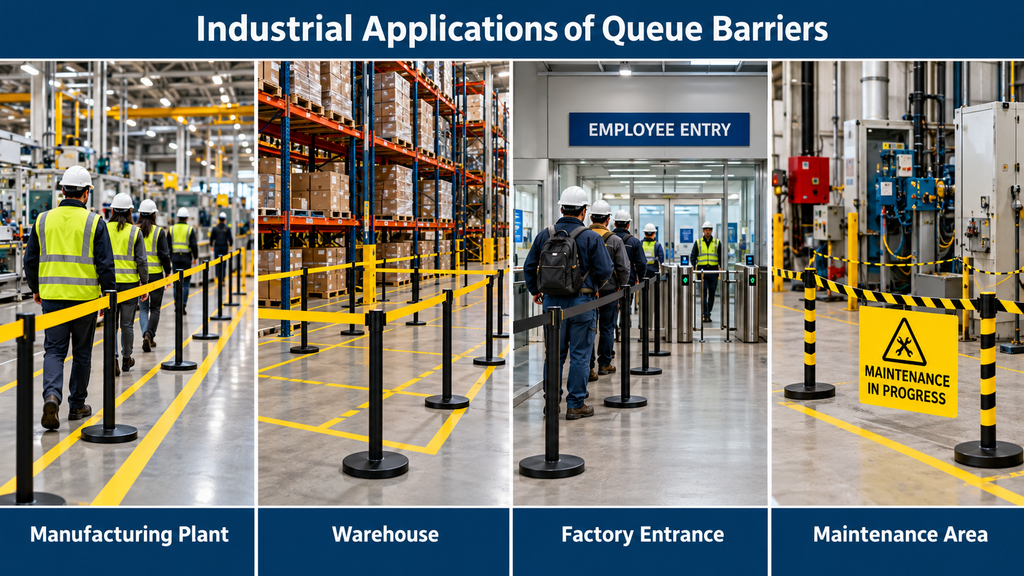
Queue barriers are useful across industrial facilities where employees, visitors, and contractors require controlled and organized access.
| Industrial Area | Application |
|---|---|
| Manufacturing Plants | Guiding visitor movement through designated safe routes |
| Warehouses | Marking pedestrian waiting zones and low-risk boundaries |
| Factory Entrances | Managing employee entry and security queues |
| Production Areas | Indicating restricted access at safe distances |
| Maintenance Areas | Identifying low-risk temporary boundaries |
| Quality Control Areas | Organizing visitors during inspections |
| Industrial Training Centers | Managing participant queues and training access |
5. Others Applications of Queue Barriers:
| Location | Main Application |
|---|---|
| Airports | Passenger queues and security checkpoints |
| Hospitals | Registration counters and patient waiting lines |
| Banks | Customer queues and counter management |
| Shopping Malls | Entrances, promotional events, and checkout areas |
| Offices | Reception and visitor access control |
| Events | Ticketing, entry management, and pedestrian guidance |

6. Potential Hazards and Preventive Measures:
| Potential Hazard | Preventive Measure |
|---|---|
| Barrier tipping over | Use stable bases and inspect positioning |
| Tripping over posts or bases | Keep walkways clear and provide adequate space |
| Damaged or loose belts | Inspect and replace defective components |
| Blocked emergency exits | Maintain unobstructed evacuation routes |
| Unauthorized entry | Use appropriate physical access controls where required |
| Vehicle or forklift collision | Install properly designed protective barriers, not queue belts |

OSHA and the UK HSE recommend separating pedestrians from industrial vehicles wherever practical, using suitable barriers, marked routes, and other traffic controls.
7. Selection Criteria for Industrial Queue Barriers
Before selecting a queue barrier, consider the following factors:
- Environment: Indoor or outdoor use, floor condition, and available space.
- Material: Stainless steel, coated steel, or suitable durable materials.
- Barrier Type: Belt, chain, rope, or rigid panel according to the application.
- Visibility: High-contrast belts and clear warning messages where needed.
- Stability: Appropriate base design to reduce tipping risk.
- Crowd Volume: Expected pedestrian traffic and queue capacity.
- Risk Level: Where impact protection or guarding is necessary, select purpose-designed protective equipment instead.
8. Installation and Maintenance Guidelines
Proper installation and routine inspection help ensure effective performance.
- Assess pedestrian movement and identify suitable barrier locations.
- Position barriers on firm, stable surfaces.
- Ensure belts, chains, or ropes are correctly connected.
- Maintain clear, accessible routes and emergency exits.
- Provide warning signs where necessary.
- Inspect posts, bases, connectors, and belts regularly.
- Repair or replace damaged barriers before further use.

9. Queue Barriers vs. Industrial Safety Barriers
Although both are used to manage movement and access, their protective functions are different.
| Feature | Queue Barrier | Industrial Safety Barrier |
|---|---|---|
| Primary Purpose | Crowd guidance and queue organization | Physical protection and separation |
| Typical Design | Belt, rope, chain, or lightweight panel | Engineered steel or polymer barrier |
| Portability | Usually portable | Often fixed |
| Impact Protection | Not intended for vehicle impact | May provide rated impact protection |
| Applications | Entry points, visitor routes, waiting areas | Forklift routes, machinery and hazardous zones |
Industrial safety barriers must be selected according to the specific hazard and risk assessment.
10. Key Benefits of Queue Barriers
1. Improved Workplace Safety: Help prevent unauthorized access to restricted areas, guide pedestrians away from potential hazards, and support a safer working environment.
2. Effective Crowd Management: Organize people into proper queues, reduce overcrowding and confusion, and maintain smooth movement in busy areas.
3. Organized Pedestrian Movement: Guide employees, contractors, and visitors along designated walkways, reducing unnecessary movement into controlled areas.
4. Flexible & Portable Design: Lightweight and retractable barriers are easy to install, relocate, and adjust according to changing workplace requirements.
5. Better Operational Organization: Support efficient security checks, visitor registration, employee entry management, and industrial inspections.
11. Conclusion
Queue barriers are practical tools for improving crowd organization, pedestrian guidance, and access management in industrial and commercial environments.
When properly selected, installed, and maintained, they help create organized workplaces and support safer movement of employees and visitors.
However, queue barriers should always be used within their intended purpose and must never replace engineered protective barriers, machinery guarding, or other essential safety controls.