
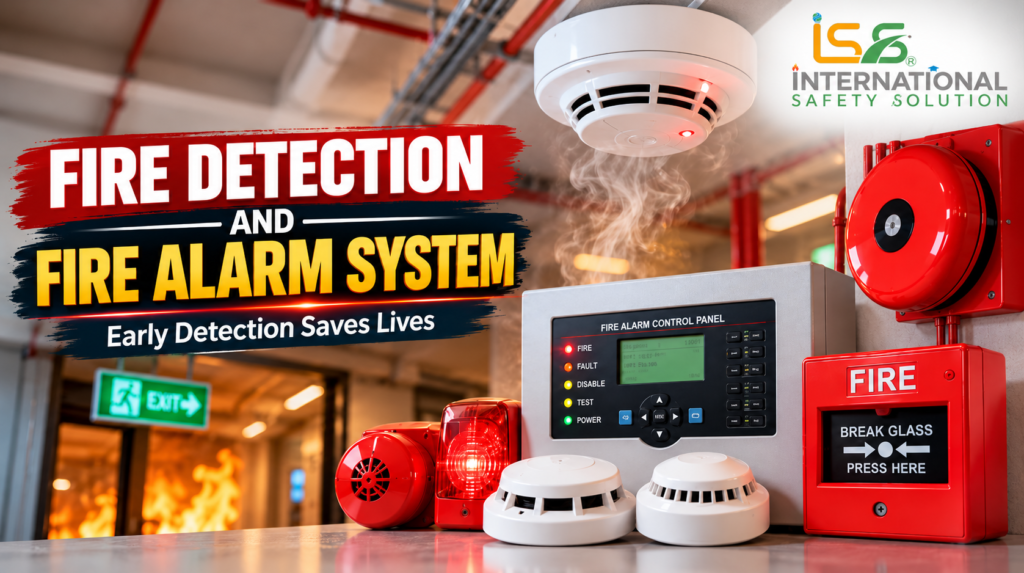
Early Detection Saves Lives – Early Warning Prevents Disasters!
1. Introduction:
Fire Detection & Alarm System is an essential life safety system designed to identify early signs of fire, alert building occupants, and support emergency response.
These systems are widely used in industries, hospitals, shopping malls, offices, warehouses, and commercial buildings to protect lives, property, and business operations.
2. Fire Detection vs. Fire Alarm System:
| Fire Detection System | Fire Alarm System |
|---|---|
| Detects smoke, heat, or fire-related conditions | Warns occupants about potential fire emergencies |
| Uses smoke, heat, and flame detectors | Uses hooters, sounders, strobes, and control panels |
| Identifies potential fire conditions | Initiates alerts and supports evacuation |
Example: A smoke detector identifies smoke in an electrical room, and the connected fire alarm system activates sounders to warn occupants.
3. Main Components of a Fire Alarm System
| Image | Component | Function |
|---|---|---|
 | Smoke Detector | Detects smoke particles and signals a possible fire condition. |
 | Heat Detector | Responds to excessive temperature or a rapid temperature rise, depending on detector type. |
 | Manual Call Point (MCP) | Allows occupants to manually activate a fire alarm. |
 | Fire Alarm Control Panel (FACP) | Monitors devices, receives alarm signals, identifies faults, and controls system responses. |
 | Sounders, Hooters & Strobes | Provide audible and visual warnings during a fire emergency. |
4. Types of Fire Alarm Systems
| Image | Type | Key Feature |
|---|---|---|
 | Conventional System | Identifies the affected detection zone. |
 | Addressable System | Identifies individual devices and their locations. |
| Wireless System | Uses wireless communication between compatible devices. |

5. How Does a Fire Alarm System Work?

6. Practical Workplace Example:
Fire Emergency in an Industrial Warehouse
An electrical fault causes a fire inside a warehouse.
- Detection: A smoke detector senses smoke from the developing fire.
- Signal: The detector transmits an alarm signal to the FACP.
- Warning: The control panel activates hooters and strobes.
- Evacuation: Workers follow designated emergency exit routes.
- Response: The emergency response team investigates and coordinates appropriate action.
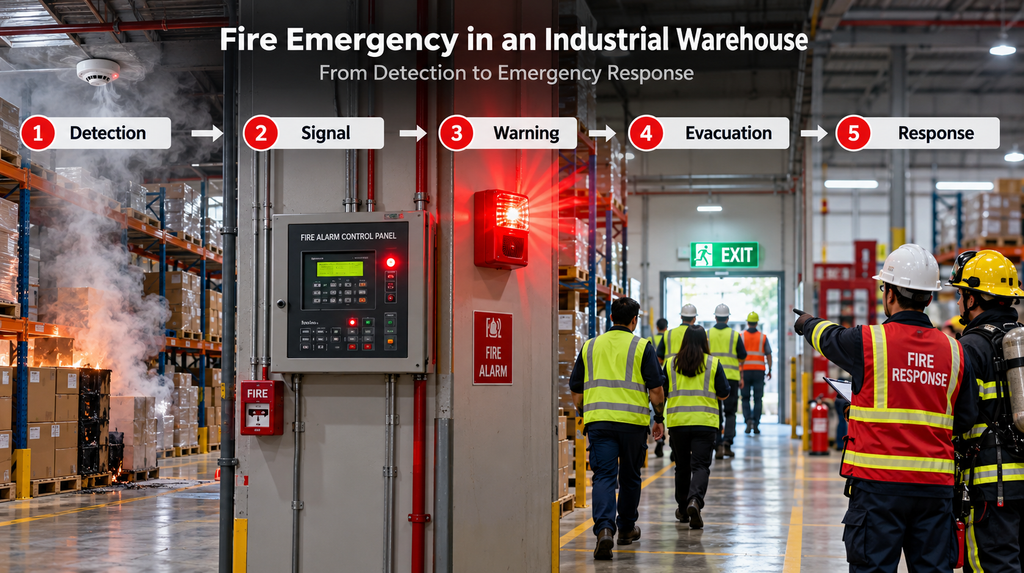
Result: Early warning helps reduce evacuation delays, potential injuries, and property damage.
7. Inspection & Preventive Maintenance:
Regular inspection and testing help maintain fire alarm system reliability.
- Control Panel: Check alarm, fault, trouble, and supervisory indications.
- Detectors: Inspect for dust, damage, and obstruction; test as required.
- Manual Call Points: Check accessibility and operation.
- Hooters & Strobes: Verify audible and visual alarm operation.
- Power Supply: Inspect batteries and backup power condition.
- Maintenance Records: Document testing, defects, and corrective actions.
Inspection and testing intervals should follow applicable fire codes, manufacturer instructions, and local authority requirements.
8. Key Benefits:
- Early Fire Detection: Identifies potential fires at an early stage.
- Life Safety: Provides warnings for safe evacuation.
- Property Protection: Supports faster emergency intervention.
- Emergency Preparedness: Improves response coordination.
- Operational Reliability: Routine maintenance helps reduce unexpected system failures.
9. Types of Fire Alarm Systems Based on Activation:
Fire alarm systems can be activated manually or automatically to provide early warning and support emergency evacuation.
| Feature | Manual Fire Alarm | Automatic Fire Alarm |
|---|---|---|
| Activation | Activated manually by a person | Activated automatically by detectors |
| Main Devices | Manual Call Point (MCP), break-glass unit | Smoke, heat, and flame detectors |
| Working Principle | A person identifies a fire and activates the MCP | Sensors detect smoke, heat, or flame and send a signal |
| Human Involvement | Required to initiate an alarm | Not required for initial detection |
| Response Time | Depends on how quickly someone discovers and reports the fire | Can provide early warning when detector activation conditions are met |
| Applications | Offices, factories, warehouses, and public buildings | Hospitals, shopping malls, industries, and commercial buildings |
| Main Advantage | Allows occupants to raise an alarm immediately | Detects potential fire conditions even when nobody is nearby |
| Limitation | Fire may remain undetected if nobody notices it | Performance depends on detector selection, placement, and maintenance |

10. Conclusion:
Fire Detection and Fire Alarm Systems play a critical role in modern workplace fire safety. Proper system design, installation, regular inspection, and preventive maintenance help ensure reliable early warning and effective emergency response.
International Safety Solution (ISS) promotes proactive fire safety management to help organizations protect their people, facilities, and operations.
Safety Today | Strong & Secure Tomorrow