
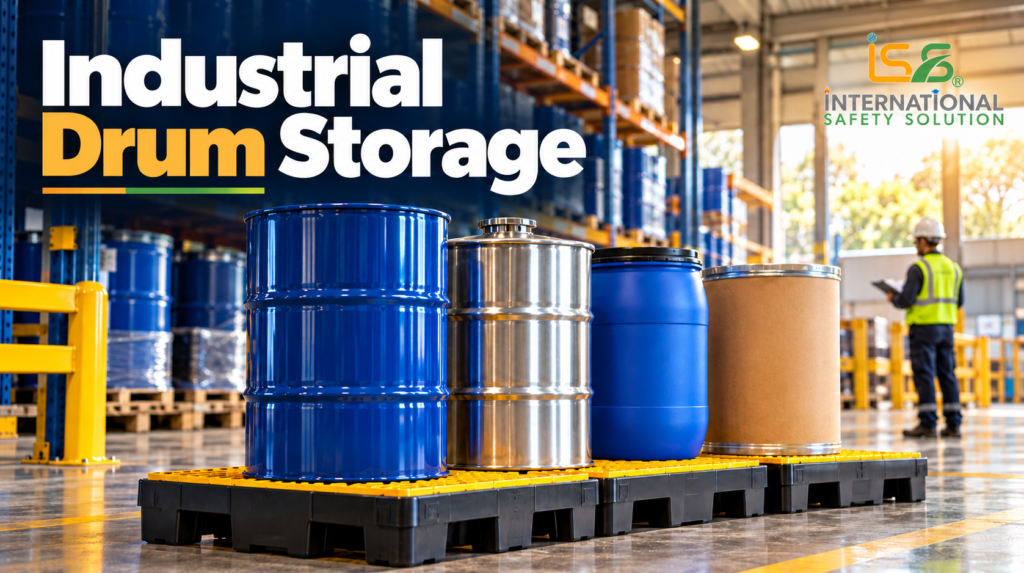
Industrial Drum Storage: Industrial drums are widely used to store chemicals, lubricants, solvents, food ingredients, powders and industrial waste. Their performance depends on the relationship between the contents, the container and the storage environment.
A drum may appear strong and properly sealed but still be unsuitable because its material reacts with the product, its gasket deteriorates, or its load rating is exceeded. Effective drum storage therefore starts with correct selection and continues through handling, inspection and disposal.
1. What Is an Industrial Storage Drum?
An industrial drum is a rigid container designed for holding and handling liquids, semi-solids or dry materials. Depending on its construction and approval, it may also be suitable for transporting dangerous goods.
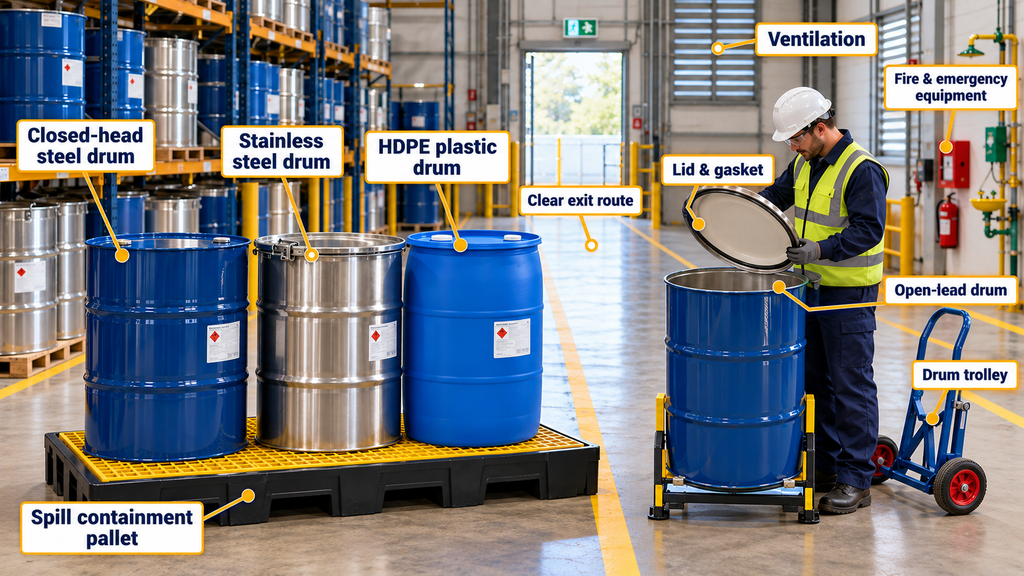
A drum storage system includes:
- The drum body, lid, closures and seals.
- Internal coatings or liners.
- Pallets, racks and handling equipment.
- Spill containment and chemical segregation.
- Ventilation, fire protection and emergency arrangements.
Storage suitability and transport approval require separate checks. A drum approved for transporting a hazardous material does not automatically make the warehouse or storage arrangement suitable.
1. Drum Sizes and Capacities
| Common capacity | Typical applications |
|---|---|
| 20–30 L | Additives, small chemical batches and maintenance products |
| 50–60 L | Lubricants, coatings and intermediate quantities |
| 100–120 L | Production chemicals and bulk ingredients |
| 200–220 L | Bulk oils, solvents and industrial chemicals |
| Specialist sizes | Recovery, salvage and specific process requirements |
Capacity and dimensions are different specifications. For example, certain 208 L steel drums measure approximately 595 mm in diameter and 873–881 mm in height, but actual dimensions vary by manufacturer. Check the datasheet before selecting racks, pallets or handling equipment.
Nominal capacity is the stated capacity; brimful capacity is the total volume when filled to the top. Liquid filling limits must allow for thermal expansion and follow the product and packaging instructions.
2. Drum Shapes
| Shape | Features and considerations |
|---|---|
| Cylindrical | Common industrial design; requires restraint against rolling when stored horizontally |
| Conical or tapered | Some designs allow empty drums to nest; filled stacking requires approval |
| Specialist overpack | Larger container designed to enclose another package; salvage use requires suitable specifications |
Square or rectangular containers are also available, but may be classified as jerricans or other packaging rather than drums.
3. Materials and Their Suitability
| Material | Typical uses | Key limitations |
|---|---|---|
| Carbon steel | Oils, lubricants, solvents and compatible chemicals | Corrosion; some contents require an internal lining |
| Stainless steel | Food, pharmaceutical and purity-sensitive products | Grade must suit the chemical and temperature |
| HDPE plastic | Compatible aqueous chemicals and industrial liquids | Solvent compatibility, UV exposure, temperature and static risks |
| Fibre | Powders, granules and dry ingredients | Moisture sensitivity; liquid use requires a specific design |
| Composite | Plastic inner receptacle with protective outer packaging | Both components must remain suitable and undamaged |
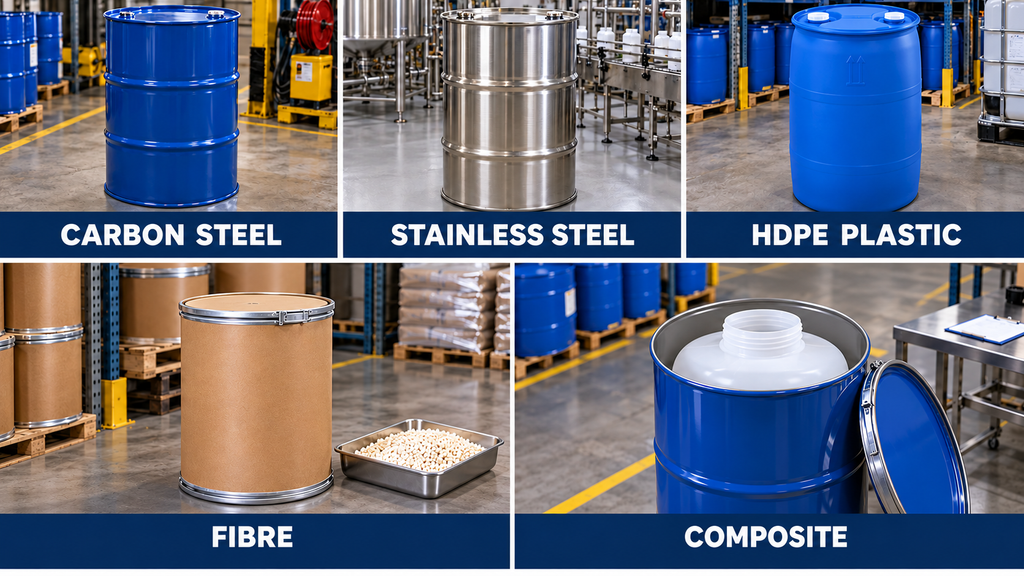
Plastic drums must have adequate strength and resistance to degradation from their contents and environmental exposure. No drum material is compatible with every chemical.
4. Construction and Drum Types:
A drum’s performance depends on its body, top and bottom heads, seams, reinforcing ribs, closures, gaskets and internal lining.
Steel drums require suitable material thickness, secure seams and leakproof closures. Thickness should match the intended service; there is no universal thickness for all applications.
| Type | Construction and application |
|---|---|
| Tight-head / closed-head | Fixed top with smaller openings; commonly used for pumpable liquids |
| Open-head / removable-head | Removable lid and closing ring; suitable for powders, pastes and approved liquid applications |
| Lined drum | Internal coating protects the drum or preserves product quality |
| Food-contact drum | Materials suitable for the intended food-contact conditions |
| Reconditioned drum | Previously used drum restored through a controlled process |
| Salvage drum | Purpose-designed packaging for damaged or leaking packages |
Gaskets, liners and closures must be compatible with the contents. Follow the manufacturer’s closure and tightening instructions.
5. Understanding UN Markings
Common dangerous-goods packaging codes include:
| Code | Description |
|---|---|
| 1A1 | Closed-head steel drum |
| 1A2 | Open-head steel drum |
| 1H1 | Closed-head plastic drum |
| 1H2 | Open-head plastic drum |
Performance letters indicate tested packing-group capability: X: I, II and III; Y: II and III; Z: III only.
UN marking does not establish chemical compatibility, and a hydrostatic test-pressure marking is not a permitted operating pressure.
6. What to Consider Before Selecting a Drum:
Contents and Compatibility
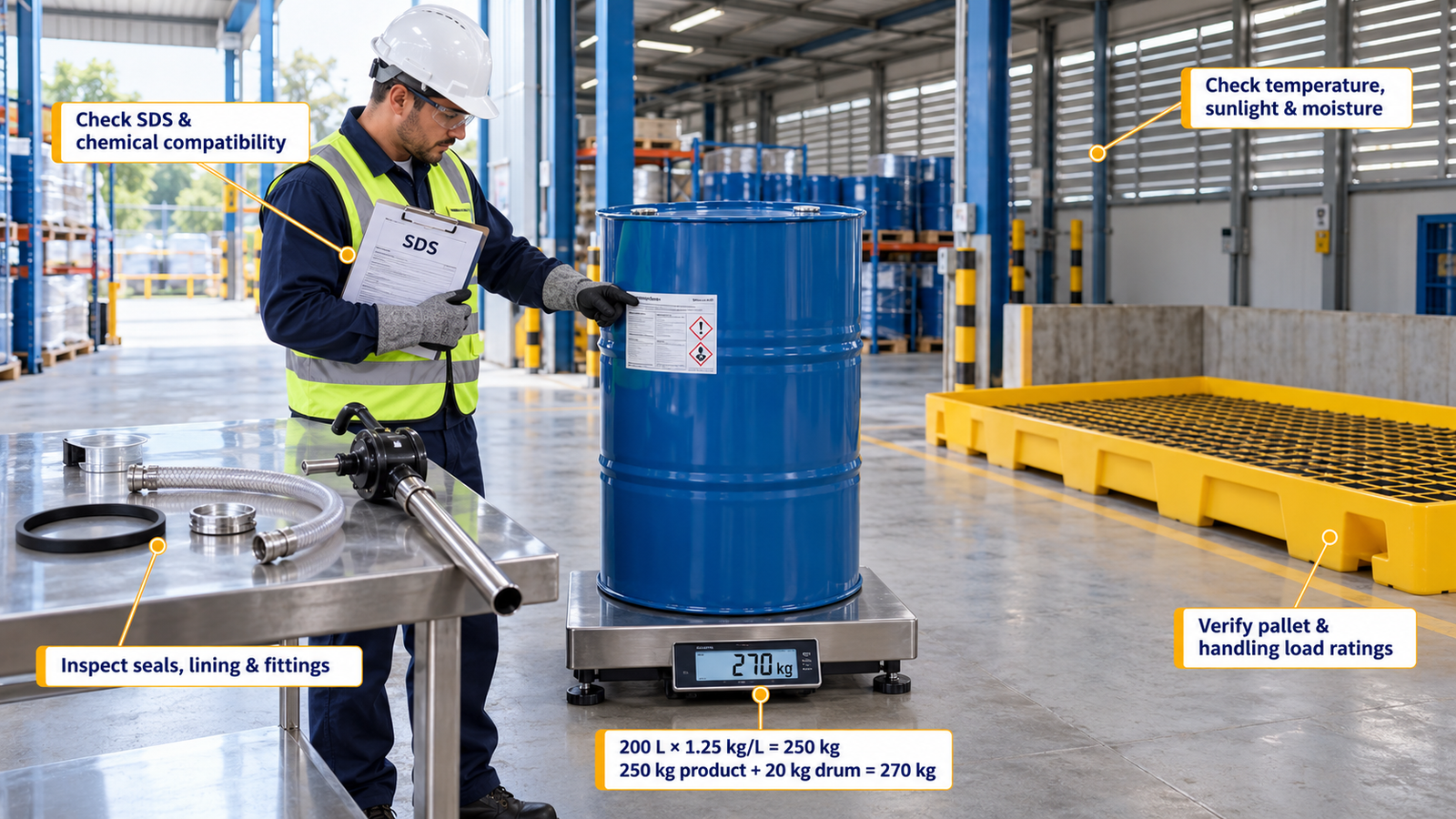
Review the current Safety Data Sheet (SDS), especially handling, storage and reactivity information. Confirm compatibility with the complete system:
- Drum body and internal lining.
- Gaskets, bungs and lid.
- Pumps, hoses and dispensing fittings.
- Spill pallet or bund.
Check the exact chemical, concentration and temperature rather than relying on general descriptions such as “chemical-resistant.”
Capacity and Filled Weight
Select the drum according to both volume and mass.
Product mass = Volume × Density
For example, 200 L × 1.25 kg/L = 250 kg of product. Adding a 20 kg empty drum gives a total mass of 270 kg.
Verify the capacity of the drum, pallet, rack, floor and handling equipment against the actual load.
Operating Conditions
Consider storage duration, temperature, sunlight, moisture, dispensing method, cleanliness requirements and reuse history. Transport approval must also be checked where applicable.
7. Safe Storage Arrangements:
Location, Ventilation and Access
Use a designated storage area with suitable ventilation and protection from impact. Keep escape routes, firefighting equipment and inspection access clear.
Separation distances and stacking limits depend on the hazards, quantities and container design. One fixed distance or stacking height cannot suit every drum store.
Chemical Segregation
Separate incompatible substances—for example:
- Acids from alkalis.
- Oxidizers from flammables and combustible materials.
- Acids from hypochlorite products.
- Water-reactive substances from water exposure.
Do not allow incompatible chemicals to share containment where leaks could mix.
Spill Containment
Provide a compatible bund or spill pallet. Some guidance uses 110% of the largest container or 25% of the total stored volume, whichever is greater; confirm the applicable site requirements.
For four 200 L drums, this criterion gives:
- 110% of largest drum: 220 L
- 25% of total volume: 200 L
- Required usable containment: at least 220 L
Keep containment free from accumulated rainwater and waste.

8. Handling and Dispensing:
Use rated drum trolleys, lifters or suitable forklift attachments. Secure drums before movement and use appropriate pumps in a designated transfer area.
For flammable liquids, assess ignition risks and provide suitable bonding, earthing and equipment. An earth clip on an ordinary insulating plastic drum does not make it conductive.
Never use compressed air to force liquid from an ordinary shipping drum.
9. Common Hazards and Corrective Actions:
| Hazard | Corrective action |
|---|---|
| Corrosion, cracks or leakage | Isolate and arrange competent assessment or recovery |
| Bulging or unusually hot drum | Restrict access; do not casually open or move it; follow emergency procedures |
| Incorrect gasket or damaged closure | Replace with compatible, specified components |
| Unstable or excessive stacking | Reduce loads and verify the approved arrangement |
| Missing label | Quarantine and identify contents before use |
| Incompatible chemicals together | Separate storage and spill containment |
| Forklift impact risk | Improve traffic controls and physical protection |
| Blocked aisles or exits | Remove obstructions and restore access |

10. Practical Example: Factory Drum Store:
An inspection finds a leaking solvent drum, an oxidizer on the same spill pallet and cartons blocking the aisle.
The conditions could cause fire, incompatible mixing, chemical exposure and delayed evacuation.
Corrective actions:
- Restrict access and activate the spill procedure.
- Have trained personnel assess and recover the leaking package.
- Separate the incompatible chemicals.
- Restore access and verify containment condition.
- Record the defects and confirm completion of corrective actions.
11. Inspection, Reuse and Disposal:
Inspect drums on receipt, before handling and at risk-based intervals. Check for leakage, corrosion, cracks, swelling, damaged closures, missing labels and unstable supports.
Empty drums can still contain hazardous residues or vapours. Keep them closed and identified. Never cut, weld or heat a used drum without a competent, controlled process.
Reconditioned drums require verified suitability and history. Former chemical drums should not be reused for food or drinking water.
Apply the product SDS, manufacturer instructions and relevant local storage and environmental requirements.