

FTT & HAZOP: Equipment failures often develop from problems that remain unnoticed: a blocked pipeline, a faulty sensor, an incorrectly positioned valve or a missed maintenance task. Understanding how these problems can lead to harm helps organisations improve safety and reliability.
Failure Tracing Techniques (FTT) provide a structured way to examine possible failures, trace their causes and understand their consequences. Within this discussion, HAZOP—Hazard and Operability Study—is a powerful technique for exploring how a process could depart from its intended operation.
What Are Failure Tracing Techniques?
Failure tracing involves systematically examining how equipment, processes or activities might fail—or investigating why a failure has already occurred.
For this blog, FTT refers broadly to methods that help answer questions such as:
- What could go wrong?
- What could cause it?
- How could the failure affect other equipment or people?
- What safeguards are already available?
- What further action is needed?
Some methods begin with a component failure and trace its effects. Others start with an unwanted event and work backwards to possible causes. HAZOP approaches the problem by examining deviations from intended operation.
What Is HAZOP?
HAZOP stands for Hazard and Operability Study. It is a structured team examination of a system or process to identify potential hazards and operating problems.
The team considers how actual conditions could differ from the design intent—the way the system is supposed to operate. It then examines possible causes, consequences and safeguards.
IEC 61882 provides guidance on HAZOP preparation, examination, documentation and follow-up.
For example, a pipeline may be designed to transfer liquid at a controlled rate. A HAZOP study asks what could happen if there is no flow, too much flow or reverse flow.
How Does HAZOP Work?
A HAZOP study divides a system into manageable sections called nodes, such as a tank, pump or transfer line. For each node, the team establishes its intended operation.
It then applies guide words to relevant parameters:
| Guide word | Parameter | Resulting deviation | Question to explore |
|---|---|---|---|
| No | Flow | No flow | What could stop the liquid moving? |
| More | Pressure | High pressure | What could raise pressure above the intended level? |
| Less | Flow | Low flow | What could restrict the transfer rate? |
| Reverse | Flow | Reverse flow | Could liquid move in the wrong direction? |
| Other than | Material | Wrong material | Could an incorrect substance enter the system? |

These combinations prompt discussion; the team selects those that are meaningful for the system being studied.
Practical Example: Diesel Transfer to a Storage Tank
Consider a facility transferring diesel from a delivery tanker into a storage tank through a pump and hose.
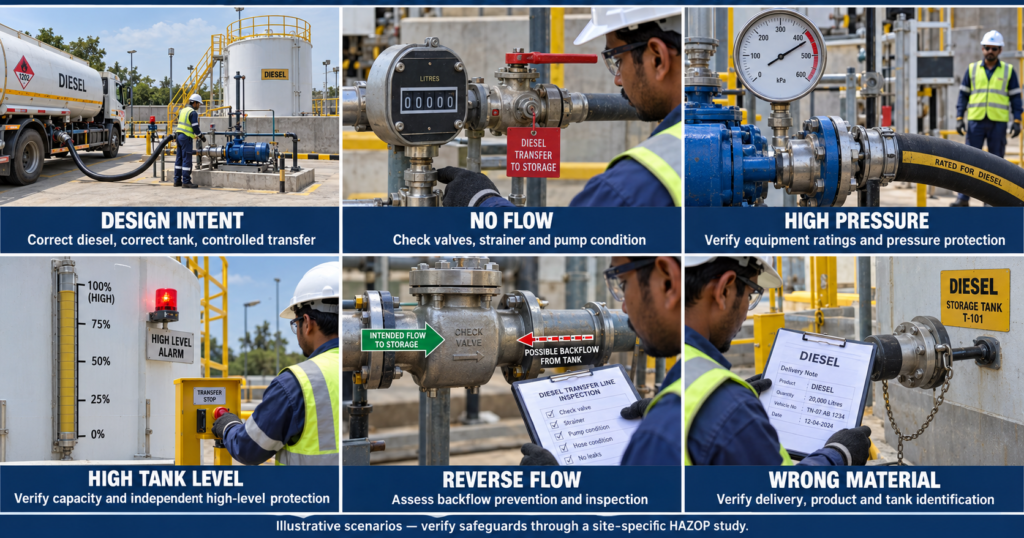
Design intent: Transfer the correct product into the correct tank at a controlled rate, within the equipment’s operating limits, without leakage or overfilling.
An illustrative HAZOP review could identify the following:
| Deviation | Possible causes | Potential consequences | Safeguards or actions to assess |
|---|---|---|---|
| No flow | Closed valve, blocked strainer or pump failure | Interrupted delivery; depending on pump type, overheating or pressure buildup | Confirm valve lineup, maintain strainers and assess suitable pump protection |
| High pressure | Restricted discharge or closed downstream valve | Hose or connection failure, releasing diesel | Verify pressure ratings and assess suitable pressure protection |
| Excessive tank level | Incorrect available-capacity check, level indication failure or delayed shutdown | Tank overflow, spill and potential fire exposure | Verify available capacity and assess independent high-level protection |
| Reverse flow | Pressure difference combined with ineffective backflow prevention | Unintended drainage or product movement | Assess suitable backflow prevention and inspection arrangements |
| Wrong material | Incorrect delivery or connection to the wrong tank | Contamination, equipment problems or incompatible mixing | Verify delivery documents, product identity and connection identification |
These are possible scenarios for discussion. A real study must establish which safeguards exist, whether they are effective and what additional measures the specific installation requires.
Following One Failure Through to Its Consequences
Take the high-pressure scenario:
- A downstream valve remains closed.
- The transfer pump starts.
- Pressure may rise, depending on the pump characteristics and protection provided.
- If the equipment’s limits are exceeded, a hose or connection could fail.
- Released diesel could create environmental damage and a fire hazard if an ignition source is present.
The value of the study is in finding opportunities to interrupt this sequence—through better operating arrangements, suitable protective systems and verified equipment limits.
Who Should Take Part?
A useful HAZOP study brings together people who understand different aspects of the process, typically including:
- A competent HAZOP facilitator.
- Process or design personnel.
- Operators.
- Maintenance and instrumentation personnel.
- A safety representative.
- A recorder to document findings and actions.
Their combined knowledge helps expose problems that one person might overlook.
Recording Findings and Closing Actions
A HAZOP worksheet should clearly distinguish existing safeguards from recommended improvements. Typical entries include:
Node → Design intent → Deviation → Causes → Consequences → Existing safeguards → Recommendations → Responsible person → Completion status
Recommendations need an owner, an agreed completion date and verification that the action has been implemented effectively. Holding the meeting alone does not reduce risk.
Relevant Standards for HAZOP and Failure Analysis
Recognised international standards provide guidance for conducting structured studies and documenting findings.
| Standard | Purpose and relevance |
|---|---|
| IEC 61882:2016 — Hazard and Operability Studies (HAZOP Studies): Application Guide | The main HAZOP reference. Covers study preparation, guide words, examination sessions, documentation and follow-up. |
| IEC 31010:2019 — Risk Management: Risk Assessment Techniques | Supports the selection and application of suitable risk assessment techniques, including HAZOP. |
| IEC 60812:2018 — Failure Modes and Effects Analysis (FMEA and FMECA) | Explains how to identify possible failure modes, examine their effects and prioritise them for action. |
| IEC 61025:2006 — Fault Tree Analysis (FTA) | Provides guidance for tracing an unwanted event back to possible contributing faults and combinations of events. |
These standards address related but distinct methods: HAZOP examines process deviations, FMEA examines failure modes, and FTA examines causes leading to an unwanted event.
Terminology note: “Failure Tracing Techniques (FTT)” can be used as the broad heading in your blog, but these references do not establish it as one standardised method with a single dedicated standard.
Benefits and Limits of HAZOP
HAZOP can help teams uncover overlooked failure scenarios, examine operating difficulties and improve communication between design, operations and maintenance personnel.
Its effectiveness depends on accurate information, competent participation and proper follow-up. It does not automatically calculate failure probabilities or prove that every risk is acceptable. Some findings require further engineering analysis or more detailed risk assessment.
Failure tracing helps explain how problems develop. HAZOP strengthens that understanding by systematically examining deviations, their causes and the safeguards needed to prevent harm.