
Why do some employees wait for instructions while others confidently take responsibility? Why does one manager check every detail, while another gives the team room to decide how to achieve a goal?
The answers often begin with what managers believe about people.
A manager who assumes employees will avoid work may rely on close monitoring and repeated instructions. A manager who believes employees can exercise judgment may place greater emphasis on participation, development and responsibility.
What Are Theory X and Theory Y?
Theory X and Theory Y are theories of human work motivation and management. They were created by Douglas McGregor while he was working at the MIT Sloan School of Management in the 1950s, and developed further in the 1960 in his book, The Human Side of Enterprise. They represent two contrasting sets of assumptions about human behaviour at work.
Theory X assumes that employees generally dislike work, prefer direction and need external control.
Theory Y assumes that work can be satisfying and that employees can exercise self-direction and accept responsibility under suitable conditions.
The distinction concerns the manager’s starting assumptions. It does not divide employees into permanent “X” and “Y” personality types.
A worker may show initiative in a supportive environment and become hesitant in a workplace where every independent decision attracts criticism. Equally, enthusiasm alone cannot compensate for unclear instructions, inadequate training or missing resources.
Theory X: The Assumption Behind Close Control
Theory X starts from a belief that employees are unlikely to maintain effort without management pressure.
Its central assumptions include:
- People tend to dislike work and avoid it when possible.
- Employees often prefer to be directed.
- Responsibility may be avoided.
- External rewards, supervision and consequences are necessary to secure effort.
A manager holding these beliefs may retain most decisions, prescribe detailed methods and require frequent progress reports.ly associated with centralized decisions, frequent checking and limited employee discretion.

Theory Y: The Assumption Behind Self-Direction
Theory Y recognizes that people can find satisfaction in work and commit themselves to objectives they understand and value. Under suitable conditions, employees can accept responsibility and contribute ideas.
A manager working from this perspective pays attention to the conditions that allow people to perform: clear goals, competence, resources, meaningful responsibility and constructive feedback.

Theory X vs Theory Y: The Main Differences
| Management area | Theory X assumptions | Theory Y assumptions |
|---|---|---|
| Attitude towards work | People tend to avoid work | Work can be satisfying under suitable conditions |
| Responsibility | Employees prefer to avoid it | Employees can accept and seek it |
| Motivation | External pressure is central | Commitment and achievement can motivate |
| Supervision | Close control is necessary | Self-direction is possible |
| Employee contribution | Decisions remain concentrated with management | Employees can contribute ideas and solutions |
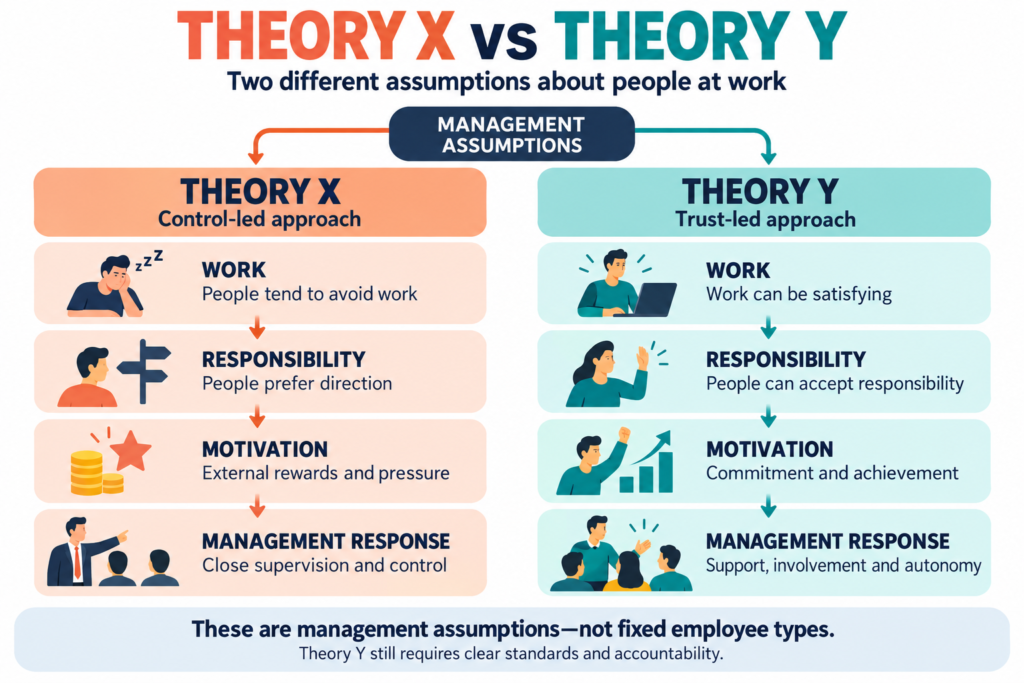
These are contrasting assumptions, rather than a complete description of every manager or workplace. McGregor’s wider message was to encourage managers to question their beliefs, rather than turn either theory into an inflexible formula.
Does Close Supervision Always Mean Theory X?
A new employee may need demonstrations, detailed instructions and frequent checks. An experienced employee may also need close oversight during an unfamiliar or complex assignment.
The important questions are:
Why is the supervision necessary? Is it proportionate to the task? Does it change as competence develops?
A manager can provide close guidance while believing that the employee is capable of learning and taking greater responsibility.
Similarly, leaving someone alone does not automatically demonstrate Theory Y. Without clear expectations or access to support, it may simply be poor supervision.
Applying the Framework in Everyday Management
1. Explain the Required Result
Describe what must be achieved, when it is needed and how quality will be assessed. Employees need a shared understanding of successful completion.
2. Confirm Competence and Resources
Check whether the person has the training, tools, information and time required. Match the assignment to demonstrated capability.
3. Define Decision-Making Authority
Make clear which decisions the employee can take independently and which require consultation or approval.
For example, a project coordinator may rearrange routine activities but need authorization before increasing the budget.
4. Agree on Useful Progress Reviews
Choose review points that suit the task. Discuss completed work, emerging difficulties and decisions that need support.
5. Investigate Performance Problems Fairly
Before attributing a mistake to poor motivation, examine the instruction, workload, competence and resources.
The response should address the cause: clarification for a misunderstanding, training for a skill gap, resources for an equipment shortage or appropriate corrective action for a conduct issue.
Relevance to Workplace Safety
The framework also provides a useful way to reflect on employee participation in safety.
Employees need clear procedures and supervision. They also need opportunities to raise concerns, explain practical difficulties and contribute to improvements.
A manager can encourage this participation by listening carefully, discussing reported problems and explaining the action taken. Responsibility remains defined: employees understand what they can address themselves and what must be escalated.
The practical aim is a workplace where people understand expectations and feel able to report problems early.
Better Management Begins With Better Questions
Theory X and Theory Y encourage managers to look beyond the immediate behaviour of an employee and examine the assumptions behind their own response.
When performance falls short, is more control necessary? Would clearer expectations, better training or appropriate authority address the problem more effectively?
Sound management requires both direction and judgment. People need standards they can understand, support they can access and responsibility they are equipped to handle.
The quality of leadership becomes visible in how well employees learn to make decisions, solve problems and take ownership of their work.