

Introduction
The NEBOSH Level 6 International Diploma for Occupational Health and Safety Management Professionals is an advanced professional qualification designed for individuals who want to develop their knowledge, technical skills, and professional competence in occupational health and safety.
It is particularly suitable for experienced HSE professionals, Safety Officers, HSE Engineers, Safety Managers, Consultants, and individuals who want to progress into senior health and safety management positions.
The qualification focuses not only on understanding health and safety principles but also on applying them in real workplace situations, evaluating risks, developing control measures, and improving an organisation’s overall safety performance.
For professionals planning to build an international career in occupational health and safety, the NEBOSH Level 6 International Diploma can be an important step towards senior-level opportunities.
1. What Is NEBOSH Level 6 International Diploma?
The NEBOSH International Diploma is a UK-based professional qualification regulated at RQF Level 6, which is at the same level as a bachelor’s degree in the UK qualifications framework. However, it is a professional qualification and is not itself a bachelor’s degree.
It is designed to develop advanced knowledge and practical competence in managing occupational health and safety across different industries.
The qualification is divided into three units:
- DI1 – Know: Workplace Health and Safety Principles (International)
- DI2 – Do: Controlling Workplace Health Issues (International)
- DI3 – Do: Controlling Workplace Safety Issues (International)
Each unit has a separate assessment. Learners must successfully complete all three units to achieve the full qualification.
2. NEBOSH IDip Level 6 Syllabus – Complete Unit Overview
Unit DI1 – Know: Workplace Health and Safety Principles
DI1 develops the learner’s understanding of the principles, theories, and professional responsibilities involved in managing occupational health and safety.
Key topics include:
- Health and safety leadership and management.
- Health and safety management systems.
- Legal and regulatory frameworks.
- Risk management principles.
- Health and safety culture.
- Human factors and organisational behaviour.
- Incident investigation and analysis.
- Monitoring, auditing, and reviewing health and safety performance.
- Professional ethics and responsibilities.
- Promoting continuous improvement in workplace safety.
Main objective: To develop the knowledge required to understand, evaluate, and improve health and safety management systems.
Unit DI2 – Do: Controlling Workplace Health Issues
DI2 focuses on identifying, evaluating, and controlling workplace health hazards that may affect employees and other people.
Key topics include:
- Occupational health management.
- Physical health hazards.
- Chemical and biological agents.
- Hazardous substances and exposure control.
- Noise and vibration.
- Radiation.
- Workplace ergonomics.
- Musculoskeletal disorders.
- Work-related stress.
- Occupational health surveillance.
- Prevention and control of occupational diseases.
Main objective: To develop the ability to recognise workplace health risks and recommend appropriate measures to prevent occupational illness and long-term health problems.
Unit DI3 – Do: Controlling Workplace Safety Issues
DI3 focuses on workplace safety hazards, accident prevention, and the implementation of suitable control measures.
Key topics include:
- Workplace transport safety.
- Work equipment and machinery safety.
- Electrical safety.
- Fire and explosion hazards.
- Construction and maintenance activities.
- Working at height.
- Confined spaces.
- Lifting operations and equipment.
- Pressure systems.
- Process safety.
- Emergency planning and response.
- Accident prevention and workplace risk control.
Main objective: To develop the ability to assess workplace safety risks and implement effective measures to prevent accidents, injuries, and dangerous occurrences.
3. NEBOSH IDip Assessment Structure
The NEBOSH Level 6 International Diploma is assessed through three separate digital assessments.
| Unit | Assessment Type | Approximate Assessment Time |
| DI1 | Assignment | 40 hours |
| DI2 | Scenario-based Case Study | 20 hours |
| DI3 | Scenario-based Case Study | 20 hours |
DI1 – Assignment
DI1 is an assignment that tests your understanding of health and safety principles and your ability to apply them to workplace situations.
It involves workplace-based tasks, simulations, reflective statements, and a research topic.
You should be able to:
- Explain health and safety management principles.
- Evaluate organisational arrangements.
- Apply relevant theories and professional knowledge.
- Support recommendations with appropriate reasoning.
- Demonstrate critical thinking and research skills.
The approximate assessment completion period is four weeks (20 working days).
DI2 – Scenario-Based Case Study
DI2 is a scenario-based assessment focusing on workplace health issues.
You will receive a workplace scenario and questions requiring you to identify health hazards, assess their potential consequences, and recommend suitable control measures.
Your answers should demonstrate:
- Understanding of occupational health hazards.
- Ability to interpret scenario information.
- Application of relevant health and safety knowledge.
- Practical and justified control recommendations.
The approximate assessment completion period is two weeks (10 working days).
DI3 – Scenario-Based Case Study
DI3 is a scenario-based assessment focusing on workplace safety issues.
You will be required to analyse workplace situations, identify safety risks, evaluate existing control measures, and recommend improvements.
Your answers should demonstrate:
- Knowledge of workplace safety hazards.
- Understanding of accident prevention.
- Practical application of risk control principles.
- Ability to justify recommendations.
- Professional judgement in safety management.
The approximate assessment completion period is two weeks (10 working days).
Important: These are approximate assessment working times and periods. Always follow the assessment release date, submission deadline, instructions, and requirements issued by NEBOSH for your particular sitting.
4. NEBOSH IDip Word Limits – How Many Words Should You Write?
One of the most common questions students ask is how many words are required for each NEBOSH Diploma assessment.
There is no single universal word limit that should be applied to every DI1, DI2, or DI3 assessment. The expected length depends on the assessment brief and its individual task requirements.
Students should carefully check:
- The recommended word count stated in the assessment brief.
- Any task-specific word limits.
- The number of marks allocated to each question.
- Instructions about appendices, references, and supporting evidence.
- The required format for submitting the assessment.
Do not write unnecessarily long answers just to increase the word count. Your priority should be answering the actual question, addressing the command word, and providing relevant technical detail.
5. How to Attempt NEBOSH IDip Questions According to Marks
When attempting NEBOSH IDip assessments, students should focus on providing detailed technical answers, practical workplace applications, and relevant scenario-based explanations rather than simply writing short points or memorising textbook information. Carefully analyse the question and understand what the examiner is asking before preparing your response. For higher-mark questions, develop your answers with sufficient technical depth, explain the reasons behind your statements, and demonstrate how the relevant health and safety principles can be applied in real workplace situations. Where a scenario is provided, use its specific details, identify the actual hazards and shortcomings, discuss their potential consequences, and recommend realistic control measures. Support your recommendations with technical justification, suitable examples, recognised safety principles, and relevant workplace practices. Avoid repeating the same information, writing generic statements, or including irrelevant material just to increase the word count. Your answer should be clear, logically structured, technically accurate, and directly relevant to the question. Remember that marks are awarded for the quality, relevance, depth, and application of your response, so concentrate on demonstrating professional understanding and practical problem-solving skills.
6. NEBOSH IDip Passing Marks and Qualification Grades
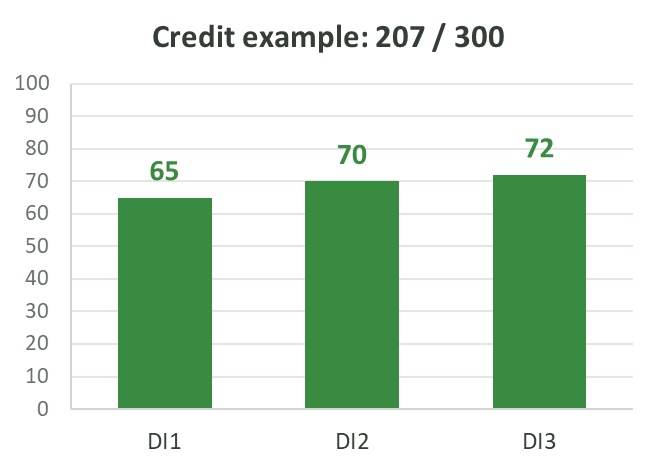
According to the qualification guidance, the provisional pass mark for each unit is 50%.
| Unit | Maximum Marks | Provisional Pass Mark |
| DI1 | 300 | 150 |
| DI2 | 175 | 87 |
| DI3 | 175 | 87 |
NEBOSH may adjust the final pass mark through its awarding process. Therefore, the provisional mark should not be treated as a guaranteed final pass threshold for every assessment sitting.
Overall Qualification Grades
Your marks from all three units are combined to determine your overall qualification grade.
| Overall Grade | Combined Marks |
| Pass | 150–195 |
| Credit | 196–225 |
| Distinction | 226 or above |
You must pass all three units to achieve the complete NEBOSH Level 6 International Diploma.
7. NEBOSH IDip Course Fee in Pakistan
The course fee depends on the learning partner, training format, support services, and assessment arrangements.
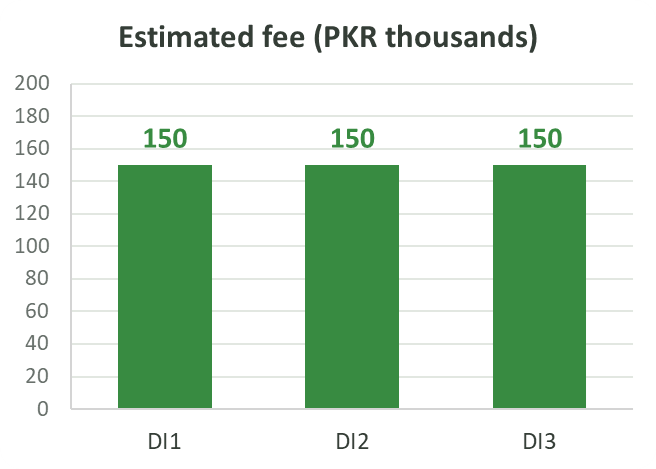
For students planning to study through International Safety Solution (ISS), the approximate training fee structure in Pakistan is:
| Unit | Approximate Fee |
| DI1 | PKR 150,000 |
| DI2 | PKR 150,000 |
| DI3 | PKR 150,000 |
| Total | PKR 450,000 |
Important Fee Information:
- The above amounts are approximate training fees.
- NEBOSH assessment registration charges may be separate.
- Resit or reassessment charges may be additional.
- The final fee and included services should be confirmed with International Safety Solution before registration.
Students are encouraged to confirm the complete fee breakdown and payment arrangements before enrolling.
8. What Happens If You Fail a NEBOSH IDip Unit?
If you do not achieve a pass in one unit, you may be able to register for a reassessment of that unit.
You do not normally need to repeat the units you have already passed, provided your enrolment remains valid and you meet the applicable NEBOSH requirements.
For example:
- If you pass DI1 and DI2 but fail DI3, you can focus on preparing for the DI3 reassessment.
- If you fail DI1, you can prepare again and register for the DI1 reassessment.
- If you pass all three units, you achieve the complete qualification.
Reassessment fees and registration deadlines should be confirmed with your Learning Partner.
9. Entry Requirements – Who Can Study NEBOSH IDip?
There are no formal mandatory entry requirements for the qualification. However, NEBOSH recommends that learners have completed the NEBOSH International General Certificate or an equivalent qualification.
The Diploma is an advanced professional-level course, so students should ideally have:
- A good understanding of health and safety fundamentals.
- Knowledge of workplace hazards and risk assessment.
- Practical experience in an HSE-related role.
- Good English reading and writing skills.
- The ability to research, analyse, and present technical information.
NEBOSH recommends an English language standard equivalent to IELTS 7.0 or higher.
Students who have completed NEBOSH IGC and gained relevant workplace experience may find the transition to Diploma-level study more manageable.
10. Career Scope of NEBOSH IDip Level 6
The NEBOSH International Diploma can support career progression in Pakistan and internationally.
It is particularly valuable for professionals who want to move beyond operational safety responsibilities into management, consultancy, auditing, and strategic health and safety roles.
Potential Job Opportunities
After completing the qualification and gaining relevant professional experience, you may pursue positions such as:
- HSE Manager.
- Health and Safety Manager.
- Senior HSE Engineer.
- HSE Consultant.
- QHSE Manager.
- HSE Lead.
- Safety Auditor.
- Occupational Health and Safety Specialist.
- Regional HSE Manager.
- Corporate HSE Manager.
- Health and Safety Advisor.
Industries Where NEBOSH IDip Can Be Valuable
The qualification is relevant to a wide range of industries, including:
- Oil and Gas.
- Construction.
- Manufacturing.
- Power Generation.
- Engineering.
- Chemical and Process Industries.
- Logistics and Warehousing.
- Healthcare.
- Food and Packaging.
- Infrastructure and Development Projects.
Employers may value Diploma-qualified professionals for their ability to manage complex safety issues, develop management systems, conduct audits, and support organisational compliance.
11. International Job Opportunities
NEBOSH qualifications are recognised by employers in many countries.
Professionals with a NEBOSH Diploma, relevant work experience, good communication skills, and suitable professional competencies may explore opportunities in:
- United Arab Emirates (UAE).
- Saudi Arabia.
- Qatar.
- Oman.
- Kuwait.
- Bahrain.
- United Kingdom.
- Other international markets.
However, completing the Diploma does not automatically guarantee employment or a particular salary. Job opportunities depend on experience, technical knowledge, industry requirements, professional memberships, and employer expectations.
12. Professional Membership and Career Development
The NEBOSH Level 6 International Diploma may support applications for professional membership with recognised health and safety organisations, subject to their current membership criteria.
For example, Diploma holders may explore relevant professional routes with:
- IOSH – Institution of Occupational Safety and Health.
- Other recognised occupational health and safety professional bodies.
Membership grades, experience requirements, and application procedures are determined by the relevant professional organisation.
Students should check the latest membership requirements directly with the organisation before applying.
13. Recommended Study Resources for NEBOSH IDip Students
To prepare effectively, students should use reliable learning resources and practise applying their knowledge.
Recommended resources include:
- Official NEBOSH syllabus and learner guidance.
- NEBOSH assessment guidance.
- NEBOSH examiner reports and assessment feedback.
- Relevant health and safety legislation and guidance.
- International standards and recognised safety publications.
- Workplace case studies and practical examples.
- Technical books and reference materials.
- Learning Partner study notes and recorded lectures.
- Practice questions and assessment-writing exercises.
14. Common Mistakes Students Should Avoid
Many students have good technical knowledge but struggle to demonstrate it effectively in their assessments.
Avoid these common mistakes:
- Memorising answers without understanding the topic.
- Ignoring the question requirements.
- Writing generic answers without applying the scenario.
- Repeating the same point in different words.
- Providing recommendations without justification.
- Ignoring assessment instructions and word limits.
- Submitting copied or plagiarised material.
- Leaving insufficient time for proofreading.
- Using technical terms incorrectly.
- Failing to reference sources where required.
Best Advice: Read the question carefully, understand what is being asked, apply your knowledge to the given situation, and provide clear, technically accurate answers.
15. NEBOSH IDip Level 6 – Video Guidance
For a detailed explanation of the NEBOSH Level 6 International Diploma, including its units, assessments, passing criteria, career opportunities, and study guidance, watch our video:
Video Link: [https://youtube.com/shorts/1eZi9o9yAyE?si=Qlpz7sNdnvobBAez]
Official Qualification Information
NEBOSH Level 6 International Diploma – Qualification and Resources
ISS Learning Resources
NEBOSH IDip Past Papers and Learning Resources
Check that each resource matches your qualification specification. Older papers may use different unit codes, formats or requirements.
International Safety Solution