
Change is an inevitable part of every organisation. Whether a business introduces new machinery, modifies its operational processes, restructures departments, adopts new technology or expands its facilities, change can significantly influence workplace health and safety. This makes Health and Safety Professionals in Change Management essential to ensuring that organisational improvements do not introduce unnecessary risks to employees, contractors, visitors or business operations.
Change management is not simply about implementing new systems or achieving operational targets. It involves understanding how changes affect people, processes, equipment and the working environment. Without proper planning and risk evaluation, even a well-intentioned organisational change can create new hazards, weaken existing safety controls and increase the likelihood of workplace incidents.
Health and safety professionals play an important role in this process by identifying potential risks, advising management, supporting decision-making and ensuring that safety considerations are integrated into every stage of organisational change.
This article explores their responsibilities, the importance of effective change management and how the Plan-Do-Check-Act (PDCA) cycle can support a structured and continuous approach to managing workplace changes safely.
1. Understanding Change Management in Health and Safety
Change management is a systematic process of planning, assessing, implementing and reviewing changes within an organisation to ensure that they achieve their intended objectives without creating unacceptable risks.
In occupational health and safety, it is commonly associated with the Management of Change (MoC) process. This approach ensures that changes are properly evaluated before they are introduced and that appropriate safety measures are established throughout implementation.
Changes can take several forms:
Technological Changes
Introducing automated machinery, robotics, digital monitoring systems, new software or advanced safety equipment.
Operational Changes
Modifying production methods, introducing new chemicals, changing maintenance schedules or altering standard operating procedures.
Organisational Changes
Restructuring departments, changing management responsibilities, recruiting new personnel or reducing workforce numbers.
Physical and Environmental Changes
Expanding facilities, relocating workstations, modifying building layouts or introducing new storage areas.
Legislative and Regulatory Changes
Adapting workplace policies, procedures and safety arrangements to meet new legal requirements, industry standards or regulatory expectations.
Regardless of the type of change, health and safety professionals must evaluate its potential impact before implementation.
2. Why Is Health and Safety Involvement Important in Change Management?
Organisations often focus on the financial, technical and operational benefits of change. However, overlooking health and safety considerations can create serious consequences.
A new machine may improve productivity but introduce additional noise, vibration or mechanical hazards. A change in staffing arrangements may reduce operational costs but increase workload, fatigue and human error. Similarly, relocating a production area may affect emergency evacuation routes and access to firefighting equipment.
The involvement of health and safety professionals helps organisations identify these issues before they develop into incidents.
Key reasons include:
- Preventing workplace accidents: Identifying new hazards and evaluating risks before changes take effect.
- Maintaining legal compliance: Ensuring that changes do not compromise applicable health and safety obligations.
- Protecting employee wellbeing: Considering physical, mental and psychosocial impacts during organisational transitions.
- Maintaining operational continuity: Reducing disruption caused by incidents, unsafe procedures or inadequate preparation.
- Improving safety culture: Encouraging employees to participate in decisions that affect their working conditions.
- Supporting informed decisions: Providing management with professional advice on risks, resources and necessary control measures.
Effective change management therefore makes safety an integral part of organisational development rather than an activity considered only after problems occur.
3. Key Responsibilities of Health and Safety Professionals in Change Management
Health and safety professionals are not simply responsible for checking whether new arrangements are safe after implementation. Their involvement should begin when a change is first proposed and continue until its effectiveness has been evaluated.
3.1 Identifying Hazards and Assessing Risks
One of the most important responsibilities is identifying hazards that may arise from proposed changes.
A health and safety professional should conduct or facilitate suitable risk assessments to determine:
- What new hazards could be introduced?
- Could existing hazards become more significant?
- Which employees, contractors or visitors could be affected?
- Are existing control measures still effective?
- What additional precautions are required?
For example, introducing a new automated production line may create risks involving moving machinery, electrical systems, maintenance access and interaction between workers and robots.
The professional must ensure that these risks are assessed and suitable control measures are established before the equipment becomes operational.
3.2 Reviewing Existing Safety Procedures and Control Measures
Changes can make existing safety arrangements unsuitable or ineffective.
Health and safety professionals should review relevant documentation, including:
- Risk assessments and method statements.
- Safe systems of work.
- Standard operating procedures.
- Emergency response arrangements.
- Permit-to-work systems.
- Fire safety and evacuation plans.
- Personal protective equipment requirements.
- Maintenance and inspection schedules.
Any procedures affected by the change should be revised, communicated and made available before implementation.
3.3 Advising Senior Management and Supporting Decision-Making
Health and safety professionals provide management with competent advice about the potential safety implications of organisational decisions.
Their role includes explaining risks, recommending appropriate controls and highlighting the resources required to implement changes safely.
They should also help management understand that the cheapest or fastest option is not necessarily the safest or most sustainable.
For example, when purchasing new machinery, a health and safety professional can advise management to consider machine guarding, emergency stops, noise emissions, maintenance access, operator competence and applicable safety standards before approving the purchase.
3.4 Communicating Changes and Consulting Employees
Employees are directly affected by many workplace changes. Therefore, their involvement is essential.
Health and safety professionals should work with managers and employee representatives to ensure that workers understand:
- Why the change is necessary.
- What is going to change.
- How their responsibilities may be affected.
- What new hazards or risks may arise.
- Which safety procedures they must follow.
- Where they can raise concerns or report problems.
Effective consultation also helps identify practical issues that management may overlook.
The UK Health and Safety Executive emphasises timely communication, employee consultation and appropriate training during organisational change.
3.5 Providing Training and Developing Competence
New systems, equipment and responsibilities may require employees to develop additional knowledge and skills.
Health and safety professionals should identify training needs and ensure that suitable instruction is provided before employees undertake unfamiliar tasks.
This may include:
- Machinery operation and safety training.
- Updated emergency response procedures.
- Chemical handling and COSHH-related training, where applicable.
- Working at height and confined space procedures.
- Updated permit-to-work requirements.
- Training on revised safe systems of work.
Training should be appropriate to the risks, responsibilities and competence requirements of the affected workforce.
3.6 Monitoring Implementation and Evaluating Performance
The responsibilities of health and safety professionals do not end when a change is introduced.
They must monitor the implementation process to verify that safety arrangements are working as intended.
This can involve workplace inspections, safety audits, employee feedback, incident investigations, performance indicators and competency assessments.
If new risks emerge or control measures prove ineffective, corrective action should be taken promptly.
3.7 Promoting a Positive Safety Culture
Change can create uncertainty and resistance among employees. Some workers may be unfamiliar with new procedures, while others may be concerned about increased workloads or changing responsibilities.
Health and safety professionals should promote a culture where employees feel comfortable discussing concerns, reporting hazards and contributing to improvements.
Their role is to encourage shared responsibility, strengthen safety leadership and ensure that safety remains a priority even during periods of organisational pressure.
4. Applying the PDCA Cycle to Change Management
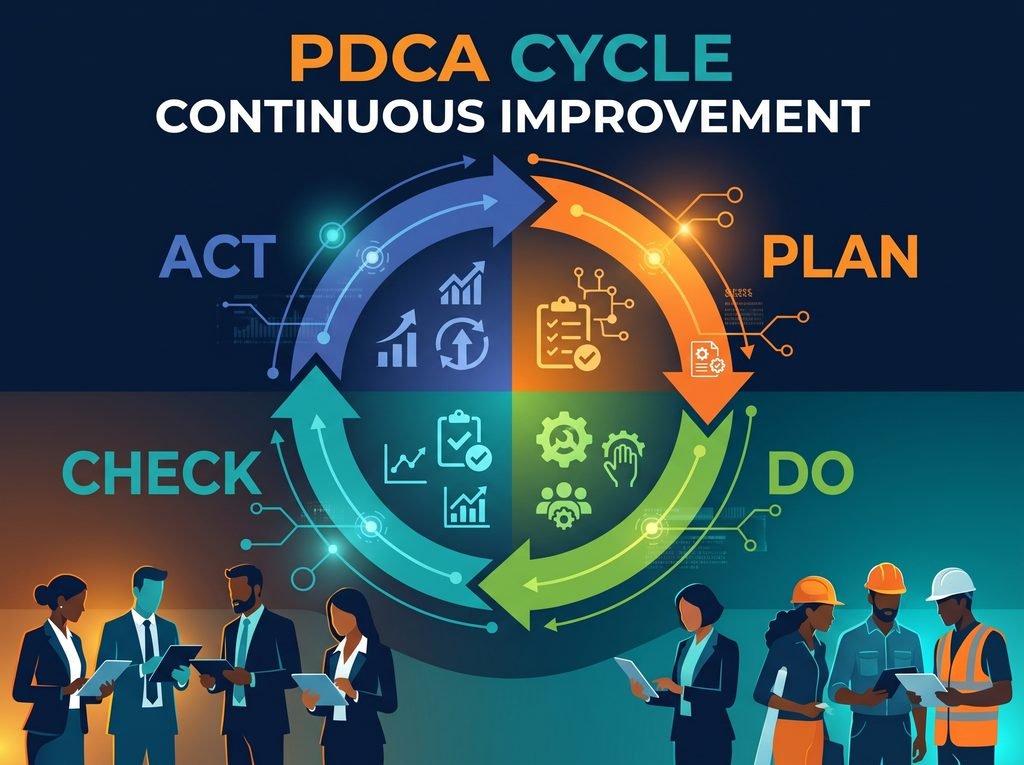
The Plan-Do-Check-Act (PDCA) cycle is an effective framework for managing workplace changes systematically. It provides a continuous improvement approach that helps organisations plan changes, implement appropriate controls, evaluate results and make necessary improvements.
For health and safety professionals, the PDCA cycle ensures that change management is not treated as a one-time activity. Instead, it becomes an ongoing process of risk management, monitoring and improvement.
The four stages can be applied as follows:
Stage 1: PLAN – Identify and Prepare for Change
The planning stage involves understanding the proposed change, identifying potential hazards and determining the measures required to manage associated risks.
Health and safety professionals should:
- Identify the nature, purpose and scope of the proposed change.
- Consult relevant managers, employees and stakeholders.
- Conduct suitable hazard identification and risk assessments.
- Review applicable legislation, standards and organisational procedures.
- Identify training, equipment and resource requirements.
- Establish responsibilities, deadlines and safety objectives.
- Develop an implementation plan with appropriate control measures.
Practical example: Before installing new industrial machinery, the health and safety professional assesses mechanical, electrical and ergonomic hazards, reviews the proposed layout and identifies operator training requirements.
Stage 2: DO – Implement the Change Safely
The Do stage involves putting the approved plan into action.
Health and safety professionals support implementation by ensuring that agreed safety controls are introduced and communicated.
Key activities include:
- Installing and commissioning equipment safely.
- Providing employee training and instruction.
- Updating risk assessments and operating procedures.
- Implementing necessary engineering and administrative controls.
- Providing appropriate personal protective equipment.
- Communicating revised responsibilities and safety requirements.
- Supervising the transition and addressing emerging issues.
Practical example: During machinery installation, the professional verifies that guarding, emergency stops and electrical isolation arrangements are in place and that operators receive the required training before using the equipment.
Stage 3: CHECK – Monitor and Evaluate the Change
The Check stage determines whether the change has achieved its objectives without compromising workplace safety.
Health and safety professionals should monitor performance and compare actual results against established objectives.
This may involve:
- Conducting workplace inspections and safety audits.
- Reviewing incident and near-miss reports.
- Checking employee competence.
- Monitoring compliance with revised procedures.
- Gathering employee feedback.
- Reviewing maintenance and equipment inspection records.
- Evaluating the effectiveness of risk control measures.
Practical example: After commissioning the machinery, the professional conducts inspections, reviews operator feedback and checks whether employees are following the new operating procedures correctly.
Stage 4: ACT – Improve and Correct
The Act stage involves addressing any problems identified during monitoring and making improvements to the change management process.
Health and safety professionals should:
- Investigate deficiencies and identify root causes.
- Introduce corrective and preventive measures.
- Revise risk assessments and procedures where necessary.
- Arrange additional training if competence gaps are identified.
- Improve ineffective control measures.
- Share lessons learned with relevant departments.
- Update organisational arrangements to prevent similar problems.
Practical example: If inspections identify that operators are frequently bypassing a machine safety control because of poor equipment design, the professional recommends reviewing the design and implementing an effective engineering solution.
Once improvements are introduced, the cycle begins again with further planning and evaluation.
5. Practical Example: Managing Change in an Industrial Workplace
Consider a manufacturing organisation planning to replace its traditional production machinery with an automated production system.
Although the change is intended to increase productivity, it may introduce several new health and safety risks.
| Potential change | Possible safety implications |
| Automated machinery | Entanglement, crushing and unexpected movement |
| New electrical systems | Electric shock and electrical fire |
| Revised production layout | Obstructed walkways and evacuation routes |
| New operating procedures | Human error and unfamiliarity |
| Reduced manual intervention | New maintenance and isolation requirements |
| Changes in job responsibilities | Training gaps, workload and stress |
The health and safety professional should coordinate with engineering, operations, maintenance and management teams to ensure that these risks are addressed.
The PDCA approach can guide the process:
- Plan: Assess risks, consult employees, review machine safety requirements and develop a safe implementation plan.
- Do: Install the machinery, introduce safety controls, update procedures and train operators.
- Check: Inspect the installation, monitor equipment performance and evaluate employee competence.
- Act: Address identified weaknesses, improve controls and revise procedures based on findings.
This example demonstrates that successful change management requires more than installing new equipment. It requires a structured process that considers the safety of people throughout the transition.
6. Common Challenges in Managing Workplace Change
Even organisations with established safety management systems can experience difficulties when implementing change.
Health and safety professionals should be prepared to address the following challenges.
Resistance to Change
Employees may be reluctant to adopt unfamiliar procedures or technologies.
Solution: Involve employees early, explain the reasons for change and provide opportunities for consultation and feedback.
Inadequate Communication
Poor communication can lead to misunderstandings, inconsistent procedures and unsafe working practices.
Solution: Establish clear communication channels and ensure that everyone affected understands the changes and their responsibilities.
Insufficient Training
Employees may be expected to operate new equipment or perform unfamiliar tasks without adequate preparation.
Solution: Conduct training needs assessments and verify competence before authorising employees to undertake new activities.
Time and Budget Constraints
Management may prioritise rapid implementation and cost reduction over adequate safety preparation.
Solution: Present evidence-based recommendations and explain the operational, legal and financial consequences of inadequate risk control.
Failure to Monitor Changes
Some organisations evaluate risks before implementation but fail to review the effectiveness of controls afterwards.
Solution: Establish monitoring arrangements, measurable safety objectives, inspection schedules and regular management reviews.
7. Skills Required by Health and Safety Professionals to Manage Change Effectively
Managing change requires a combination of technical knowledge, professional competence and interpersonal skills.
Important skills include:
- Risk assessment and analytical skills: To identify hazards, evaluate risks and recommend appropriate control measures.
- Communication skills: To explain safety requirements and communicate effectively with employees, managers and contractors.
- Leadership skills: To influence organisational decisions and promote safety as a shared responsibility.
- Problem-solving skills: To identify implementation difficulties and develop practical solutions.
- Negotiation skills: To influence stakeholders and secure the resources required for safe implementation.
- Legislative knowledge: To understand relevant legal duties, regulatory requirements and recognised standards.
- Decision-making skills: To evaluate different options and advise management using evidence and professional judgement.
- Monitoring and evaluation skills: To measure performance, identify weaknesses and support continuous improvement.
These competencies enable health and safety professionals to move beyond routine compliance activities and contribute strategically to organisational development.
8. The Connection Between Change Management and ISO 45001
The principles of change management are closely connected with the requirements of ISO 45001:2018, the international standard for occupational health and safety management systems.
ISO 45001 promotes a proactive approach to identifying hazards, assessing risks, consulting workers and continually improving occupational health and safety performance.
Several areas of the standard are particularly relevant to managing change:
- Clause 5 – Leadership and Worker Participation: Encourages leadership commitment and worker consultation.
- Clause 6 – Planning: Addresses hazard identification, risk assessment and planning for actions.
- Clause 7 – Support: Covers competence, awareness and communication.
- Clause 8 – Operation: Includes operational planning and control, procurement, contractors and management of change.
- Clause 9 – Performance Evaluation: Requires monitoring, measurement, analysis and evaluation.
- Clause 10 – Improvement: Focuses on incidents, corrective actions and continual improvement.
In particular, Clause 8.1.3 addresses the management of change. It requires organisations to establish processes for controlling planned temporary and permanent changes that can affect occupational health and safety.
These may include changes to products, services, processes, workplace locations, work organisation, working conditions, equipment and the workforce.
Health and safety professionals help organisations translate these requirements into practical workplace arrangements.
9. How Health and Safety Professionals Add Strategic Value to Organisations
The contribution of health and safety professionals extends beyond preventing accidents.
When involved in organisational planning, they help businesses introduce improvements while maintaining safe working conditions.
Their strategic contribution includes:
- Supporting safer organisational transformation.
- Reducing the likelihood of workplace incidents and associated costs.
- Protecting employee health, wellbeing and productivity.
- Improving regulatory compliance and organisational accountability.
- Strengthening employee confidence and engagement.
- Supporting sustainable business operations.
- Building a culture of continuous improvement.
A competent health and safety professional understands that workplace safety and organisational performance are interconnected. A change that improves productivity but compromises worker safety cannot be considered a successful organisational improvement.
10. Conclusion: Making Safety an Essential Part of Every Change
Change is necessary for organisational growth, innovation and improved performance. However, successful change must never come at the expense of employee health, safety and wellbeing.
Health and safety professionals play a vital role in ensuring that organisational changes are properly assessed, communicated, implemented and monitored. Their contribution helps management anticipate risks, maintain compliance, develop employee competence and create safer working environments.
By applying the PDCA cycle, organisations can establish a structured approach to managing change while continuously evaluating and improving their safety performance.
Ultimately, effective change management is not about preventing change. It is about ensuring that every change is introduced responsibly, with the right planning, professional guidance and safety controls in place.
A successful change is not simply one that improves business performance; it is one that improves performance while protecting people.