
Introduction
The Kübler-Ross Change Curve is a widely recognised model used to understand how people may emotionally respond to change, uncertainty and challenging transitions. In the workplace, change is unavoidable. Organisations regularly introduce new technologies, management systems, operational procedures, organisational structures and health and safety policies. Although these changes may be necessary for improvement, employees do not always accept them immediately.
Change can create uncertainty, anxiety, frustration and resistance, particularly when employees feel that familiar working practices, responsibilities or levels of control are being disrupted. Understanding these reactions is essential for managers, leaders and health and safety professionals who are responsible for guiding people through organisational transitions.
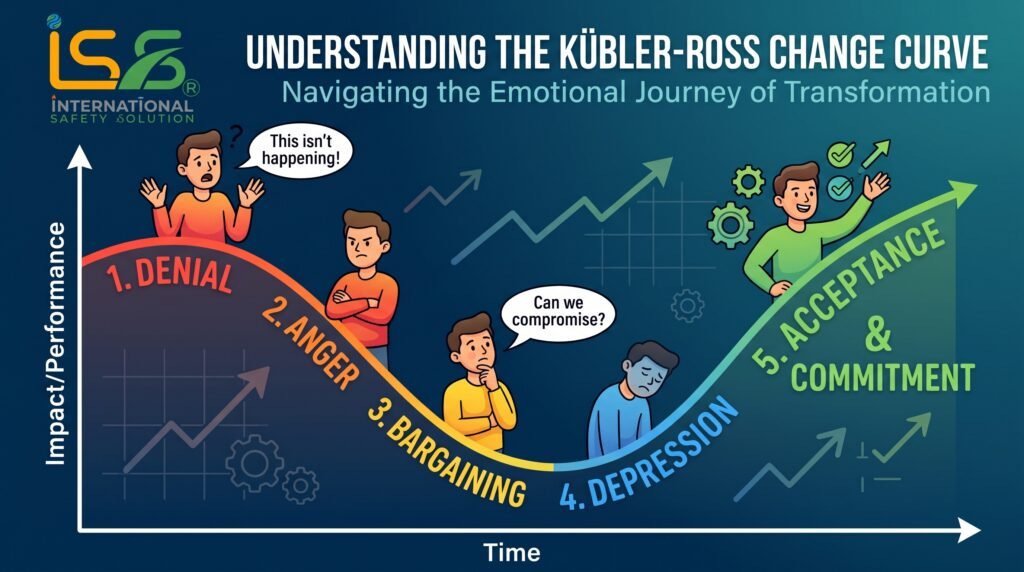
The Kübler-Ross Change Curve provides a framework for understanding five commonly described emotional responses to change: denial, anger, bargaining, depression and acceptance. By recognising these responses, organisations can better understand employee behaviour, provide appropriate support and develop effective change management strategies.
Originally associated with the work of psychiatrist Elisabeth Kübler-Ross on the emotional responses to death and dying, the model has subsequently been adapted and applied to organisational change. Although employees do not necessarily experience every stage or follow a fixed sequence, the model offers a useful way of exploring the human side of change management.
For health and safety professionals, understanding the change curve is particularly valuable when introducing new risk control measures, safety procedures, training programmes and organisational policies. Successful change depends not only on implementing new systems but also on ensuring that people understand, accept and actively participate in them.
1. What Is the Kübler-Ross Change Curve?

The Kübler-Ross Change Curve is a psychological model that illustrates how individuals may respond emotionally when experiencing significant change or loss.
The model is based on the work of Dr Elisabeth Kübler-Ross, who introduced the five commonly recognised stages in her 1969 book On Death and Dying.
Although the original research focused on people facing terminal illness and their experiences of loss, the model was later adapted to explain how employees and organisations may respond to major workplace changes.
In organisational change management, the curve helps managers understand that resistance is not necessarily a refusal to improve. It may reflect uncertainty, fear of losing familiar responsibilities, concerns about competence or a lack of understanding about the reasons behind a proposed change.
The five commonly recognised stages are:
- Denial
- Anger
- Bargaining
- Depression
- Acceptance
Each stage represents a possible emotional response that employees may experience when adapting to a new situation. Understanding these responses allows leaders to provide appropriate communication, guidance and support throughout the transition.
It is important to recognise that the curve is a descriptive framework, not a scientifically established timetable for employee behaviour. Individuals may experience several responses simultaneously, skip stages or move backwards and forwards.
Elisabeth Kübler-Ross Foundation+2
2. The Five Stages of the Kübler-Ross Change Curve
The five stages provide a useful way to explore the emotional challenges associated with organisational change. Each stage presents different behaviours, concerns and management requirements.
Stage 1: Denial – Difficulty Accepting Change
Stage 1
Denial is often one of the initial reactions when individuals become aware of an upcoming change. Employees may struggle to accept that their familiar working environment, responsibilities or established procedures are going to change.
They may believe that the proposed change will not happen, that it will have little effect on their work or that existing arrangements will eventually return.
This reaction can occur because employees feel uncertain about the future or have difficulty understanding why the organisation needs to change.
Common workplace behaviours include:
- Ignoring or questioning announcements about the proposed change.
- Continuing to follow existing working practices.
- Assuming that the change will not affect their responsibilities.
- Showing little interest in new procedures or training.
- Believing that management will eventually withdraw the proposed changes.
- Avoiding discussions about the transition.
Example in the workplace:
An organisation decides to introduce a new digital health and safety management system to replace its paper-based reporting procedures. Some employees may initially believe that the existing system is sufficient and that the new technology will not be implemented.
They may continue using traditional reporting methods instead of learning the new system.
How should managers respond?
During the denial stage, managers should focus on clear communication and awareness.
Recommended actions include:
- Explain why the change is necessary.
- Communicate the expected benefits and objectives.
- Provide accurate information about how employees will be affected.
- Encourage questions and open discussions.
- Avoid overwhelming employees with unnecessary information.
- Explain the consequences of continuing with outdated practices.
- Provide sufficient time for employees to understand the proposed changes.
The objective is to help employees recognise the reality of the situation and understand why the transition is taking place.
Stage 2: Anger – Frustration and Resistance
Stage 2
As employees begin to recognise that the change is genuinely happening, they may experience frustration, anger and resistance.
This reaction can develop when individuals feel that they are losing control over familiar working arrangements or that decisions are being imposed without their involvement.
Employees may also become concerned about increased workloads, additional responsibilities, changes to their positions or the possibility of losing professional status.
Common workplace behaviours include:
- Criticising management decisions.
- Expressing dissatisfaction with new procedures.
- Questioning the reasons behind the change.
- Blaming management or other departments.
- Refusing to cooperate with new arrangements.
- Showing reduced motivation and productivity.
- Expressing concerns about job security or competence.
Example in the workplace:
A manufacturing organisation introduces stricter machinery inspection procedures following an incident. Employees who are accustomed to the previous system may become frustrated because the new requirements involve additional checks, documentation and time.
Some workers may consider the procedures unnecessary or believe that they interfere with production targets.
How should managers respond?
Managers should recognise that frustration may be a response to uncertainty, perceived loss or a lack of involvement.
Recommended actions include:
- Listen carefully to employee concerns.
- Avoid becoming defensive or confrontational.
- Explain the reasons behind the decisions.
- Involve employees in discussions about implementation.
- Address genuine operational difficulties.
- Provide opportunities for feedback.
- Reinforce the importance of the change.
- Demonstrate visible leadership and support.
The objective is not to eliminate disagreement but to understand its causes and address legitimate concerns constructively.
Stage 3: Bargaining – Seeking Alternatives and Compromises
Stage 3
The bargaining stage occurs when individuals begin exploring alternatives or compromises in an attempt to reduce the impact of the change.
Employees may start accepting that the existing arrangements are unlikely to continue, but they may still hope that certain aspects of the change can be avoided, delayed or modified.
They may negotiate with management to retain familiar procedures, request additional time or suggest alternative approaches.
Common workplace behaviours include:
- Requesting exceptions to new procedures.
- Suggesting alternative implementation arrangements.
- Asking management to delay the change.
- Attempting to retain selected aspects of previous systems.
- Negotiating additional resources or support.
- Agreeing to some changes while resisting others.
Example in the workplace:
A company introduces mandatory safety training for employees operating new machinery. Some experienced workers argue that they already possess sufficient knowledge and request an exemption from the training programme.
They may suggest that only newly recruited employees should complete the training.
How should managers respond?
Managers should distinguish between reasonable suggestions and attempts to avoid necessary requirements.
Recommended actions include:
- Consider constructive employee feedback.
- Evaluate alternative implementation methods.
- Explain which requirements are non-negotiable.
- Allow flexibility where it does not compromise safety or legal obligations.
- Provide additional guidance where required.
- Involve employees in finding practical solutions.
- Maintain consistency in applying organisational policies.
The objective is to encourage cooperation while ensuring that essential organisational and safety requirements remain intact.
Stage 4: Depression – Low Motivation and Uncertainty
Stage 4
The depression stage is associated with feelings of disappointment, uncertainty, reduced motivation and concern about the future.
At this point, employees may begin to recognise that the previous working arrangements are no longer returning. They may feel discouraged by the challenges involved in adapting to new expectations.
This stage can be particularly challenging when employees believe they lack the knowledge, skills or resources needed to succeed in the changed environment.
Common workplace behaviours include:
- Reduced enthusiasm and motivation.
- Lower levels of productivity.
- Withdrawal from workplace discussions.
- Increased uncertainty about responsibilities.
- Lack of confidence in using new systems.
- Difficulty adapting to new working arrangements.
- Increased absenteeism or disengagement.
Example in the workplace:
Following the introduction of a new safety management system, employees may struggle with unfamiliar software, additional reporting requirements and changes to their responsibilities.
Although they understand that the previous system has been replaced, they may feel overwhelmed and uncertain about their ability to perform effectively.
How should managers respond?
At this stage, managers should focus on employee support, encouragement and practical assistance.
Recommended actions include:
- Provide additional training and coaching.
- Offer one-to-one guidance where necessary.
- Recognise employee efforts and achievements.
- Set realistic expectations during the transition.
- Monitor workload and employee wellbeing.
- Encourage teamwork and peer support.
- Identify barriers preventing successful adaptation.
- Maintain regular communication with employees.
The objective is to rebuild confidence, improve capability and help employees recognise that they can successfully adapt to the new environment.
Stage 5: Acceptance – Understanding and Adapting to Change
Stage 5
Acceptance represents a point at which individuals begin to recognise the reality of the change and develop a more constructive attitude towards the new arrangements.
Employees may start exploring the benefits of the new system, developing the necessary skills and incorporating new procedures into their everyday work.
Acceptance does not necessarily mean that employees are enthusiastic about every aspect of the change. Rather, it indicates that they are becoming more comfortable with the new situation and are prepared to move forward.
Common workplace behaviours include:
- Demonstrating greater cooperation.
- Participating in training and development.
- Following new procedures.
- Showing increased confidence.
- Identifying opportunities for improvement.
- Supporting colleagues during the transition.
- Recognising the benefits of the new arrangements.
Example in the workplace:
Employees who initially resisted a new digital safety reporting system begin using it regularly. They become more confident in recording incidents, reporting hazards and accessing safety information.
Over time, they recognise that the new system improves communication, documentation and the overall efficiency of safety management.
How should managers respond?
Managers should reinforce positive behaviour and ensure that the change becomes part of normal organisational practice.
Recommended actions include:
- Recognise employee progress and achievements.
- Encourage continued participation.
- Provide ongoing technical and professional support.
- Monitor the effectiveness of new arrangements.
- Collect feedback and identify further improvements.
- Share successful outcomes with the workforce.
- Integrate new procedures into organisational policies and systems.
The objective is to move beyond initial acceptance towards sustained implementation and continuous improvement.
3. Summary of the Five Stages of the Kübler-Ross Change Curve
The following table summarises the five stages, typical employee reactions and the appropriate management response.
| Stage | Employee Reaction | Management Response |
| Denial | Difficulty accepting the change. | Communicate the reasons and objectives clearly. |
| Anger | Frustration, criticism and resistance. | Listen, involve employees and address concerns. |
| Bargaining | Seeking alternatives and compromises. | Consider feedback while maintaining essential requirements. |
| Depression | Low motivation and uncertainty. | Provide training, encouragement and practical support. |
| Acceptance | Greater cooperation and adaptation. | Reinforce progress and sustain the change. |
The purpose of this framework is to help managers recognise possible emotional responses and adapt their leadership approach accordingly.
4. Applying the Kübler-Ross Change Curve in Health and Safety Management
The Kübler-Ross Change Curve has particular relevance to occupational health and safety because implementing safety improvements often requires employees to change familiar behaviours, procedures and working practices.
Health and safety professionals frequently introduce changes that may initially be unpopular but are necessary to reduce workplace risks and improve organisational performance.
Examples include:
- Introducing new workplace risk assessment procedures.
- Implementing permit-to-work systems.
- Changing personal protective equipment (PPE) requirements.
- Introducing machinery guarding and safety interlocks.
- Improving emergency evacuation procedures.
- Implementing digital incident reporting systems.
- Introducing new safety training programmes.
- Changing workplace inspection and auditing arrangements.
- Implementing new environmental and occupational health controls.
Employees may resist these changes because they are accustomed to existing practices or do not fully understand the risks associated with their previous behaviour.
Understanding the change curve allows safety professionals to recognise the human factors influencing implementation and develop suitable approaches to encourage acceptance.
4.1 Introducing New Safety Procedures
When organisations introduce new procedures, employees may initially question their necessity or consider them unnecessary administrative requirements.
Safety professionals should communicate the risks that the procedures are intended to control and explain how the changes contribute to workplace protection.
4.2 Implementing New Safety Equipment
Introducing new machinery, protective equipment or monitoring technology may require employees to develop unfamiliar skills.
Practical demonstrations, training and employee involvement can help reduce uncertainty and improve confidence.
4.3 Changing Unsafe Working Practices
Employees may have followed the same working methods for many years and may not immediately accept alternative procedures.
Safety professionals should explain the hazards associated with existing practices, demonstrate safer methods and encourage employee participation.
4.4 Responding to Organisational Restructuring
Changes in management responsibilities, reporting arrangements or departmental structures can create uncertainty about authority and accountability.
Clear communication, defined responsibilities and appropriate consultation can help employees understand their roles within the new structure.
4.5 Developing a Positive Safety Culture
A successful safety culture requires more than introducing policies and procedures. Employees must understand their responsibilities and actively participate in maintaining safe working environments.
The change curve helps managers recognise that developing a positive safety culture requires consistent leadership, communication, support and reinforcement.
5. The Role of Health and Safety Professionals in Managing Change
Health and safety professionals play an important role in ensuring that organisational changes are implemented without creating unnecessary risks to employees, contractors or other stakeholders.
Their responsibilities extend beyond identifying hazards and recommending control measures. They must also consider how changes affect employee behaviour, workplace communication and operational arrangements.
Key responsibilities include:
1. Identifying the Need for Change
Professionals should identify weaknesses in existing safety arrangements, evaluate workplace risks and explain why improvements are necessary.
2. Communicating the Purpose of Change
Employees should understand why a change is being introduced, what it involves and how it will affect their work.
3. Consulting and Involving Employees
Worker consultation encourages participation and helps organisations identify practical issues before implementing new arrangements.
4. Assessing Risks Associated with Change
Changes to machinery, processes, staffing, equipment or organisational structures may introduce new hazards. These should be assessed before implementation.
5. Providing Training and Competence Development
Employees must receive appropriate information, instruction and training to perform their responsibilities safely under the new arrangements.
6. Monitoring Employee Responses
Professionals should recognise signs of uncertainty, resistance or reduced engagement and communicate these concerns to relevant management.
7. Evaluating Implementation
After introducing a change, professionals should monitor its effectiveness through inspections, audits, feedback and safety performance indicators.
8. Supporting Continuous Improvement
Lessons learned during implementation should be used to strengthen organisational systems and improve future change management activities.
6. How Managers Can Lead Employees Through the Change Curve
Effective change management requires leaders to understand that employees need more than instructions to adapt to a new working environment.
Managers must provide direction, communicate openly and create an environment where employees feel supported throughout the transition.
The following management practices can help organisations implement change more successfully.
6.1 Establish a Clear Vision for Change
Employees need to understand why change is necessary and what the organisation aims to achieve.
Managers should communicate a clear vision that explains:
- What is changing?
- Why is the change required?
- How will it affect employees?
- What benefits are expected?
- How will success be measured?
A clear vision reduces uncertainty and provides employees with a sense of direction.
6.2 Encourage Employee Participation
People are more likely to support changes when they feel that their opinions and experiences are valued.
Managers should involve employees in consultations, planning discussions and implementation activities.
This is particularly important in health and safety because employees often have practical knowledge of workplace hazards and operational challenges.
6.3 Develop Effective Communication Strategies
Communication should continue throughout the change process rather than being limited to the initial announcement.
Organisations should provide regular updates, respond to employee questions and ensure that information is consistent across departments.
Managers should also recognise that different employees may require different forms of communication and support.
6.4 Provide Training and Development
Changes to workplace systems and procedures may require employees to develop new skills.
Training should be relevant to the changes being introduced and should provide sufficient practical experience.
Managers should also assess whether employees have achieved the necessary competence before allowing them to undertake unfamiliar or safety-critical tasks.
6.5 Demonstrate Visible Leadership
Leaders must demonstrate the behaviours they expect from their employees.
If management introduces a new safety procedure but fails to follow it themselves, employees may question its importance.
Visible leadership, consistent decision-making and personal accountability help build trust and encourage participation.
6.6 Recognise and Address Resistance
Resistance should not automatically be interpreted as unwillingness to cooperate.
Employees may have legitimate concerns about workload, safety, competence, resources or the practical consequences of the proposed change.
Managers should investigate these concerns and distinguish between avoidable resistance and genuine implementation problems.
6.7 Monitor Progress and Reinforce Improvements
Change does not end when a new procedure or system is introduced.
Managers should monitor implementation, review performance and recognise employees who contribute positively.
Regular feedback helps identify weaknesses and ensures that improvements become established organisational practices.
7. Limitations of the Kübler-Ross Change Curve
Although the Kübler-Ross Change Curve is a useful framework for understanding emotional responses to change, it has limitations that managers and organisational leaders should recognise.
It should not be treated as a universal psychological rule or a complete change management methodology.
7.1 Change Does Not Always Follow a Fixed Sequence
The five stages are commonly presented in a particular order, but individuals do not necessarily experience them sequentially.
An employee may move directly from initial uncertainty to acceptance, while another may experience frustration and uncertainty at different points during implementation.
7.2 Every Individual Responds Differently
Employee reactions depend on personal experiences, organisational culture, previous exposure to change, job responsibilities and the perceived impact of the transition.
Therefore, managers should avoid assuming that every employee will react in the same way.
7.3 Employees May Experience Multiple Reactions Simultaneously
An individual may understand the need for change while still feeling frustrated or uncertain about its consequences.
Emotional responses can overlap and may change as the implementation process develops.
7.4 It Does Not Provide a Complete Implementation Strategy
The model helps explain possible emotional reactions, but it does not provide a detailed framework for planning, implementing and evaluating organisational change.
Organisations should therefore combine it with appropriate change management approaches, risk assessments, communication plans and performance monitoring.
7.5 Acceptance Does Not Guarantee Commitment
Employees may accept that a change is necessary without becoming enthusiastic supporters of it.
Managers should distinguish between basic acceptance, active participation and sustained commitment.
7.6 It Should Not Be Used to Label Employees
Managers should never use the model to categorise employees as difficult, negative or resistant simply because they question a decision.
Concerns may highlight genuine problems with the proposed change, including inadequate resources, insufficient consultation or potential safety risks.
The most effective approach is to use the curve as a conversation and support framework rather than a diagnostic tool or a rigid prediction of human behaviour.
The Elisabeth Kübler-Ross Foundation itself emphasises that the responses can overlap and return, rather than forming a fixed staircase. Academic research has also highlighted the limitations of treating the adapted organisational model as a universal or linear explanation of employee behaviour.
Elisabeth Kübler-Ross Foundation+2
8. Kübler-Ross Change Curve and the PDCA Cycle in Change Management

The Kübler-Ross Change Curve and the Plan-Do-Check-Act (PDCA) cycle can complement each other when organisations are managing workplace transitions.
While the change curve helps managers understand the emotional responses employees may experience, the PDCA cycle provides a structured approach to planning, implementing, monitoring and improving changes.
The four stages of the PDCA cycle can be applied as follows:
Plan – Prepare for Change
The organisation identifies the need for change, establishes objectives, assesses risks and develops an implementation plan.
Managers should also consider the potential impact on employees, identify stakeholders and establish suitable communication and training arrangements.
Connection with the Change Curve: Employees may initially experience denial or uncertainty when the proposed change is communicated. Clear planning and early communication help reduce confusion.
Do – Implement the Change
The organisation introduces the planned changes, provides training and ensures that employees have the necessary resources and support.
Connection with the Change Curve: Employees may experience anger or attempt to negotiate alternatives as they become familiar with the new arrangements. Consultation, involvement and practical support are important during this stage.
Check – Monitor and Evaluate
Management evaluates whether the change is achieving its intended objectives.
This involves monitoring safety performance, gathering employee feedback, reviewing incidents and identifying implementation difficulties.
Connection with the Change Curve: Some employees may experience reduced confidence or motivation while adapting to the new system. Monitoring allows managers to identify difficulties and provide additional assistance.
Act – Improve and Standardise
The organisation takes corrective action, addresses identified weaknesses and integrates successful improvements into normal operations.
Connection with the Change Curve: As employees become more comfortable with the new arrangements, managers should reinforce positive practices, encourage participation and maintain improvements.
The PDCA cycle can then be repeated to support continuous improvement.
The key distinction is that the Kübler-Ross Change Curve focuses on the human response to change, whereas PDCA focuses on the systematic management and improvement of the change process.
Using both approaches can help organisations address employee concerns while ensuring that changes are properly planned, implemented and evaluated.
9. Practical Example: Applying the Kübler-Ross Change Curve to a Workplace Safety Improvement
Consider a manufacturing organisation that decides to replace its existing manual machine inspection process with a digital inspection and reporting system.
The purpose is to improve equipment monitoring, strengthen maintenance records and reduce the likelihood of machinery-related incidents.
However, employees are unfamiliar with the new technology and initially express concerns about the additional responsibilities.
The five stages may be reflected in the following way:
| Stage | Workplace Situation | Management Action |
| Denial | Employees believe the existing inspection process is sufficient. | Explain the weaknesses of the current system and the need for improvement. |
| Anger | Workers complain about additional reporting requirements. | Listen to concerns and explain the safety and operational benefits. |
| Bargaining | Employees request that the old system remains available. | Evaluate practical suggestions without compromising essential requirements. |
| Depression | Some workers feel overwhelmed by unfamiliar technology. | Provide practical training, coaching and additional support. |
| Acceptance | Employees begin using the digital system confidently. | Recognise progress, monitor performance and encourage continuous improvement. |
This example demonstrates that implementing a new safety system requires more than purchasing technology or issuing instructions.
Successful implementation depends on employee understanding, practical competence, effective leadership and ongoing support.
10. The Importance of Change Management in Developing a Sustainable Safety Culture
Organisational change is an ongoing requirement for businesses that want to improve workplace safety, operational efficiency and employee wellbeing.
However, introducing changes without considering their human impact can result in resistance, confusion and poor implementation.
The Kübler-Ross Change Curve helps organisations recognise the emotional side of these transitions and understand why employees may respond differently to new expectations.
When supported by effective change management practices, the model can contribute to:
- Greater employee engagement and participation.
- Improved communication between management and workers.
- Better understanding of organisational objectives.
- Reduced uncertainty during workplace transitions.
- Stronger employee confidence and competence.
- Improved implementation of safety procedures.
- Greater acceptance of organisational improvements.
- A stronger commitment to continuous improvement.
For health and safety professionals, these outcomes are particularly important because successful safety management depends on both effective systems and the people responsible for implementing them.
Conclusion
The Kübler-Ross Change Curve provides valuable insight into the emotional responses that individuals may experience during significant organisational transitions. Its five commonly recognised stages—denial, anger, bargaining, depression and acceptance—help explain why employees may respond differently when familiar working practices, responsibilities and organisational arrangements change.
For managers and health and safety professionals, understanding these responses is essential to implementing workplace improvements effectively. Clear communication, employee consultation, appropriate training, visible leadership and continuous support can help individuals adapt to new expectations and develop confidence in unfamiliar working environments.
However, the change curve should not be treated as a rigid sequence or a complete change management strategy. Every individual experiences change differently, and organisations must remain flexible in their approach.
When combined with structured approaches such as the PDCA cycle, effective risk management and employee participation, the Kübler-Ross Change Curve can help organisations manage the human side of change while maintaining operational effectiveness and workplace safety.
Ultimately, successful change is not simply about introducing something new; it is about helping people understand it, adapt to it and become an active part of its success.