
Introduction
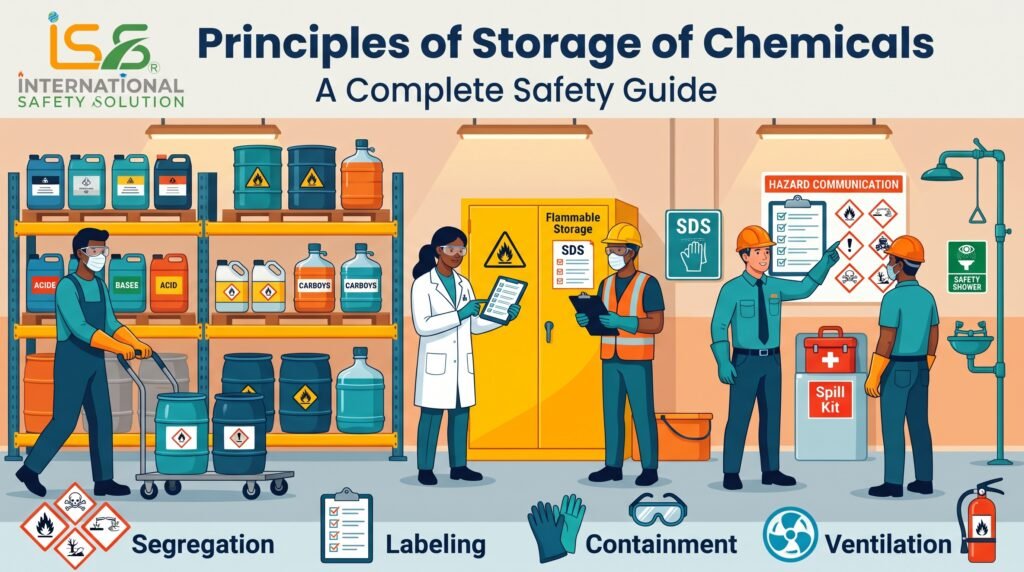
Principles of Storage of Chemicals are essential for protecting workers, facilities, emergency responders and the environment from the hazards associated with hazardous substances. Chemicals are widely used in manufacturing industries, laboratories, warehouses, healthcare facilities, construction and various industrial processes. Although chemicals provide significant benefits, improper storage, handling or transportation can result in serious incidents, including fires, explosions, toxic releases, chemical reactions and environmental contamination.
Safe chemical storage requires more than simply placing containers on shelves. Organisations must understand the physical, chemical and toxicological properties of every substance, identify potential incompatibilities, establish appropriate segregation arrangements and implement effective fire protection and emergency response measures.
The quantity, size and nature of chemical containers, together with their storage arrangements, significantly influence the level of risk. Temperature, pressure, concentration, chemical stability, reactivity and the possibility of hazardous by-products must also be considered when designing a chemical storage facility.
The principles of storage of chemicals therefore focus on segregation, protection against physical damage, hazard identification, fire control, toxicity management and the prevention of dangerous chemical reactions. This guide explores these principles in detail and explains how organisations can establish safe and effective chemical storage systems.
1. Understanding Chemical Storage Hazards
Before establishing a chemical storage arrangement, organisations must understand the hazards associated with the substances being stored.
A chemical may present one or several hazards depending on its composition, concentration, physical state and environmental conditions.
The major categories include:
- Flammable and combustible chemicals: Substances that can ignite when exposed to heat, sparks or other ignition sources.
- Oxidizing chemicals: Substances that can intensify combustion by supplying oxygen or promoting oxidation.
- Corrosive chemicals: Substances capable of damaging metals, skin, eyes and other materials through chemical action.
- Toxic chemicals: Substances that can cause harmful health effects through inhalation, ingestion, skin absorption or other exposure routes.
- Unstable chemicals: Substances that may undergo dangerous decomposition or uncontrolled reactions under certain conditions.
- Water-reactive chemicals: Substances that react dangerously with water, potentially generating heat, flammable gases or toxic gases.
- Air-reactive chemicals: Substances that react with oxygen or moisture in the atmosphere and may ignite or deteriorate.
- Self-heating materials: Substances that generate heat through internal chemical or biological processes and may eventually ignite.
- Radioactive materials: Materials that emit ionising radiation and require specialised storage and radiation protection arrangements.
Some chemicals possess multiple hazard characteristics. For example, a chemical may be both toxic and flammable. Consequently, storage arrangements must be based on a comprehensive assessment rather than relying on a single hazard label.
2. Sources of Information for Chemical Storage
Safe chemical storage begins with accurate information about the materials being handled.
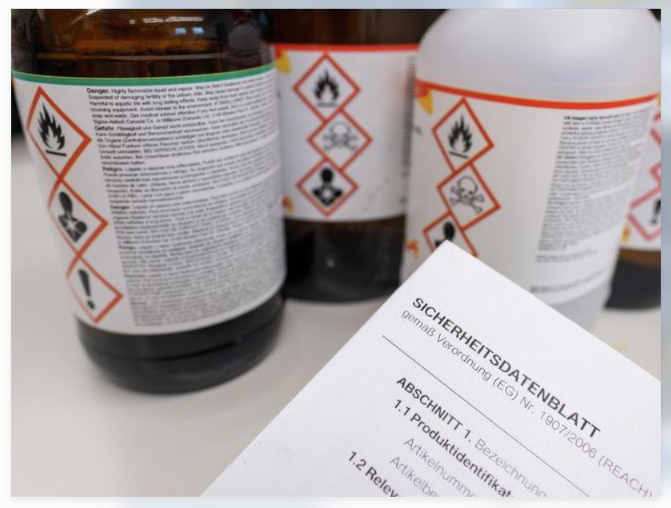
Organisations should obtain chemical hazard information from reliable sources, including:
2.1 Safety Data Sheets (SDS)
A Safety Data Sheet (SDS), previously commonly called a Material Safety Data Sheet (MSDS), is one of the most important sources of information for chemical safety.
Manufacturers and suppliers provide SDS documents containing information about the properties, hazards, handling, storage and emergency measures associated with chemical products.
Particular attention should be given to the following SDS sections:
| SDS Section | Information Relevant to Chemical Storage |
| Section 2 – Hazard Identification | Hazard classification, signal words and hazard statements |
| Section 5 – Fire-Fighting Measures | Suitable extinguishing media and specific fire hazards |
| Section 6 – Accidental Release Measures | Spill containment and cleanup procedures |
| Section 7 – Handling and Storage | Storage conditions, incompatibilities and precautions |
| Section 8 – Exposure Controls/PPE | Exposure limits, engineering controls and personal protective equipment |
| Section 9 – Physical and Chemical Properties | Flash point, flammability, pH, boiling point and other properties |
| Section 10 – Stability and Reactivity | Chemical stability, hazardous reactions and incompatible materials |
| Section 11 – Toxicological Information | Health effects and routes of exposure |
SDS Section 7 is particularly important because it provides specific storage recommendations and incompatibility information. Section 10 helps identify substances that may react dangerously with one another.
An SDS supports workplace risk assessment but does not replace the need for a site-specific chemical storage risk assessment.
2.2 Chemical Manufacturers and Suppliers
Manufacturers and suppliers can provide additional information concerning:
- Chemical composition and concentration.
- Recommended storage temperature.
- Shelf life and stability.
- Container compatibility.
- Special storage conditions.
- Emergency response requirements.
2.3 Technical Standards and Reference Publications
Organisations should also consult relevant technical standards and guidance, including:
- NFPA 49 – Hazardous Chemicals Data.
- NFPA 325 – Guide to Fire Hazard Properties of Flammable Liquids, Gases and Volatile Solids (historical reference).
- NFPA 491 – Guide to Hazardous Chemical Reactions (historical reference).
- NFPA 704 – Standard System for the Identification of the Hazards of Materials for Emergency Response.
- Applicable hazardous materials storage and fire protection standards.
The current status, edition and applicability of each standard should be verified before using it as a compliance requirement.
3. Principles of Good Chemical Storage
Effective chemical storage is based on several fundamental principles. These principles aim to prevent accidental chemical reactions, minimise exposure, protect containers and ensure safe emergency response.
3.1 Segregation of Chemicals
Segregation is one of the most important principles of good chemical storage.
It involves separating chemicals according to their chemical properties, hazard classifications and compatibility to prevent dangerous interactions.
Incompatible chemicals must not be stored together because accidental contact caused by leaking containers, breakage, spills or fire can result in:
- Violent chemical reactions.
- Heat generation and exothermic reactions.
- Fire and explosions.
- Formation of toxic gases.
- Pressure build-up.
- Release of hazardous vapours.
- Environmental contamination.
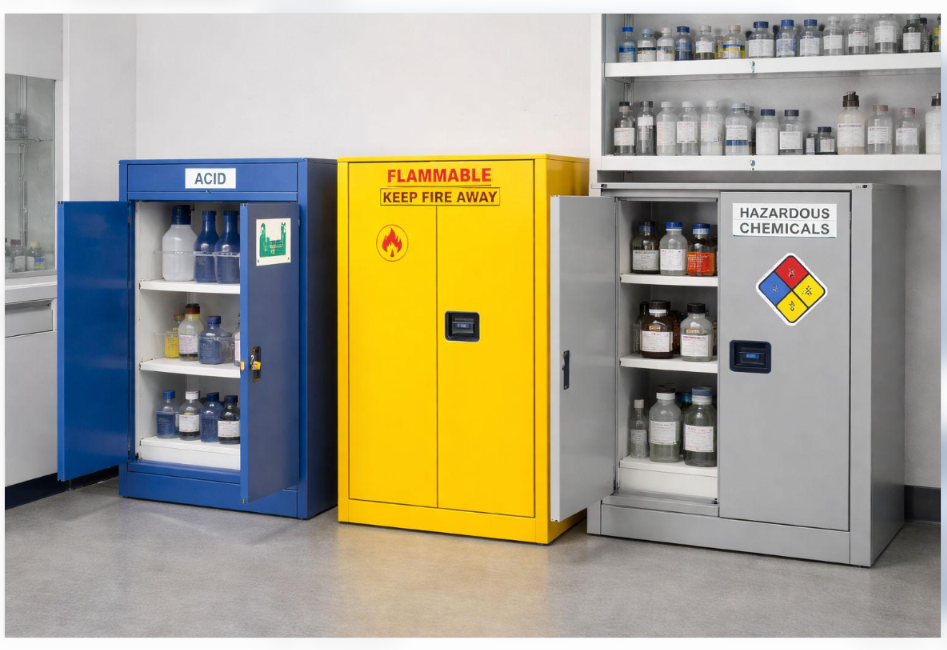
Segregation can be achieved through separate storage rooms, approved chemical storage cabinets, physical barriers, fire-resistant partitions or suitable secondary containment systems.
Examples of incompatible chemicals:
| Chemical Category | Chemicals to Keep Separate | Potential Consequences |
| Acids | Alkalis and bases | Heat generation and splashing due to exothermic reactions |
| Acids | Cyanide compounds | Potential release of highly toxic hydrogen cyanide gas |
| Acids | Sulphide compounds | Potential release of toxic hydrogen sulphide gas |
| Oxidizers | Flammable liquids and organic materials | Increased fire intensity and possible ignition |
| Oxidizers | Reducing agents | Potentially violent chemical reactions |
| Water-reactive chemicals | Water and moisture | Heat generation, fire or flammable gas release |
| Reactive metals | Water and incompatible chemicals | Hydrogen generation, heat and fire |
| Corrosive chemicals | Incompatible metals and materials | Container deterioration and chemical leakage |
These are general examples. Actual storage compatibility must always be confirmed using the specific chemical’s SDS and an approved compatibility assessment.
Chemicals should be arranged by compatibility and hazard class rather than simply in alphabetical order. Alphabetical arrangement may be used only after appropriate hazard segregation has been completed.
3.2 Protection Against Physical Damage
Chemical containers must be protected against physical damage during storage, handling and transportation.
Containers can become damaged due to:
- Impact from forklifts and other vehicles.
- Falling objects.
- Improper stacking.
- Excessive pressure.
- Corrosion or deterioration.
- Exposure to unsuitable temperatures.
- Poor handling and transportation practices.
A damaged container can release hazardous chemicals into the surrounding environment, potentially creating fire, explosion, toxic exposure or contamination hazards.
For example, oxidizing chemicals stored in damaged containers may come into contact with combustible packaging materials. If a fire occurs, the oxidizer can intensify combustion and increase the severity of the incident.
Recommended precautions include:
- Use containers specifically designed and approved for the chemical being stored.
- Inspect containers regularly for cracks, corrosion, leakage and deterioration.
- Ensure drums and cylinders are secured against falling.
- Avoid excessive stacking and overloading of storage racks.
- Protect storage containers from vehicle impact.
- Store heavy containers on lower shelves.
- Provide suitable spill containment arrangements.
- Keep incompatible chemicals in separate secondary containment systems.
3.3 Hazard Identification and Labelling
All chemical storage areas must display appropriate hazard identification signs and labels.
Workers and emergency responders should be able to identify the hazards associated with stored chemicals without unnecessary delay.
The Globally Harmonized System of Classification and Labelling of Chemicals (GHS) provides a standardised approach to communicating chemical hazards.
GHS labels generally include:
- Product identifier.
- Supplier identification.
- Signal word (Danger or Warning).
- Hazard statements.
- Precautionary statements.
- Relevant hazard pictograms.
NFPA 704 Hazard Identification System
The NFPA 704 diamond is another important hazard identification system, particularly for emergency response.
It consists of four coloured sections:
| Colour | Hazard Category | Meaning |
| Blue | Health | Health hazard |
| Red | Flammability | Fire and ignition hazard |
| Yellow | Instability | Reactivity or instability hazard |
| White | Special Hazards | Specific hazards, such as oxidizing or water-reactive properties |
The blue, red and yellow sections use numerical ratings from 0 to 4.
- 0 – Minimal hazard.
- 1 – Slight hazard.
- 2 – Moderate hazard.
- 3 – Serious hazard.
- 4 – Severe hazard.
The white section may contain special hazard symbols or abbreviations, such as OX for oxidizer or W with a bar for water reactivity.
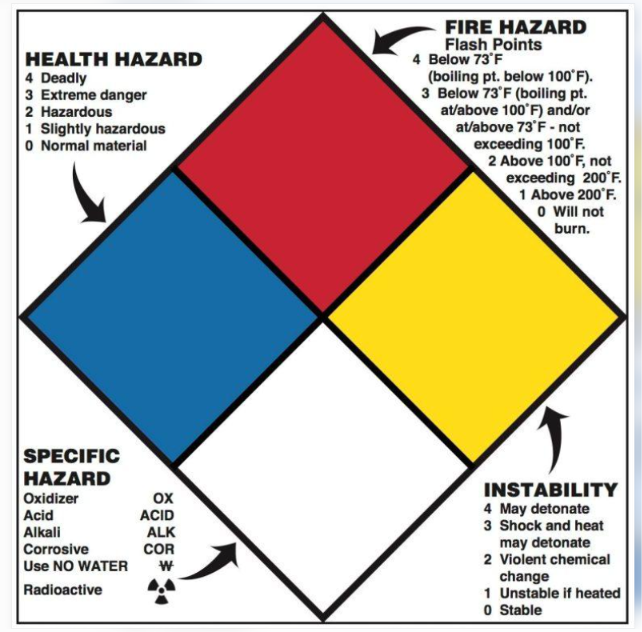
NFPA 704 provides emergency responders with a quick indication of material hazards. It does not replace GHS container labels or the chemical’s Safety Data Sheet.
3.4 Fire Control
Fire control is a critical consideration when designing chemical storage facilities.
The appropriate fire protection system depends on:
- Chemical reactivity.
- Physical state (solid, liquid or gas).
- Flammability.
- Toxicity.
- Quantity stored.
- Storage arrangement.
- Potential combustion and decomposition products.
- Possible environmental consequences.
Water is commonly used as an extinguishing agent; however, it is not suitable for every chemical fire. Some substances react dangerously with water, producing heat, flammable gases or toxic products.
Therefore, extinguishing agents must be selected according to the chemical’s properties and the recommendations in the SDS.
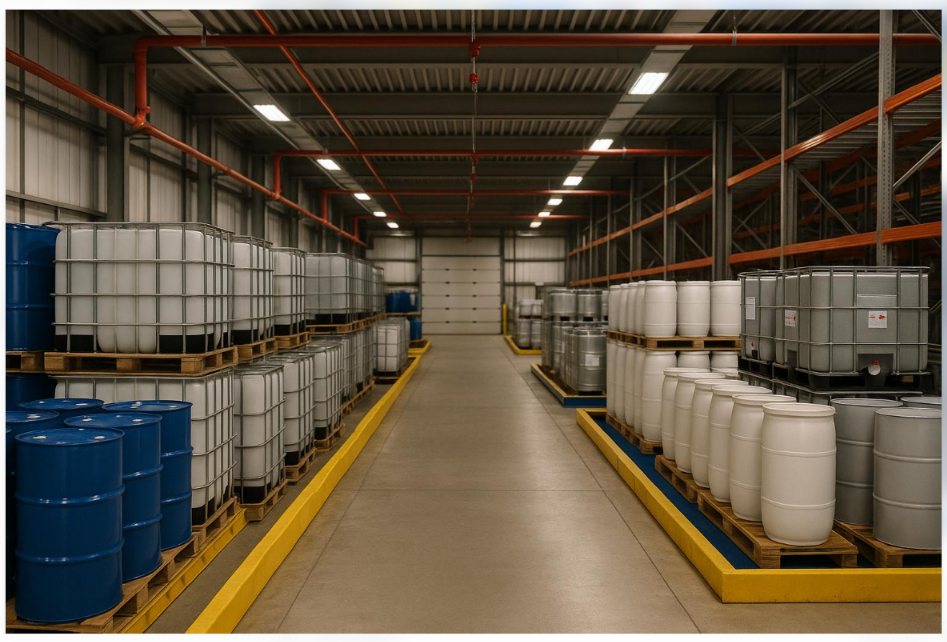
Automatic Fire Protection
Automatic sprinkler systems should be considered where required by the applicable fire protection design and storage hazard assessment.
The protection system must be specifically designed according to the chemical hazard, storage configuration, commodity classification and maximum storage quantity.
A general-purpose sprinkler arrangement may not be suitable for every chemical storage facility.
Manual Fire-Fighting Arrangements
Manual fire-fighting may supplement automatic fire protection systems, but the nature of the chemicals stored can create serious limitations.
For example, toxic smoke, hazardous combustion products and the possibility of explosions may make approaching the fire unsafe.
Firefighters may require:
- Self-Contained Breathing Apparatus (SCBA).
- Appropriate chemical protective clothing.
- Suitable respiratory protection.
- Chemical-resistant gloves and footwear.
- Remote fire-fighting techniques.
- Emergency isolation and evacuation arrangements.
Only trained and properly equipped emergency responders should undertake hazardous chemical fire-fighting operations.
3.5 Toxicity of Chemicals
Chemical toxicity is an important consideration in both occupational health and fire protection.
Toxic chemicals can enter the human body through several exposure routes:
- Inhalation: Breathing in toxic gases, vapours, fumes, mists or dust.
- Ingestion: Accidentally swallowing contaminated substances.
- Skin absorption: Chemicals entering the body through the skin.
- Injection: Chemicals entering through punctures or high-pressure injection injuries.
The severity of toxic exposure depends on factors such as:
- Chemical toxicity.
- Concentration.
- Duration of exposure.
- Exposure route.
- Physical state.
- Individual susceptibility.
Toxicity is particularly important during fire incidents because combustion or decomposition may release dangerous gases and vapours.
Workers must understand the health hazards of chemicals stored in their workplace and the protective measures required to prevent exposure.
Appropriate controls include:
- Adequate ventilation.
- Closed storage systems where necessary.
- Suitable respiratory protection.
- Chemical-resistant PPE.
- Exposure monitoring where required.
- Emergency showers and eyewash facilities.
- Restricted access to hazardous storage areas.
4. Storage Requirements for Different Types of Chemicals
Different chemical categories require different storage conditions.
4.1 Oxidizing Chemicals
Oxidizing chemicals can intensify combustion by providing oxygen or promoting oxidation reactions.
Examples include certain nitrates, chlorates, perchlorates and peroxides.
Storage precautions include:
- Keep oxidizers separate from flammable and combustible materials.
- Avoid contact with organic materials and reducing agents.
- Use compatible storage containers.
- Protect chemicals from contamination.
- Maintain the temperature and environmental conditions specified by the manufacturer.
- Keep the storage area clean and free from combustible debris.
4.2 Flammable and Combustible Chemicals
Flammable liquids and combustible substances can ignite when exposed to sufficient heat or ignition sources.
Important properties include:
- Flash point.
- Auto-ignition temperature.
- Lower Explosive Limit (LEL).
- Upper Explosive Limit (UEL).
- Vapour pressure.
- Flammable vapour concentration.
Storage precautions include:
- Use approved flammable-liquid storage cabinets or designated storage facilities.
- Keep away from open flames, sparks and hot surfaces.
- Provide suitable ventilation.
- Control static electricity and provide bonding and grounding during transfer operations where required.
- Use suitable electrical equipment for classified hazardous locations.
- Control the maximum permitted storage quantities.
- Keep containers properly closed.
4.3 Unstable Chemicals
Unstable chemicals may decompose or react under certain conditions, producing heat, pressure, fire or explosion hazards.
Storage conditions must consider:
- Temperature sensitivity.
- Pressure sensitivity.
- Shock and vibration.
- Exposure to light.
- Contamination.
- Chemical stability.
- Shelf life and decomposition characteristics.
Some unstable substances require temperature-controlled storage, specialised containers or strict limits on storage quantities.
4.4 Water- and Air-Reactive Chemicals
Some chemicals react dangerously with water, humidity or atmospheric oxygen.
For example, certain reactive metals and metal hydrides can generate flammable hydrogen gas when exposed to water or moisture.
Precautions include:
- Store in dry, suitable and compatible containers.
- Prevent water ingress.
- Maintain the environmental conditions specified by the manufacturer.
- Keep away from incompatible liquids and moisture sources.
- Provide suitable emergency response arrangements.
4.5 Corrosive Chemicals
Corrosive chemicals can cause severe damage to human tissue, metals, storage containers and infrastructure.
Storage precautions include:
- Use corrosion-resistant containers and shelving.
- Segregate acids from alkalis and other incompatible substances.
- Provide suitable secondary containment.
- Inspect containers for corrosion and deterioration.
- Provide emergency eyewash and safety shower facilities.
- Use appropriate chemical-resistant PPE.
4.6 Radioactive Materials
Radioactive materials require specialised storage arrangements based on radiation type, activity, half-life and exposure potential.
Controls may include:
- Shielding.
- Restricted access.
- Radiation warning signs.
- Secure storage.
- Radiation monitoring.
- Inventory and movement records.
- Compliance with applicable radiation protection regulations.
4.7 Self-Heating Materials
Self-heating materials can generate heat through internal chemical or biological processes.
If heat cannot dissipate sufficiently, the material temperature may increase and eventually result in spontaneous ignition.
Storage conditions must consider ventilation, material quantity, temperature, packaging and the potential for heat accumulation.
5. Chemical Storage Facility Design and Environmental Conditions
The physical design of a chemical storage area plays a significant role in preventing incidents.
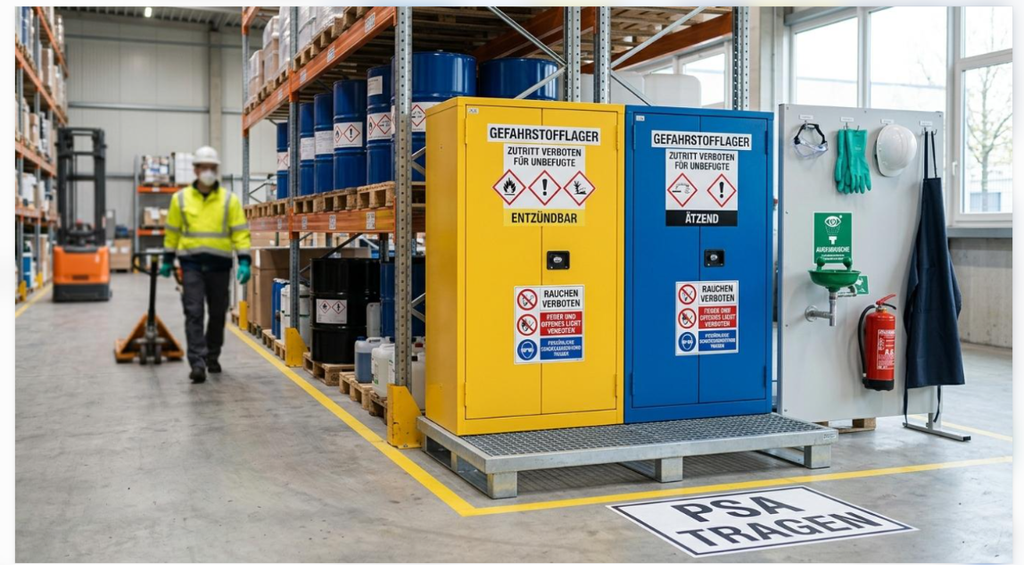
5.1 Ventilation
Adequate ventilation is necessary to prevent the accumulation of hazardous vapours, gases and airborne contaminants.
Ventilation arrangements should be selected according to:
- Chemical volatility.
- Toxicity.
- Quantity stored.
- Vapour density.
- Potential release scenarios.
- Applicable exposure limits.
Some chemicals may require local exhaust ventilation or a dedicated mechanical ventilation system.
Where flammable vapours may be present, ventilation equipment and electrical installations must be appropriately designed for the hazardous area classification.
5.2 Temperature Control
Temperature can influence chemical stability, vapour pressure, evaporation rate and reaction speed.
Excessive heat may increase vapour generation, accelerate decomposition or increase pressure inside containers.
Some chemicals may require refrigerated or temperature-controlled storage.
Storage temperatures must follow the manufacturer’s recommendations and SDS requirements.
5.3 Secondary Containment
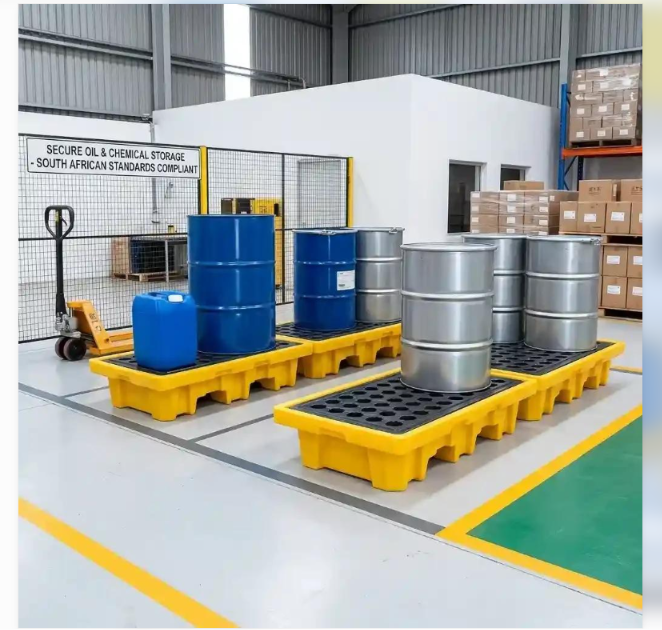
Secondary containment is designed to collect leaked or spilled liquids and prevent their uncontrolled spread.
Examples include:
- Bunded storage areas.
- Spill pallets.
- Chemical-resistant containment trays.
- Bund walls.
- Dedicated liquid containment systems.
Incompatible liquids should not share a common containment system if a spill could cause a dangerous reaction.
Containment capacity and design must be determined according to the applicable regulations, chemical properties and site-specific risk assessment.
5.4 Storage Racks and Shelving
Storage racks and shelving must be suitable for the weight, size and characteristics of chemical containers.
Important considerations include:
- Structural load capacity.
- Chemical compatibility of construction materials.
- Stability and anchoring.
- Protection against impact.
- Safe access and retrieval.
- Appropriate shelf heights.
- Prevention of falling containers.
Heavy chemical containers should generally be stored at lower levels to reduce the risk of injury and container damage.
5.5 Security and Access Control
Access to chemical storage areas should be restricted to authorised and trained personnel.
Security measures may include:
- Lockable storage cabinets.
- Controlled access systems.
- Warning signs.
- Chemical inventory registers.
- CCTV monitoring where appropriate.
- Procedures for receiving and issuing chemicals.
Highly toxic, reactive or otherwise high-risk chemicals may require additional security controls.
6. Chemical Storage Risk Assessment
A chemical storage risk assessment should identify hazards, evaluate potential consequences and determine the controls required to reduce risks.
The assessment should consider:
- Chemical identity and classification.
- Physical and chemical properties.
- Toxicological characteristics.
- Chemical compatibility.
- Maximum storage quantities.
- Container integrity.
- Storage temperature and ventilation.
- Fire and explosion potential.
- Spill and leakage scenarios.
- Worker exposure.
- Emergency response requirements.
- Environmental consequences.
A suitable risk assessment should be reviewed whenever new chemicals are introduced, storage quantities change, processes are modified or an incident reveals weaknesses in existing controls.
7. Emergency Preparedness and Response
Chemical storage facilities must have effective emergency arrangements for foreseeable incidents.
Potential emergencies include:
- Chemical spills.
- Container leakage.
- Chemical exposure.
- Fire and explosions.
- Toxic gas releases.
- Uncontrolled chemical reactions.
Emergency response arrangements should include:
Spill Response: Procedures for identifying, isolating, containing and cleaning chemical spills using compatible spill-control materials.
Fire Emergency Response: Suitable fire protection systems, evacuation arrangements, emergency isolation and coordination with trained fire responders.
First Aid: Immediate access to suitable first-aid facilities, emergency showers and eyewash stations where chemical exposure is possible.
Emergency Information: Current SDS documents, chemical inventories, hazard identification signs and emergency contact information.
Training and Drills: Workers should receive training in chemical hazards, safe storage practices, emergency reporting and evacuation procedures.
Emergency responders must be informed about the specific chemicals involved before attempting intervention.
8. Chemical Storage Inspection and Monitoring
Regular inspection helps identify unsafe conditions before they develop into serious incidents.
A chemical storage inspection programme should cover:
- Container leakage and physical damage.
- Correct chemical labelling.
- Chemical segregation and compatibility.
- Storage temperature.
- Ventilation performance.
- Housekeeping.
- Spill containment.
- Fire protection equipment.
- Emergency access and exit routes.
- Expired or deteriorated chemicals.
- Inventory accuracy.
- Storage rack condition.
- Availability of SDS documents.
Inspection findings should be documented, assigned to responsible persons and followed up until corrective actions are completed.
9. Roles and Responsibilities in Chemical Storage Safety
Effective chemical storage requires cooperation between different levels of an organisation.
Top Management
- Provide adequate resources and suitable storage facilities.
- Establish chemical safety policies.
- Ensure compliance with applicable legislation and standards.
- Review chemical storage performance.
Health and Safety Professionals
- Conduct chemical storage risk assessments.
- Advise on chemical compatibility and segregation.
- Develop safe operating procedures.
- Arrange training and inspections.
- Monitor implementation of control measures.
Warehouse and Chemical Store Personnel
- Maintain accurate chemical inventories.
- Follow storage and segregation procedures.
- Inspect containers.
- Maintain housekeeping.
- Report leaks, damage and unsafe conditions.
Supervisors
- Ensure workers follow safe storage procedures.
- Monitor compliance.
- Investigate unsafe conditions.
- Ensure corrective actions are implemented.
Workers
- Follow chemical handling instructions.
- Use appropriate PPE.
- Keep containers closed and properly labelled.
- Report spills, leaks and damaged containers.
- Never mix or transfer unidentified chemicals.
10. Benefits of Proper Chemical Storage
Implementing effective principles of chemical storage provides several organisational benefits:
- Reduces the likelihood of fires and explosions.
- Prevents dangerous chemical reactions.
- Protects workers from toxic exposure.
- Reduces chemical spills and environmental contamination.
- Protects equipment, buildings and infrastructure.
- Improves emergency preparedness.
- Supports regulatory compliance.
- Reduces business interruption.
- Improves workplace safety culture.
- Protects organisational reputation.
Conclusion
The principles of storage of chemicals are essential elements of effective occupational health and safety and process safety management. Safe chemical storage requires a thorough understanding of chemical properties, hazard identification, compatibility, segregation, physical protection, fire control and toxicity management.
Organisations must ensure that chemicals are stored according to their specific hazards rather than convenience or alphabetical arrangement. Safety Data Sheets, technical standards, chemical compatibility assessments and regular inspections should form the foundation of a reliable chemical storage programme.
Ultimately, chemical storage safety is not simply about preventing leakage or keeping containers organised. It is about preventing hazardous interactions, protecting human health, controlling fire and explosion risks and ensuring that organisations are prepared to respond effectively when an emergency occurs.
Further Reading: John A. Davenport – Chapter 4: Storage and Handling of Chemicals, particularly the sections on Sources of Information, Principles of Good Storage, Toxicity of Chemicals, Oxidizing Chemicals and Fire Control (supplied pages 7-43 and 7-44).
Technical References: