
Introduction
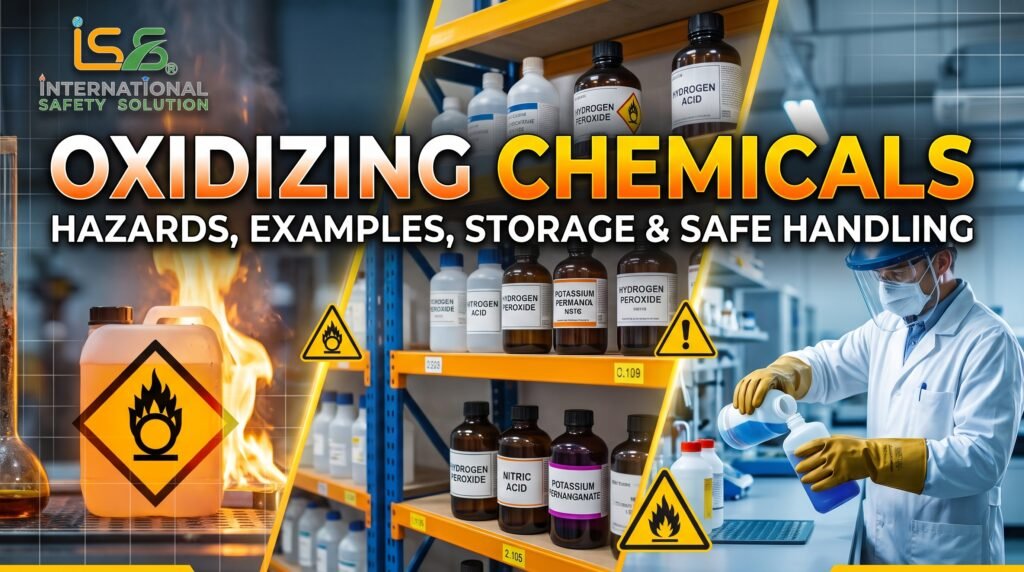
Oxidizing chemicals are an important category of hazardous substances that require careful management in industrial workplaces, laboratories, manufacturing facilities, warehouses and chemical storage areas. These substances can initiate, support or intensify combustion by reacting with other materials or supplying oxygen and other oxidising species during chemical reactions. Although many oxidizing chemicals are not themselves combustible, their presence can make fires more intense and difficult to control.
Oxidizing chemicals are widely used in industries such as chemical manufacturing, pharmaceuticals, water treatment, agriculture, textile processing, cleaning, metal treatment and healthcare. Common examples include hydrogen peroxide, potassium permanganate, ammonium nitrate, sodium chlorate, nitric acid and oxygen.
Understanding the properties, compatibility, storage requirements and potential reactions of oxidizing chemicals is essential for preventing fires, explosions, chemical exposure and other workplace incidents. Effective chemical risk assessment, correct segregation, appropriate handling procedures and emergency planning are therefore essential parts of chemical safety management.
What Are Oxidizing Chemicals?
Oxidizing chemicals, also known as oxidizing agents or oxidisers, are substances that cause or promote oxidation reactions in other materials. During an oxidation-reduction (redox) reaction, an oxidizing agent accepts electrons from another substance, causing that substance to become oxidized.
In many practical fire-safety situations, oxidizing chemicals are particularly important because they can supply oxygen or otherwise promote combustion.
Ordinary combustion generally requires three essential elements:
- Fuel
- Oxygen or another oxidising agent
- Heat
These elements form the fire triangle. When an oxidizing chemical is present, it can increase the availability of the oxidising component and make combustible materials burn more readily.
For example, a material such as paper, wood, oil or cloth may burn more intensely when it comes into contact with a suitable oxidizing substance.
Important: An oxidizer is not necessarily a flammable material. Its principal hazard is that it can cause or intensify the burning of other substances.
How Do Oxidizing Chemicals Work?
Oxidizing chemicals participate in chemical reactions by accepting electrons from other substances. The substance that loses electrons is oxidized, while the oxidizing agent gains electrons and is reduced.
Some oxidizing agents contain oxygen and can release or transfer oxygen during chemical reactions. Others, such as certain halogens, can act as oxidizers without containing oxygen.
Their effects may include:
- Supporting or accelerating combustion.
- Generating heat during reactions.
- Reacting vigorously with incompatible substances.
- Producing gases during decomposition or chemical reactions.
- Increasing the likelihood of fire or explosion under certain conditions.
The severity of a reaction depends on the chemical involved, its concentration, quantity, temperature, physical form and the materials with which it comes into contact.
Common Examples of Oxidizing Chemicals
Oxidizing chemicals are found in many industrial and commercial applications. Their hazards differ according to their chemical composition and concentration.
1. Hydrogen Peroxide
Hydrogen peroxide (H₂O₂) is an oxidizing chemical commonly used in:
- Industrial bleaching.
- Textile processing.
- Paper manufacturing.
- Water treatment.
- Disinfection and cleaning.
- Pharmaceutical applications.
Hydrogen peroxide can decompose and release oxygen. Concentrated solutions can present serious fire and reaction hazards, particularly when contaminated or exposed to incompatible materials.
Its concentration has a significant influence on its hazard classification and safe handling requirements.
2. Potassium Permanganate
Potassium permanganate (KMnO₄) is a strong oxidizing agent used in:
- Water treatment.
- Chemical laboratories.
- Industrial oxidation processes.
- Certain cleaning and treatment applications.
It can react with organic materials and reducing agents. Contact with incompatible substances may generate heat and create fire or explosion hazards under certain conditions.
3. Ammonium Nitrate
Ammonium nitrate (NH₄NO₃) is an oxidizing chemical widely used in:
- Agricultural fertilisers.
- Industrial chemical manufacturing.
- Certain regulated blasting applications.
Although ammonium nitrate is not a conventional combustible fuel, it can intensify fires and may undergo hazardous decomposition under certain conditions, particularly when exposed to heat, contamination or confinement.
Its storage and handling require strict controls because large quantities can present significant fire and explosion hazards.
4. Sodium Chlorate
Sodium chlorate (NaClO₃) is a strong oxidizing agent used in some industrial processes, including pulp and paper manufacturing and chemical production.
It can react dangerously with combustible materials and reducing agents. Contamination with incompatible substances can increase the likelihood of fire or violent reactions.
5. Potassium Chlorate
Potassium chlorate (KClO₃) is an oxidizing chemical used in certain industrial and specialist applications.
It can react vigorously with combustible and reducing materials. Its handling and storage require strict control of contamination, friction, heat and incompatible substances.
6. Nitric Acid
Nitric acid (HNO₃) is a highly corrosive chemical that also has strong oxidizing properties, particularly in concentrated form.
It is used in:
- Fertiliser manufacturing.
- Metal treatment and etching.
- Chemical manufacturing.
- Laboratory processes.
Nitric acid can react with organic substances, metals and other incompatible materials. It may release hazardous fumes and can cause severe chemical burns.
7. Oxygen
Oxygen is an essential gas for human respiration, but it also supports combustion.
Industrial oxygen is used in:
- Welding and cutting.
- Metal processing.
- Medical applications.
- Chemical manufacturing.
- Industrial furnaces.
Oxygen-enriched environments can cause materials to ignite more easily and burn more intensely. Oil, grease and other incompatible materials can create serious hazards when they come into contact with oxygen equipment.
8. Sodium Hypochlorite
Sodium hypochlorite (NaOCl) is widely used in bleaching, cleaning, disinfection and water treatment.
It is an oxidizing chemical and can react with incompatible substances, including acids and certain cleaning products. Mixing it with acids can release toxic chlorine-containing gases.
It must never be mixed with other cleaning chemicals unless the product instructions explicitly permit the combination.
Classification of Oxidizing Chemicals
Under the Globally Harmonized System of Classification and Labelling of Chemicals (GHS), oxidizing substances are classified according to their physical state and oxidizing properties.
The main categories include:
1. Oxidizing Gases
Oxidizing gases are gases that may cause or intensify the combustion of other materials.
Examples include:
- Oxygen.
- Fluorine.
- Nitrous oxide.
These gases can create oxygen-enriched or highly reactive environments. Equipment, valves, regulators and pipelines must be suitable for the specific gas and kept free from incompatible contamination.
2. Oxidizing Liquids
Oxidizing liquids are liquids that can cause or intensify combustion when they react with other materials.
Examples include:
- Hydrogen peroxide solutions.
- Nitric acid.
- Certain perchloric acid solutions.
Their hazards may include corrosivity, chemical burns, decomposition and violent reactions with incompatible materials.
3. Oxidizing Solids
Oxidizing solids are solid substances that can cause or intensify combustion.
Examples include:
- Potassium permanganate.
- Potassium chlorate.
- Sodium chlorate.
- Ammonium nitrate.
- Potassium nitrate.
They may present significant hazards when mixed with combustible materials, reducing agents or other incompatible chemicals.
Under GHS, oxidizing liquids and solids are further divided into categories based on their test results and hazard severity. Oxidizing gases have their own classification.
The GHS Hazard Pictogram for Oxidizing Chemicals
The Globally Harmonized System uses a specific hazard pictogram to identify oxidizing substances.
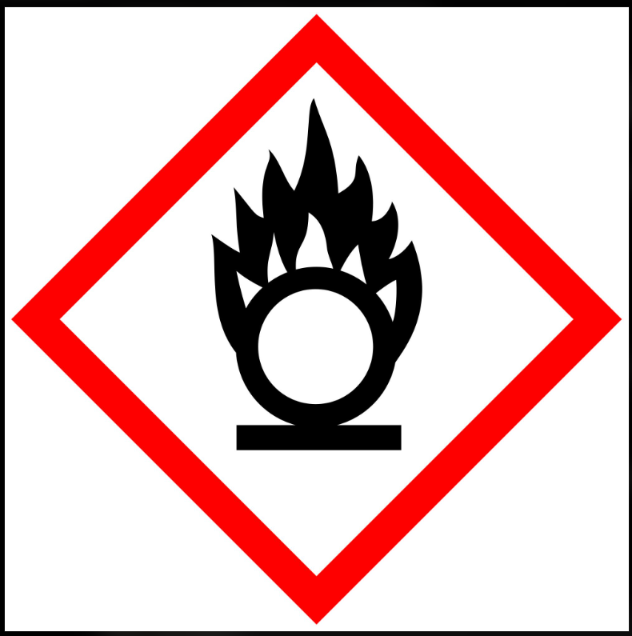
Flame over circle pictogram
The symbol consists of a flame above a circle within a red diamond-shaped border.
It indicates that a chemical may cause or intensify fire.
The pictogram is used on relevant chemical labels and Safety Data Sheets (SDSs).
The label may also include:
- Signal word: Danger or Warning.
- Hazard statements.
- Precautionary statements.
- Product identification.
- Supplier information.
Workers should understand the meaning of this pictogram and follow the precautions specified on the chemical label and SDS.
Hazards and Risks Associated with Oxidizing Chemicals
Oxidizing chemicals can create serious workplace hazards if they are stored, handled or used incorrectly.
1. Increased Fire Intensity
Oxidizing chemicals can accelerate the combustion of flammable and combustible materials.
A fire involving an oxidizer may burn more intensely than an ordinary fire, potentially increasing heat release and making firefighting more difficult.
2. Fire and Explosion
Some oxidizing chemicals can react violently with combustible materials, organic substances and reducing agents.
Under certain conditions, these reactions can produce sufficient heat or gases to cause fire, pressure build-up or explosions.
3. Chemical Burns
Certain oxidizing liquids, including concentrated hydrogen peroxide and nitric acid, can cause severe burns to the skin and eyes.
The severity depends on the chemical, concentration, exposure duration and affected body area.
4. Toxic Fumes and Gases
Some oxidizing chemicals may release harmful fumes during decomposition, chemical reactions or fires.
For example, certain chlorine-containing chemicals can release toxic gases when mixed with incompatible substances.
5. Incompatible Chemical Reactions
Oxidizers may react dangerously with reducing agents, organic materials, combustible substances and certain metals.
These reactions may generate heat, gas, fire or explosive conditions.
6. Contamination
Contamination is a major concern when handling oxidizing chemicals.
Even small quantities of incompatible substances may initiate hazardous reactions, depending on the chemical involved.
Contamination can occur through:
- Dirty containers.
- Contaminated tools and equipment.
- Incorrect transfer procedures.
- Reusing containers without proper approval.
- Mixing incompatible chemicals.
- Using unsuitable absorbent materials.
7. Environmental Hazards
Some oxidizing chemicals can contaminate soil and water or harm aquatic organisms.
Uncontrolled releases, incorrect disposal and contaminated firefighting runoff may create environmental risks.
Chemical Incompatibility: What Should Oxidizing Chemicals Be Kept Away From?
One of the most important aspects of oxidizer safety is preventing contact with incompatible materials.
Oxidizing chemicals should generally be segregated from the following groups, subject to the specific chemical’s SDS and compatibility information.
1. Flammable and Combustible Materials
Examples include:
- Petrol and diesel.
- Oils and lubricants.
- Solvents.
- Paper and cardboard.
- Wood.
- Cloth and other combustible materials.
- Flammable liquids and gases.
Contact with an oxidizer can significantly increase the risk and severity of fire.
2. Reducing Agents
Reducing agents are substances that donate electrons during oxidation-reduction reactions.
Examples include certain metals, sulphites and other reducing chemicals.
Mixing oxidizers with reducing agents may generate heat, gas or violent reactions.
3. Organic Materials
Many organic substances can react with strong oxidizers.
Examples include:
- Alcohols.
- Certain solvents.
- Oils and greases.
- Organic powders.
- Some cleaning materials.
The nature and severity of the reaction depend on the specific chemicals involved.
4. Certain Metals
Some oxidizing chemicals react dangerously with particular metals, especially under certain conditions involving moisture, heat or contamination.
The compatibility of storage containers, fittings and handling equipment must therefore be checked.
5. Other Incompatible Chemicals
Certain acids, alkalis, reactive chemicals and other oxidizing substances may be incompatible with a particular oxidizer.
It is important not to assume that all oxidizers can safely be stored together. Compatibility must be assessed using the relevant SDS and chemical compatibility information.
Safe Storage of Oxidizing Chemicals
Proper storage is essential to prevent contamination, chemical reactions, fires and explosions.
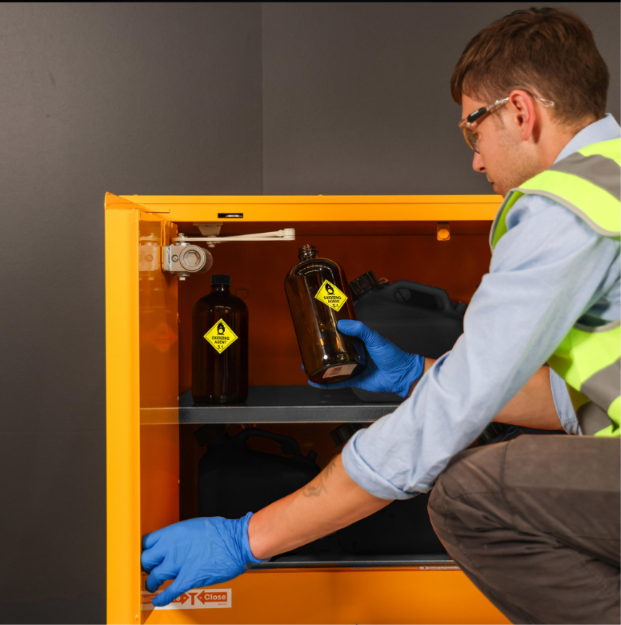
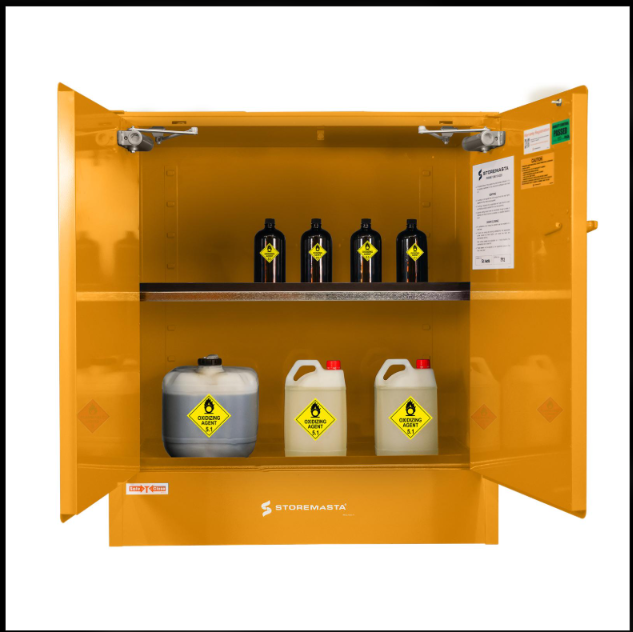
Organisations should establish a designated storage area based on the chemical properties, quantity and applicable storage requirements.
1. Segregate from Combustible Materials
Oxidizing chemicals should be stored separately from flammable and combustible substances.
They should not be stored alongside materials such as paper, wood, oils, solvents and other incompatible substances.
2. Use Suitable Storage Areas
Storage cabinets, rooms, shelves and containment systems must be suitable for the chemical involved.
The materials used for storage should be compatible with the chemical and its concentration.
Wooden shelves and cardboard packaging may be unsuitable for certain oxidizers.
3. Maintain Appropriate Temperature Conditions
Some oxidizing chemicals are sensitive to heat and may decompose under unsuitable conditions.
Storage temperatures should follow the manufacturer’s recommendations and the SDS.
4. Prevent Contamination
Containers should remain properly closed when not in use.
Tools, scoops and transfer equipment should be clean and suitable for the chemical.
Dedicated equipment may be necessary to prevent cross-contamination.
5. Provide Appropriate Ventilation
Some oxidizers may release harmful vapours or gases, particularly during decomposition or chemical reactions.
Storage areas should have ventilation appropriate to the chemical and the risk assessment.
6. Use Clear Labelling and Signage
Containers and storage areas should be clearly identified.
Labels should include relevant chemical information and hazard pictograms.
Appropriate signage should warn workers about oxidizing substances and restricted access where necessary.
7. Provide Secondary Containment Where Required
Secondary containment can help control leaks and spills.
However, the containment material must be chemically compatible with the oxidizer. Incompatible absorbents or containment materials may increase the hazard.
8. Conduct Regular Inspections
Storage areas should be inspected to identify:
- Damaged or leaking containers.
- Corrosion or deterioration.
- Missing or incorrect labels.
- Signs of contamination.
- Poor housekeeping.
- Incompatible materials.
- Temperature or ventilation problems.
- Inadequate segregation.
Inspection findings should be recorded and corrective actions completed.
Safe Handling of Oxidizing Chemicals
Workers must follow approved procedures when receiving, transferring, using and disposing of oxidizing chemicals.
Important precautions include:
- Read the Safety Data Sheet before use.
- Understand the chemical’s hazards and incompatibilities.
- Use only approved containers and transfer equipment.
- Avoid contamination during handling.
- Do not mix chemicals unless the process has been specifically assessed and authorised.
- Keep oxidizers away from heat and ignition sources where required.
- Avoid contact with combustible materials.
- Use suitable personal protective equipment.
- Ensure appropriate ventilation.
- Follow approved operating procedures.
- Maintain good housekeeping.
- Report damaged containers, leaks and unsafe conditions immediately.
Workers should never improvise chemical mixing or transfer procedures.
Personal Protective Equipment (PPE)
The required PPE depends on the chemical, its concentration, the task and the exposure assessment.
Possible PPE includes:
Chemical-Resistant Gloves
Gloves should be selected based on chemical compatibility, concentration, exposure duration and manufacturer’s guidance.
Not all chemical-resistant gloves provide protection against every oxidizer.
Safety Goggles
Chemical splash goggles help protect the eyes from splashes and contact with hazardous liquids.
Face Shields
Face shields may be required for tasks involving a significant splash or splash-pressure risk. They should generally be used with suitable eye protection.
Protective Clothing
Chemical-resistant aprons, coveralls or other protective clothing may be necessary to prevent skin contact.
Respiratory Protective Equipment
Respiratory protection may be required where a suitable exposure assessment identifies inhalation risks that cannot be adequately controlled by other measures.
It must be selected, fitted, maintained and used according to an appropriate respiratory protection programme.
PPE should be considered the final layer of protection rather than a replacement for safe systems of work, engineering controls and effective chemical storage.
Risk Assessment for Oxidizing Chemicals
A chemical risk assessment helps identify hazards, evaluate risks and determine the precautions required to prevent harm.
The assessment should consider:
Chemical identification: Identify the chemical, concentration, quantity and physical state.
Hazard identification: Review fire, explosion, toxicity, corrosivity and reactivity hazards.
Exposure assessment: Identify possible routes of exposure, including inhalation, skin contact and eye contact.
Chemical compatibility: Determine which materials and chemicals must be kept separate.
Storage arrangements: Assess the suitability of storage locations, containers and segregation.
Work activities: Examine receiving, transferring, mixing, processing, cleaning and disposal activities.
Emergency arrangements: Establish procedures for spills, exposure, fire and accidental releases.
Control measures: Determine appropriate engineering, administrative and PPE controls.
The assessment should be reviewed whenever there is a change in chemical, concentration, quantity, process or workplace conditions.
Emergency Response and Spill Management
An emergency involving oxidizing chemicals requires careful consideration because ordinary spill and firefighting methods may be unsuitable.
Chemical Spills
In the event of a spill:
- Stop work and warn people in the affected area.
- Isolate the area and restrict access.
- Inform the responsible supervisor or emergency response team.
- Identify the chemical only if it is safe to do so.
- Consult the SDS and emergency response procedure.
- Prevent contact with incompatible materials.
- Use only approved spill-control materials and equipment.
- Ensure contaminated waste is handled and disposed of appropriately.
Workers should not attempt to clean up an unknown, large or highly reactive oxidizer spill unless they are specifically trained, equipped and authorised.
Some common absorbents, including cellulose-based and polymeric materials, may be incompatible with particular oxidizers. The SDS and specialist guidance should determine the correct response.
Fire Emergencies
If a fire involves oxidizing chemicals:
- Raise the alarm immediately.
- Evacuate people from the affected area.
- Contact the emergency response team and fire service.
- Inform responders about the chemical involved and its quantity, if known.
- Follow the chemical-specific emergency response guidance.
- Avoid approaching heated or damaged containers.
- Allow only trained emergency responders to determine the appropriate firefighting method.
The correct extinguishing medium depends on the specific oxidizer and the materials involved. There is no single firefighting method suitable for every oxidizing chemical.
For large fires or situations involving potentially explosive decomposition, emergency responders may need to fight the fire remotely and establish an appropriate isolation area.
Chemical Exposure
If a worker is exposed:
- Follow the first-aid instructions in the SDS.
- Immediately use the appropriate emergency washing facilities where indicated.
- Remove contaminated clothing when it is safe to do so.
- Obtain urgent medical assistance for significant exposure.
- Report and investigate the incident.
The precise first-aid response must be chemical-specific. For example, some oxidizers require immediate prolonged water irrigation, while other situations require specialist medical advice.
Legal and Regulatory Considerations
Organisations handling oxidizing chemicals should comply with applicable occupational health and safety, environmental, fire safety and chemical management requirements.
Important international frameworks and guidance include:
- Globally Harmonized System of Classification and Labelling of Chemicals (GHS).
- International Labour Organization (ILO) guidance on occupational chemical safety.
- International standards and national regulations governing chemical classification, labelling and transport.
- Applicable fire prevention and hazardous materials storage requirements.
- Manufacturer’s Safety Data Sheets and technical instructions.
The GHS provides a framework for classifying chemical hazards and communicating them through labels and Safety Data Sheets. Organisations should also consult the relevant national legislation and regulatory authorities for their location.
Responsibilities of Employers and Health and Safety Professionals
Effective oxidizer management requires cooperation between management, procurement, engineering, warehouse personnel, supervisors and workers.
Employer Responsibilities
Employers should:
- Identify all oxidizing chemicals present in the workplace.
- Maintain an accurate chemical inventory.
- Obtain and maintain current Safety Data Sheets.
- Establish suitable storage and segregation arrangements.
- Provide appropriate handling procedures.
- Arrange chemical safety training.
- Provide suitable PPE and emergency facilities.
- Conduct regular inspections.
- Develop spill and fire emergency arrangements.
- Ensure proper disposal of chemical waste.
Health and Safety Professional Responsibilities
Health and safety professionals should:
- Identify oxidizing chemicals and their associated hazards.
- Review chemical inventories and Safety Data Sheets.
- Assess fire, explosion and chemical exposure risks.
- Advise on chemical compatibility and segregation.
- Inspect chemical storage facilities.
- Review safe systems of work and handling procedures.
- Ensure appropriate training and awareness programmes.
- Advise on PPE selection.
- Review emergency response arrangements.
- Investigate chemical incidents and near misses.
- Monitor compliance with relevant safety requirements.
- Recommend improvements to chemical safety management systems.
Training and Awareness for Workers
Workers who handle or work near oxidizing chemicals should receive appropriate training before performing their tasks.
Training should cover:
- Identification of oxidizing chemicals.
- Understanding the flame-over-circle GHS pictogram.
- Reading chemical labels and Safety Data Sheets.
- Chemical incompatibility.
- Safe storage and handling.
- Spill prevention and response.
- Appropriate PPE.
- Emergency alarms and evacuation procedures.
- First-aid and exposure reporting.
- Waste disposal procedures.
Refresher training should be provided when procedures change, new chemicals are introduced or inspections and incident investigations identify knowledge gaps.
Conclusion
Oxidizing chemicals are widely used across industrial, commercial and laboratory environments, but their ability to initiate or intensify combustion makes them an important chemical safety concern. Even when an oxidizer is not itself combustible, it can significantly increase the severity of a fire or react dangerously with incompatible substances.
Understanding the properties and hazards of oxidizing chemicals is essential for preventing workplace fires, explosions, chemical exposure and environmental damage.
Organisations should establish effective chemical risk assessments, appropriate storage and segregation arrangements, safe handling procedures, suitable PPE, worker training and emergency response systems.
The safe management of oxidizing chemicals depends on recognising their hazards before an incident occurs.
Identify the chemical. Understand its compatibility. Prevent contamination. Store it safely. Handle it responsibly.
Important technical references
1. OSHA – Hazard Communication: Hazard Classification Guidance for Manufacturers, Importers, and Employers. Explains chemical hazard classification, including oxidizing materials and their properties.
Read OSHA Guidance (PDF)
2. OSHA – Hazard Communication Standard, Appendix C. Provides GHS hazard pictograms, hazard statements and precautionary statements for oxidizing gases, liquids and solids.
Read OSHA Appendix C
3. University of California, Berkeley – Segregate Incompatibles. Covers chemical incompatibility, oxidizer segregation and safe storage precautions.
Read UC Berkeley Chemical Safety Guidance
4. NOAA CAMEO Chemicals – Oxidizing Substances. Provides information on chemical reactivity, fire hazards, toxic effects and emergency considerations.
Read NOAA CAMEO Chemicals
5. National Institutes of Health (NIH) – Chemical Safety Guide. Provides guidance on chemical segregation, storage arrangements, incompatible substances and protective measures.
Read NIH Chemical Safety Guide (PDF)
Additional useful reference:
NIH – Chemical Segregation and Storage
Textbook Reference
John A. Davenport – Chapter 4: Storage and Handling of Chemicals, particularly the section on Combustible Chemicals, including Carbon Black, Lamp Black, Lead Sulfocyanate, Nitroaniline, Nitrochlorobenzene, Sulfides, Sulfur and Naphthalene (supplied pages 7-45 and 7-47).