
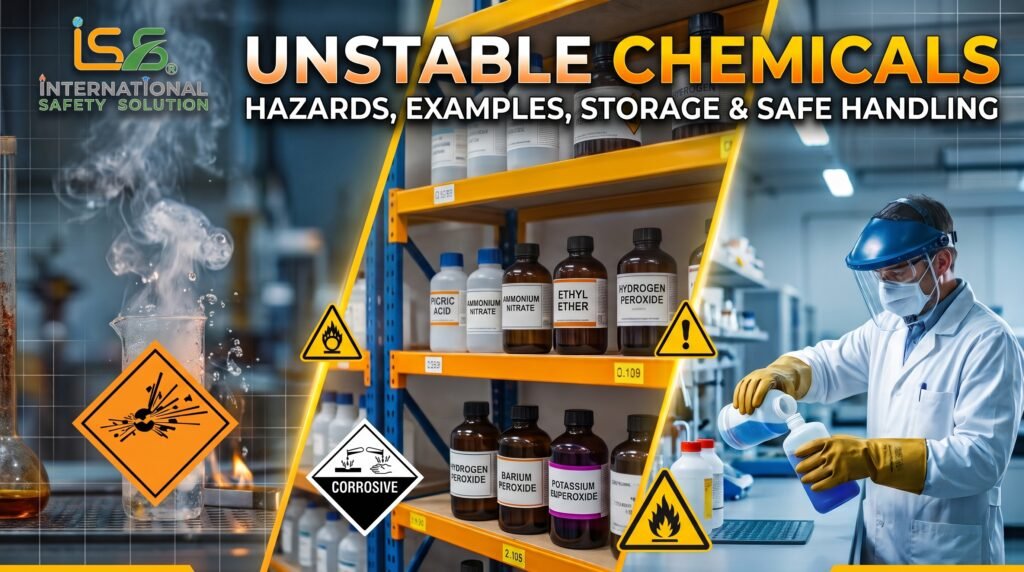
Unstable chemicals are substances that can undergo unwanted or potentially dangerous chemical changes under certain conditions. They may decompose, react violently, release heat, generate toxic gases, or cause fires and explosions. Understanding unstable chemicals is essential for organisations that manufacture, store, transport or use hazardous substances.
Chemical instability can result from exposure to heat, pressure, light, moisture, contamination, mechanical shock or contact with incompatible materials. In workplaces such as chemical manufacturing facilities, laboratories, warehouses and industrial processing plants, inadequate control of these conditions can lead to serious incidents.
For health and safety professionals, identifying unstable chemicals and understanding their reaction characteristics are important steps in preventing chemical emergencies, protecting workers and maintaining safe operating conditions.
1. What Are Unstable Chemicals?
Unstable chemicals are substances that may undergo spontaneous decomposition or hazardous reactions when exposed to particular environmental or operating conditions.
Unlike substances that remain chemically stable under normal conditions, unstable materials may change their chemical composition and release energy or hazardous by-products. The severity of the reaction depends on the chemical’s properties, quantity, concentration, temperature, pressure and surrounding conditions.
Chemical instability may result in:
- Sudden or uncontrolled heat generation.
- Rapid gas production and pressure build-up.
- Fire or explosion.
- Release of toxic or corrosive gases.
- Violent reactions with water, air or other chemicals.
- Damage to storage containers, processing equipment and buildings.
It is important to understand that a chemical does not necessarily have to be unstable under ordinary conditions to become dangerous. Some substances remain stable when stored correctly but become hazardous when exposed to heat, contamination, moisture or incompatible materials.
2. What Causes Chemical Instability?
Several environmental and operational factors can affect the stability of chemicals.
2.1 Exposure to High Temperatures
Heat can accelerate chemical reactions and cause some unstable substances to decompose. If decomposition releases additional heat, the reaction may accelerate further.
In certain situations, this can develop into thermal runaway, where heat generation exceeds the ability of the system to remove it.
2.2 Pressure Changes
Some chemical reactions generate gases. If these gases cannot escape safely, pressure can build up inside containers, vessels or processing equipment.
Excessive pressure may cause container failure, equipment damage or an explosion.
2.3 Exposure to Light
Certain chemicals are sensitive to light, particularly ultraviolet radiation. Light exposure can initiate photochemical reactions, decomposition or the formation of reactive substances.
Where specified by the manufacturer, these materials must be stored in suitable light-protective containers or designated storage conditions.
2.4 Contact with Water or Moisture
Some chemicals react dangerously when they come into contact with water or moisture.
Depending on the substance, the reaction may produce heat, flammable gases, corrosive products or toxic substances. Water-reactive chemicals therefore require storage conditions that prevent accidental moisture contact.
2.5 Contamination
Contamination can significantly affect chemical stability. Even a small quantity of an incompatible substance may initiate an unwanted reaction.
Contamination may occur through:
- Using unclean transfer equipment.
- Mixing chemicals without checking compatibility.
- Using unsuitable containers.
- Introducing foreign substances during manufacturing.
- Returning unused chemicals to their original containers.
2.6 Mechanical Shock and Friction
Some highly reactive materials are sensitive to impact, friction or vibration. Mechanical disturbance may initiate rapid decomposition or an explosive reaction.
Such substances require specialised handling procedures, suitable equipment and restricted access.
3. Examples and Categories of Unstable Chemicals
Unstable chemicals include several categories of substances with different reaction characteristics. The following examples illustrate important types of chemical instability. Not every substance within a category has the same level of risk; its actual hazard classification and storage requirements must be confirmed from its Safety Data Sheet (SDS).
3.1 Organic Peroxides
Organic peroxides contain an oxygen-oxygen bond that can be relatively weak. Some may decompose when exposed to heat, friction, contamination or other unsuitable conditions.
Their decomposition can release heat and gases, potentially resulting in fire, explosion or pressure build-up.
Examples include:
- Benzoyl peroxide.
- Methyl ethyl ketone peroxide.
- Acetyl peroxide.
Organic peroxides require specific temperature controls and compatibility-based storage. Certain products also require stabilising ingredients or other manufacturer-specified conditions.
3.2 Peroxide-Forming Chemicals
Some chemicals can gradually form explosive peroxide compounds during storage, particularly when exposed to air and light.
Examples include certain ethers, such as:
- Diethyl ether.
- Tetrahydrofuran (THF).
- Isopropyl ether.
Peroxide formation can create serious hazards, particularly when containers are opened, concentrated, distilled or allowed to evaporate.
Appropriate controls include maintaining inventory records, following supplier shelf-life guidance, dating containers where required and implementing a suitable peroxide-testing and disposal programme.
Important: Never open, move or attempt to test a container suspected of containing shock-sensitive peroxide crystals. Isolate the area and seek advice from competent hazardous-materials personnel.
3.3 Water-Reactive Chemicals
Water-reactive chemicals may react violently or release hazardous gases when exposed to water or moisture.
Examples include:
- Sodium metal.
- Potassium metal.
- Certain metal hydrides.
- Calcium carbide.
Some of these materials release flammable gases or generate considerable heat when they react with water.
They must be stored in accordance with manufacturer instructions, protected from moisture and kept separate from incompatible substances.
3.4 Pyrophoric Chemicals
Pyrophoric substances can ignite spontaneously when exposed to air, sometimes without an external ignition source.
Examples include:
- Certain organolithium compounds.
- Some metal alkyl compounds.
- Certain finely divided reactive metals.
These substances require specialised handling arrangements, controlled atmospheres where specified, suitable containers and trained personnel.
3.5 Shock-Sensitive and Explosive Chemicals
Some chemicals may undergo rapid decomposition when subjected to impact, friction, heat or other forms of mechanical disturbance.
Examples of substances that can present these hazards under particular conditions include:
- Certain organic azides.
- Some metal acetylides.
- Certain highly sensitive explosive compounds.
The risk depends on the exact compound, concentration, physical form and conditions. Such materials must only be handled by appropriately qualified personnel under approved procedures.
3.6 Polymerisation-Prone Chemicals
Some chemicals can undergo uncontrolled polymerisation when exposed to heat, contamination or other initiating conditions.
Polymerisation may generate significant heat and increase pressure, particularly in enclosed equipment.
Certain monomers, including styrene and methyl methacrylate, require appropriate stabilisation and storage conditions to control unwanted polymerisation.
4. Major Hazards Associated with Unstable Chemicals
The hazards associated with unstable chemicals can affect employees, equipment, buildings and the surrounding environment.
4.1 Fire and Explosion
Rapid decomposition or an uncontrolled chemical reaction may release heat and flammable gases. If an ignition source is present, a fire or explosion may occur.
Some unstable substances may also explode due to shock, friction or heat without requiring an external ignition source.
4.2 Thermal Runaway
Thermal runaway occurs when an exothermic reaction produces heat faster than the system can remove it.
As the temperature increases, the reaction may accelerate, generating even more heat. This can create a dangerous cycle that may eventually result in vessel failure, fire or explosion.
Thermal runaway is a recognised hazard in chemical manufacturing and processing operations. The UK Health and Safety Executive highlights the importance of identifying reaction hazards and implementing appropriate process controls. Source: HSE – Chemical Reaction Hazards and the Risk of Thermal Runaway.
4.3 Toxic Gas Release
Some unstable chemicals release toxic gases when they decompose or react with incompatible materials.
Depending on the chemical involved, exposure may cause respiratory irritation, poisoning, chemical burns or potentially fatal health effects.
4.4 Pressure Build-Up
Gas generation during decomposition or chemical reactions can increase pressure inside storage containers and process equipment.
If the pressure exceeds the design capacity of the equipment, the container may rupture or fail.
4.5 Chemical Burns and Injuries
Uncontrolled reactions may release corrosive substances, hot liquids or reactive materials that can cause serious skin and eye injuries.
4.6 Environmental Contamination
Chemical releases may contaminate soil, surface water and drainage systems. Toxic decomposition products and hazardous reaction mixtures can also create long-term environmental risks.
5. Safe Storage of Unstable Chemicals
Safe storage is one of the most important control measures for preventing incidents involving unstable chemicals.
5.1 Follow Safety Data Sheet Requirements
Before purchasing or storing any unstable chemical, review the manufacturer’s Safety Data Sheet.
Particular attention should be given to:
- Section 7 – Handling and Storage: Provides information about safe handling, storage conditions and incompatible materials.
- Section 10 – Stability and Reactivity: Provides information about chemical stability, possible hazardous reactions, conditions to avoid and incompatible materials.
- Section 2 – Hazard Identification: Identifies the chemical’s hazard classification and relevant warnings.
The storage arrangements must reflect the specific requirements of each chemical rather than relying only on general storage practices.
5.2 Segregate Incompatible Chemicals
Unstable chemicals must be segregated from substances that may initiate dangerous reactions.
For example:
- Water-reactive substances must be protected from water and moisture.
- Oxidising agents must be separated from incompatible fuels and reducing agents.
- Reactive chemicals must be kept away from substances that may initiate decomposition.
- Acids and alkalis should be segregated where their contact could create hazardous reactions.
Chemical segregation should be based on compatibility information in the SDS and an appropriate chemical compatibility assessment.
5.3 Maintain Suitable Temperature Conditions
Some unstable chemicals require controlled storage temperatures.
Where refrigeration or temperature-controlled storage is specified:
- Use equipment suitable for the chemical’s hazard characteristics.
- Monitor and record storage temperatures.
- Provide alarms where necessary.
- Establish procedures for responding to temperature deviations.
- Avoid exposure to direct sunlight and other heat sources.
Never assume that refrigeration is suitable for every unstable chemical. The correct storage temperature and equipment must be confirmed from the manufacturer’s instructions.
5.4 Protect Chemicals from Moisture and Contamination
Containers should be kept properly closed and protected from moisture, dust and incompatible substances.
Transfer equipment must be suitable for the chemical and cleaned using an approved procedure before use.
5.5 Use Suitable Containers
Chemical containers must be compatible with their contents and capable of maintaining the required storage conditions.
Containers should be inspected for:
- Corrosion.
- Leakage.
- Cracks or physical damage.
- Bulging or unusual pressure signs.
- Damaged closures.
- Missing or unclear labels.
Any suspicious container should be isolated and assessed by competent personnel. It should not be opened or moved unnecessarily.
5.6 Control Storage Quantities
Only the quantities required for operational needs should be stored where practicable.
Excessive storage increases the potential consequences of an incident and may complicate emergency response.
Highly reactive materials may require additional restrictions, dedicated storage facilities and specialist oversight.
6. Safe Handling of Unstable Chemicals
Handling unstable chemicals requires careful planning, trained personnel and suitable equipment.
The following precautions should be implemented:
- Review chemical information: Understand the chemical’s stability, reactivity and incompatibilities before starting work.
- Prepare a risk assessment: Identify potential reaction scenarios and determine appropriate controls.
- Follow approved procedures: Use written instructions for receiving, transferring, mixing and using unstable chemicals.
- Avoid unnecessary mixing: Never combine chemicals unless their compatibility and the intended reaction have been assessed.
- Control operating conditions: Maintain specified temperature, pressure, concentration and addition rates.
- Use suitable equipment: Ensure containers, transfer lines and processing equipment are compatible with the chemical.
- Minimise quantities: Handle only the amount required for the task.
- Use appropriate PPE: Select gloves, eye protection, protective clothing and respiratory protection according to the chemical risk assessment.
- Maintain good housekeeping: Keep work areas clean and prevent accidental contamination.
- Ensure emergency readiness: Provide suitable emergency arrangements, equipment and trained personnel.
7. Risk Assessment and Control Measures
A detailed risk assessment should be completed before unstable chemicals are introduced into a workplace or process.
The assessment should consider:
| Risk factor | Required control consideration |
| Chemical instability | Identify decomposition and reaction hazards |
| Temperature | Establish safe operating and storage limits |
| Pressure | Assess gas generation and overpressure risks |
| Incompatible substances | Establish chemical segregation arrangements |
| Contamination | Prevent contact with unintended materials |
| Equipment failure | Assess container and process equipment suitability |
| Human error | Provide training, supervision and written procedures |
| Emergency situations | Establish isolation, evacuation and response arrangements |
The hierarchy of controls should be considered when selecting risk reduction measures.
Elimination and Substitution
Where practicable, eliminate the need to use highly unstable substances or substitute them with safer alternatives.
Engineering Controls
Use suitable engineering systems to prevent or minimise exposure and control dangerous reactions.
Examples include:
- Temperature monitoring and automatic shutdown systems.
- Pressure monitoring and appropriate pressure-relief arrangements.
- Emergency cooling systems.
- Suitable ventilation and containment.
- Interlocks and automated process controls.
Administrative Controls
Implement written procedures, chemical inventories, inspection programmes, restricted access, maintenance schedules and employee training.
Personal Protective Equipment
Provide appropriate PPE as the final layer of protection. PPE must be selected according to the chemical’s specific hazards and the task being performed.
8. Emergency Response to Unstable Chemical Incidents
An incident involving unstable chemicals can escalate rapidly. Emergency arrangements must therefore be established before the chemical is used or stored.
8.1 Chemical Leakage or Spillage
If an unstable chemical container leaks or spills:
- Stop work and warn nearby personnel.
- Keep people away from the affected area.
- Avoid touching or attempting to clean up the material.
- Prevent unauthorised access.
- Inform the designated emergency response team.
- Follow the chemical-specific emergency procedure.
Only trained and appropriately equipped personnel should manage the spill.
8.2 Unusual Heating or Pressure Build-Up
If a container or process vessel shows signs of abnormal heating, pressure build-up, bulging or unexpected reaction:
- Activate the established emergency procedure.
- Isolate the area and evacuate personnel where necessary.
- Do not attempt to open, move or cool the container unless this is specifically covered by an approved procedure and carried out by competent responders.
- Contact the emergency response team.
8.3 Fire or Explosion
In the event of a fire involving unstable chemicals:
- Raise the alarm immediately.
- Evacuate personnel to a safe location.
- Inform emergency responders about the chemicals involved.
- Provide available SDS information and chemical inventory details.
- Do not attempt firefighting unless personnel are trained, the situation is within the scope of the emergency plan and the correct extinguishing method has been established.
The appropriate response depends on the chemical’s properties. An extinguishing agent suitable for one chemical may be dangerous when used on another.
9. Responsibilities of Health and Safety Professionals
Health and safety professionals play an important role in managing the risks associated with unstable chemicals.
Their responsibilities include:
- Identifying unstable and highly reactive substances in the workplace.
- Maintaining an accurate chemical inventory.
- Reviewing Safety Data Sheets and technical information.
- Conducting chemical risk assessments.
- Developing chemical storage and handling procedures.
- Ensuring incompatible substances are properly segregated.
- Monitoring storage and process conditions.
- Arranging employee training and competency assessments.
- Coordinating emergency response planning.
- Investigating chemical incidents and near misses.
- Reviewing control measures and recommending improvements.
Health and safety professionals should work closely with operations managers, process engineers, laboratory supervisors and chemical suppliers to ensure that chemical hazards are properly understood and controlled.
10. Importance of Training and Competence
Employees who work with unstable chemicals must understand the hazards associated with the substances they handle.
Training should cover:
- Chemical hazard identification and classification.
- Reading and interpreting Safety Data Sheets.
- Chemical compatibility and segregation.
- Safe storage and handling practices.
- Recognising signs of chemical instability.
- Emergency procedures and evacuation arrangements.
- Correct selection and use of PPE.
- Reporting leaks, spills and unsafe conditions.
Practical training and competency assessments help ensure that employees can apply safe working procedures rather than simply understanding them in theory.
11. Legal and Regulatory Considerations
Organisations must comply with applicable occupational health and safety, environmental protection, fire safety and hazardous-substance requirements.
In Pakistan, organisations should consider applicable federal and provincial requirements. In Punjab, the Punjab Environmental Protection (Handling of Hazardous Substances) Rules, 2022, and associated supplementary guidance provide relevant considerations for hazardous-substance management, including chemical segregation, labelling, storage arrangements and emergency preparedness.
International guidance can also support good practice. For example:
- OSHA’s Hazard Communication Standard provides requirements relating to chemical hazard communication and Safety Data Sheets.
- The UK Health and Safety Executive provides guidance on chemical reaction hazards and thermal runaway.
- Relevant chemical storage and process safety standards can help organisations establish suitable technical controls.
Organisations should identify which legal requirements and technical standards apply to their activities and locations rather than assuming that one country’s guidance automatically applies everywhere.
12. Conclusion
Unstable chemicals can present serious workplace hazards because they may decompose, react violently, generate heat, release toxic gases or cause fires and explosions. Their risks are influenced by temperature, pressure, moisture, contamination, mechanical disturbance and contact with incompatible substances.
Effective chemical safety management requires more than simply storing containers in designated areas. Organisations must understand the properties of each chemical, follow Safety Data Sheet instructions, maintain suitable storage conditions, segregate incompatible substances and establish effective handling and emergency procedures.
For health and safety professionals, recognising chemical instability and implementing appropriate preventive measures are essential responsibilities. Through proper risk assessment, engineering controls, employee training and continuous monitoring, organisations can reduce the likelihood of chemical incidents and create safer working environments.
Technical References and Further Reading
- Health and Safety Executive (HSE) – Chemical Reaction Hazards and the Risk of Thermal Runaway. Explains exothermic reactions, thermal runaway and measures for controlling chemical reaction hazards.
https://www.hse.gov.uk/pubns/indg254.pdf - Health and Safety Executive (HSE) – Reaction / Product Testing. Discusses identifying and controlling reaction hazards, including runaway reactions and decomposition.
https://www.hse.gov.uk/comah/sragtech/techmeasreaction.htm - Occupational Safety and Health Administration (OSHA) – Chemical Hazards and Safety Data Sheets. Explains how SDS information supports chemical hazard identification, safe handling and storage.
https://www.osha.gov/sites/default/files/2021-03/Chemical%20Hazards.pdf - National Institutes of Health (NIH) – Fact Sheet on Compatible Chemical Storage. Provides guidance on chemical compatibility, segregation and storage groups.
https://ors.od.nih.gov/sr/ds/Documents/fact-sheet-on-compatible-chemical-storage.pdf - Punjab Environmental Protection (Handling of Hazardous Substances) Rules, 2022 – Supplementary Guidelines. Provides guidance relevant to hazardous-substance storage, segregation, labelling and emergency arrangements in Punjab, Pakistan.
https://www.sia-toolbox.net/sites/default/files/2023-11/Guidelines%20for%20Punjab%20Hazardous%20Substances%20Rules%202022.pdf
John A. Davenport – Chapter 4: Storage and Handling of Chemicals, particularly the section on Combustible Chemicals, including Carbon Black, Lamp Black, Lead Sulfocyanate, Nitroaniline, Nitrochlorobenzene, Sulfides, Sulfur and Naphthalene (supplied pages 7-50 and 7-52).