
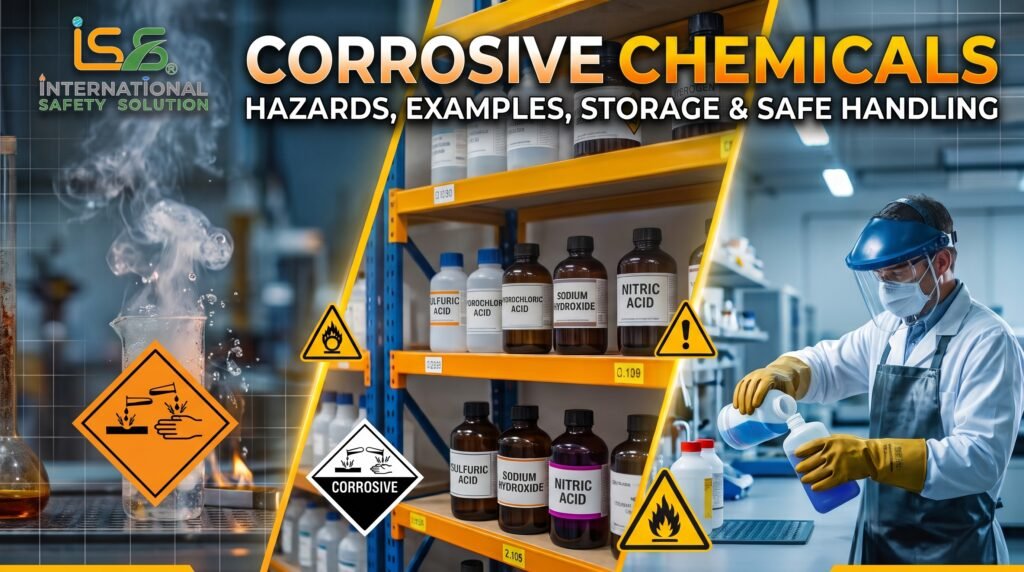
Corrosive chemicals are hazardous substances that can cause serious damage to living tissues and materials through chemical action. Contact with these substances can result in severe skin burns, permanent eye damage, respiratory injuries and corrosion of metals and equipment. They are commonly used in manufacturing, laboratories, construction, cleaning operations, water treatment, textile processing and other industrial activities.
Corrosive chemicals may be present as liquids, solids, gases or vapours. Their effects depend on the chemical’s properties, concentration, exposure duration, route of exposure and the conditions in which it is used.
Strong acids and alkalis are among the most familiar corrosive substances. However, not all corrosive chemicals are acids or bases, and some substances may present additional hazards such as toxicity, flammability or reactivity.
Understanding corrosive chemicals is therefore essential for health and safety professionals, employers and workers who are responsible for chemical storage, handling, transportation and emergency response.
1. What Are Corrosive Chemicals?
Corrosive chemicals are substances capable of destroying or causing irreversible damage to living tissue through chemical action at the point of contact.
They can affect:
- Skin: Causing chemical burns, tissue destruction and permanent scarring.
- Eyes: Causing severe irritation, corneal damage and permanent loss of vision.
- Respiratory system: Damaging the nose, throat and lungs when corrosive gases, vapours, mists or dusts are inhaled.
- Digestive system: Causing serious internal injuries if swallowed.
- Metals and equipment: Corroding surfaces, pipelines, storage tanks and machinery.
Corrosive substances are commonly associated with very low pH values in the case of strong acids or very high pH values in the case of strong alkalis. However, pH alone is not sufficient to determine every chemical’s corrosive hazard. The substance’s full chemical properties and hazard classification must also be considered.
According to OSHA’s hazard communication guidance, corrosive substances can cause visible destruction or irreversible changes in living tissue at the site of contact.
2. Types of Corrosive Chemicals
Corrosive chemicals can be divided into several categories according to their chemical properties.
2.1 Corrosive Acids
Acids are substances that can release hydrogen ions in aqueous solutions. Strong acids can cause severe chemical burns and damage metals and other materials.
Common examples include:
- Sulphuric Acid (H₂SO₄): Used in battery manufacturing, petroleum refining and chemical production.
- Hydrochloric Acid (HCl): Used in metal cleaning, pickling operations and industrial cleaning.
- Nitric Acid (HNO₃): Used in fertiliser manufacturing, metal treatment and chemical production. It is also a strong oxidising agent.
- Phosphoric Acid (H₃PO₄): Used in fertiliser production, food processing and metal treatment.
- Hydrofluoric Acid (HF): Used in specialised industrial processes, including glass treatment and certain metal-processing applications.
- Acetic Acid: Concentrated forms can be corrosive and are used in chemical manufacturing and industrial applications.
The corrosive strength and additional hazards of these acids vary. For example, nitric acid is both corrosive and oxidising, while hydrofluoric acid presents a particularly serious systemic toxicity hazard in addition to its corrosive effects.
2.2 Corrosive Alkalis and Bases
Alkalis are bases that dissolve in water and can cause serious chemical burns. Strong alkalis can penetrate tissue deeply and may cause extensive damage.
Examples include:
- Sodium Hydroxide (NaOH): Also known as caustic soda, used in soap manufacturing, cleaning products and chemical processing.
- Potassium Hydroxide (KOH): Used in chemical manufacturing, batteries and industrial cleaning.
- Calcium Hydroxide [Ca(OH)₂]: Also known as hydrated lime, used in construction, water treatment and industrial processes.
- Ammonium Hydroxide (NH₄OH): Aqueous ammonia solution used in cleaning and chemical applications.
Strong alkalis can be particularly dangerous because tissue damage may continue below the surface of the skin.
2.3 Corrosive Gases and Vapours
Some gases and vapours can cause severe damage to the respiratory system, eyes and skin.
Examples include:
- Hydrogen chloride gas.
- Ammonia.
- Sulphur dioxide.
- Nitrogen dioxide.
- Chlorine.
The exact health effects depend on the gas, its concentration and the duration of exposure. Some of these gases also have significant toxic or oxidising properties.
2.4 Corrosive Solids
Corrosive chemicals are not limited to liquids. Certain solid substances can cause serious burns when they come into contact with moisture on the skin or in the eyes.
Examples include:
- Sodium hydroxide flakes.
- Potassium hydroxide pellets.
- Certain corrosive metal salts.
- Some strongly alkaline cleaning compounds.
Corrosive dust can also become airborne during handling, creating inhalation and eye-exposure hazards.
3. The GHS Corrosion Pictogram
The Globally Harmonized System of Classification and Labelling of Chemicals (GHS) uses a specific pictogram to identify certain corrosive hazards.
The GHS corrosion pictogram shows two test tubes pouring liquid onto a metal surface and a human hand, illustrating damage to metals and living tissue.
It is used for relevant classifications, including:
- Skin corrosion.
- Serious eye damage.
- Corrosive to metals.
<image-placeholder>Suggested visual: GHS corrosion pictogram – black test tubes pouring liquid onto a hand and metal surface inside a red diamond.</image-placeholder>
The pictogram is accompanied by appropriate hazard statements and precautionary statements. For example, a skin-corrosion classification may carry the hazard statement:
“Causes severe skin burns and eye damage.”
Workers should understand the meaning of chemical labels and never handle a substance without first checking its hazard information.
4. Major Hazards Associated with Corrosive Chemicals
Corrosive chemicals can create serious health, safety and operational risks.
4.1 Chemical Burns to the Skin
Direct contact with corrosive substances can destroy skin tissue and cause chemical burns.
The severity of injury depends on:
- Chemical concentration.
- Duration of contact.
- Quantity of the chemical.
- Area of skin exposed.
- Chemical-specific properties.
Some alkalis can penetrate deeper into tissue, while certain acids can cause rapid and severe surface damage.
4.2 Serious Eye Damage
Corrosive splashes can cause severe eye injuries, including permanent damage to the cornea and loss of vision.
Eye exposure may occur during:
- Chemical transfer.
- Mixing and dilution.
- Cleaning operations.
- Equipment maintenance.
- Handling damaged containers.
Suitable chemical splash goggles and, where required, additional face protection should be used.
4.3 Respiratory Injuries
Inhaling corrosive gases, vapours, mists or dusts can damage the respiratory tract.
Potential effects include:
- Coughing.
- Breathing difficulties.
- Throat and nasal irritation.
- Chemical burns to respiratory tissues.
- Serious lung injury.
Appropriate ventilation and exposure controls are essential when handling chemicals capable of releasing hazardous airborne substances.
4.4 Internal Chemical Injuries
Accidental ingestion of corrosive chemicals can cause severe injuries to the mouth, throat, oesophagus and stomach.
Ingestion can occur through contaminated hands, food, drinks or incorrect chemical handling practices.
Food and beverages must never be stored or consumed in chemical handling and storage areas.
4.5 Corrosion of Equipment and Infrastructure
Corrosive substances can damage industrial equipment, storage tanks, pipelines, valves, floors and structural components.
Equipment deterioration may result in:
- Leakage and chemical spills.
- Failure of pipelines and storage vessels.
- Damage to protective coatings.
- Equipment breakdown.
- Secondary exposure and environmental contamination.
Selecting chemically compatible construction and storage materials is therefore an important safety consideration.
4.6 Chemical Reactions and Secondary Hazards
Corrosive substances may react dangerously with incompatible chemicals.
For example:
- Acids reacting with certain metals may release flammable hydrogen gas.
- Acids reacting with cyanide-containing substances can release highly toxic hydrogen cyanide.
- Acids reacting with sulphide-containing substances can release toxic hydrogen sulphide.
- Mixing acids and alkalis can generate considerable heat.
- Certain corrosive substances may react with organic materials or oxidising agents.
Chemical compatibility must always be checked before mixing, transferring or storing substances together.
5. Factors Affecting the Severity of Corrosive Chemical Exposure
The extent of injury caused by corrosive chemicals depends on several factors.
Chemical concentration: More concentrated solutions may cause more severe damage, although even dilute solutions can be hazardous depending on the substance.
Exposure duration: Longer contact generally increases the potential for tissue damage.
Temperature: Higher temperatures may increase the severity of certain chemical exposures and reactions.
Physical form: Liquids can splash, solids can produce hazardous dust, and gases or vapours can spread through the workplace.
Chemical properties: Different corrosive substances affect living tissues in different ways.
Route of exposure: Skin contact, eye contact, inhalation and ingestion can produce different types of injury.
A proper risk assessment should consider all these factors before work begins.
6. Safe Storage of Corrosive Chemicals
Correct storage arrangements are essential to prevent leaks, incompatible chemical reactions and accidental exposure.
6.1 Segregate Acids and Alkalis
Acids and alkalis should generally be stored separately because accidental mixing can generate significant heat and cause splashing or other hazardous reactions.
Use designated storage cabinets or areas with appropriate segregation and secondary containment.
6.2 Separate Incompatible Chemicals
Chemical segregation must be based on compatibility information rather than simply grouping substances under the general category of corrosives.
Examples of important segregation considerations include:
- Oxidising acids, such as nitric acid, require separation from incompatible organic materials and other substances.
- Acids should be kept away from cyanides and sulphides that could release toxic gases if mixed.
- Corrosive substances should be separated from incompatible flammable materials.
- Alkalis should be segregated from acids and other incompatible chemicals.
- Hydrofluoric acid requires specialised storage arrangements and compatible containers.
Always consult the SDS and a suitable chemical compatibility chart.
6.3 Use Compatible Storage Containers
Storage containers must be suitable for the chemical’s concentration, temperature and other conditions.
Some corrosive chemicals can damage ordinary metals, plastics or glass. Hydrofluoric acid, for example, attacks glass and requires specially compatible storage materials.
6.4 Provide Secondary Containment
Secondary containment helps prevent leaked chemicals from spreading beyond the storage area.
Suitable arrangements may include:
- Chemical-resistant trays.
- Bunded storage areas.
- Compatible spill containment systems.
- Separate containment for incompatible chemical groups.
Secondary containment materials must also be chemically compatible with the substances being stored.
6.5 Store Containers Safely
Containers should be:
- Clearly labelled.
- Properly closed when not in use.
- Stored upright where required.
- Protected from physical damage.
- Kept away from incompatible substances.
- Inspected regularly for leaks and deterioration.
Liquid corrosives should generally be stored on low-level shelving to reduce the risk of splashes to the face and eyes.
6.6 Maintain Appropriate Environmental Conditions
Follow the manufacturer’s instructions regarding temperature, ventilation, sunlight and moisture.
Storage areas should be designed to prevent unauthorised access and minimise the consequences of accidental releases.
7. Safe Handling of Corrosive Chemicals
Safe handling procedures reduce the likelihood of chemical exposure, splashes and accidental reactions.
Important precautions include:
- Read the Safety Data Sheet: Understand the chemical’s hazards, exposure controls, first-aid requirements and incompatibilities.
- Conduct a risk assessment: Identify possible exposure routes and establish suitable control measures.
- Use the smallest practical quantity: Avoid unnecessary storage and handling of large quantities.
- Use suitable transfer equipment: Ensure pumps, hoses, containers and tools are chemically compatible.
- Avoid direct contact: Never handle corrosive substances with bare hands.
- Prevent splashes: Use controlled transfer techniques and suitable splash protection.
- Keep containers closed: Close containers immediately after dispensing.
- Avoid uncontrolled mixing: Never mix chemicals unless the procedure has been assessed and authorised.
- Maintain good hygiene: Wash hands after handling and prohibit eating or drinking in chemical work areas.
- Ensure emergency facilities are available: Provide suitable eyewash and emergency shower facilities where exposure is possible.
Important Precaution When Diluting Acids
When a procedure requires dilution of concentrated acid with water, the general safety rule is:
Always add acid slowly to water, never water to concentrated acid.
The dilution process can release significant heat. Adding water to concentrated acid may cause localised boiling and violent splashing.
Use an approved procedure, suitable equipment and appropriate protective measures. Follow chemical-specific instructions where they differ.
8. Personal Protective Equipment (PPE)
Personal protective equipment provides an additional layer of protection when working with corrosive chemicals.
PPE should be selected according to the chemical’s properties, concentration, exposure potential and task requirements.
8.1 Chemical-Resistant Gloves
Gloves must be compatible with the chemical being handled.
The selection should consider:
- Chemical breakthrough time.
- Permeation resistance.
- Degradation resistance.
- Glove thickness and condition.
- Duration of the task.
No single glove material protects against every corrosive chemical.
8.2 Chemical Splash Goggles
Chemical splash goggles protect the eyes from splashes and droplets.
Ordinary spectacles or basic safety glasses may not provide adequate protection where significant chemical splash hazards exist.
8.3 Face Shield
A face shield provides additional protection to the face during activities such as chemical transfer, mixing and handling of concentrated corrosive substances.
A face shield should not be treated as a replacement for suitable eye protection.
8.4 Protective Clothing and Aprons
Chemical-resistant aprons, coveralls and protective footwear may be necessary to prevent contact with corrosive liquids and contaminated surfaces.
The materials must be selected according to the chemical compatibility requirements.
8.5 Respiratory Protection
Where hazardous gases, vapours, mists or dusts may be present, engineering controls and suitable ventilation should be prioritised.
If respiratory protection is required, it must be selected through an appropriate assessment and used as part of a suitable respiratory protection programme.
9. Engineering and Administrative Control Measures
Organisations should implement a combination of engineering and administrative controls to minimise exposure.
Engineering Controls
- Local exhaust ventilation.
- Chemical-resistant storage cabinets.
- Enclosed chemical transfer systems.
- Automated dispensing equipment.
- Chemical-resistant pipelines and fittings.
- Suitable secondary containment.
- Emergency eyewash stations and safety showers.
- Leak detection and monitoring systems where appropriate.
Administrative Controls
- Written safe operating procedures.
- Chemical inventory management.
- Safety Data Sheet availability.
- Chemical compatibility assessments.
- Employee training and competency checks.
- Regular inspection and maintenance.
- Restricted access to chemical storage areas.
- Emergency response and evacuation procedures.
The hierarchy of controls should guide decisions. Where possible, eliminate or substitute a hazardous corrosive chemical with a less hazardous alternative before relying primarily on PPE.
10. Emergency Response and First Aid
Emergency response arrangements must be established before corrosive chemicals are used or stored.
The correct response depends on the chemical involved. Always follow the SDS, workplace emergency procedure and instructions from medical professionals.
10.1 Skin Contact
If a corrosive chemical comes into contact with the skin:
- Immediately use the emergency shower or suitable running water.
- Remove contaminated clothing, footwear and jewellery while rinsing, where safe to do so.
- Flush the affected area thoroughly in accordance with the SDS and emergency procedure.
- Seek urgent medical assessment for corrosive exposure.
Do not attempt to neutralise a chemical on the skin using another chemical, as this can generate heat and worsen the injury.
10.2 Eye Contact
If a corrosive chemical enters the eyes:
- Immediately use an eyewash station.
- Hold the eyelids open and rinse continuously.
- Continue flushing according to the SDS and medical guidance.
- Remove contact lenses if easy to do while rinsing.
- Obtain urgent medical attention.
Do not delay irrigation while searching for additional equipment or assistance.
10.3 Inhalation
If a person inhales corrosive gases, vapours or mists:
- Move the person to fresh air only if it is safe to do so.
- Avoid entering a contaminated atmosphere without appropriate training and respiratory protection.
- Call emergency medical services.
- Seek immediate medical assessment.
10.4 Ingestion
If a corrosive chemical is swallowed:
- Seek emergency medical assistance or contact an appropriate poison information service immediately.
- Do not induce vomiting.
- Do not attempt to neutralise the chemical.
- Do not give food or drink unless directed by qualified medical personnel or the chemical-specific emergency instructions.
10.5 Chemical Spillage
For a corrosive chemical spill:
- Raise the alarm and restrict access.
- Isolate the affected area where appropriate.
- Avoid direct contact with the chemical.
- Inform trained emergency response personnel.
- Use the chemical-specific spill response procedure.
- Do not attempt neutralisation or clean-up unless trained, equipped and authorised to do so.
Some corrosive spills may also release toxic gases or react with spill-cleaning materials. Spill response must therefore be based on the specific chemical and its hazards.
11. Risk Assessment for Corrosive Chemicals
A risk assessment should be completed before corrosive chemicals are introduced into a workplace or used in an activity.
The assessment should identify:
| Hazard or risk factor | Control consideration |
| Skin and eye contact | Chemical-resistant gloves, goggles and suitable clothing |
| Inhalation of vapours or mists | Ventilation, enclosure and exposure assessment |
| Chemical spills | Suitable containment and spill response procedures |
| Incompatible chemicals | Segregated storage and compatibility checks |
| Container failure | Suitable materials, inspections and maintenance |
| Chemical transfer | Compatible equipment and controlled dispensing |
| Emergency exposure | Eyewash, safety shower and emergency arrangements |
| Human error | Training, supervision and written procedures |
The risk assessment should also consider the quantity and concentration of the chemical, frequency of use, number of workers exposed and potential consequences of equipment failure.
12. Responsibilities of Health and Safety Professionals
Health and safety professionals play a vital role in managing corrosive chemical hazards.
Their responsibilities include:
- Identifying corrosive substances used in the workplace.
- Maintaining an accurate chemical inventory.
- Reviewing Safety Data Sheets and chemical labels.
- Conducting risk assessments.
- Establishing safe storage and handling procedures.
- Ensuring chemical compatibility and segregation.
- Selecting suitable PPE and engineering controls.
- Arranging employee training and competency assessments.
- Inspecting chemical storage and handling facilities.
- Ensuring emergency showers and eyewash stations are maintained.
- Investigating chemical spills, exposures and near misses.
- Reviewing control measures and recommending improvements.
They should work with managers, supervisors, procurement teams and employees to ensure that corrosive chemical hazards are controlled throughout the chemical’s lifecycle.
13. Importance of Employee Training and Awareness
Employees must understand the hazards associated with the corrosive chemicals they use.
Training should include:
- Recognising corrosive hazard labels and pictograms.
- Understanding Safety Data Sheets.
- Identifying acids, alkalis and other corrosive substances.
- Understanding chemical compatibility.
- Following safe storage and handling procedures.
- Selecting and inspecting appropriate PPE.
- Using emergency showers and eyewash stations.
- Reporting leaks, spills and unsafe conditions.
- Following chemical-specific emergency response procedures.
Practical demonstrations and competency assessments can help employees apply these procedures correctly.
14. Conclusion
Corrosive chemicals present significant workplace hazards because they can cause severe skin burns, permanent eye damage, respiratory injuries and deterioration of equipment and infrastructure. Their risks can increase when chemicals are stored incorrectly, mixed with incompatible substances or handled without suitable protective measures.
Effective corrosive chemical management requires proper hazard identification, risk assessment, chemical segregation, compatible storage, appropriate PPE, engineering controls and employee training.
For health and safety professionals, controlling corrosive chemical hazards is an essential part of workplace risk management. By implementing safe systems of work and maintaining effective emergency arrangements, organisations can reduce chemical exposure, prevent serious injuries and create safer working environments.
Technical References and Further Reading
- OSHA – Hazard Communication: Hazard Classification Guidance for Manufacturers, Importers, and Employers. Explains the classification of skin-corrosive chemicals and the effects of corrosive substances on living tissue.
https://www.osha.gov/sites/default/files/publications/OSHA3844.pdf - OSHA – Hazard Communication Standard, Appendix C: Allocation of Label Elements. Provides GHS hazard pictograms, signal words, hazard statements and precautionary statements for skin corrosion and serious eye damage.
https://www.osha.gov/hazcom/appendix-c - OSHA – Acid and Caustic Solutions. Discusses workplace exposure risks and control measures for corrosive acids and alkalis, including ventilation, PPE and emergency flushing facilities.
https://www.osha.gov/semiconductors/solutions/acid-caustic - National Institutes of Health (NIH) – Chemical Safety Guide. Provides information on chemical segregation, storage compatibility and precautions for corrosive acids and bases.
https://ors.od.nih.gov/sr/ds/Documents/Chemical-Safety-Guide.pdf - International Labour Organization (ILO) – Transport and Storage of Dangerous Substances. Provides general information about corrosive substances, including acids, bases and other corrosive materials.
https://webapps.ilo.org/static/english/protection/safework/cis/products/safetytm/transpo.htm
John A. Davenport – Chapter 4: Storage and Handling of Chemicals, particularly the section on Combustible Chemicals, including Carbon Black, Lamp Black, Lead Sulfocyanate, Nitroaniline, Nitrochlorobenzene, Sulfides, Sulfur and Naphthalene (supplied pages 7-48 and 7-49).