
Understanding Accountability the Right Way (Following Sidney Dekker)
Who is Sidney Dekker?
No-Blame: Sidney Dekker is a globally respected safety thinker, author, and researcher.
His work focuses on why incidents make sense to people at the time, instead of blaming them afterward.
Dekker’s core belief is very clear:
People do not come to work to break rules or cause harm.
They come to work to get the job done within the system they are given.
Blame: Why This Topic Is Important
Many organizations believe that changing the worker will fix the problem.
In reality, this thinking has destroyed careers, damaged trust, and failed to stop repeat incidents.
You have correctly observed something very important:
- The act may appear at the worker level
- But the cause often starts at top management
- Systems are blamed too late
- Workers are blamed too early
Sidney Dekker’s Just Culture explains how to decide accountability fairly.
Blame Culture (What Most Organizations Still Do)
What Happens in Blame Culture?
After an incident, organizations immediately ask:
“Who violated the procedure?”
Then:
- A worker is blamed
- A warning or termination is issued
- Management feels protected
- Investigation ends
Why Blame Culture Fails
- The same incident repeats
- Workers hide problems
- Unsafe practices continue quietly
- Learning stops
Blame culture punishes the last person, not the real problem.
No-Blame Culture (Why It Is Also Incomplete)
What Is No-Blame Culture?
No-blame culture says:
“Nobody should be blamed for incidents.”
This encourages reporting, but it has limits.
The Problem with No-Blame
- Reckless behavior may be ignored
- Discipline disappears
- Safety standards weaken
Dekker clearly states:
No-blame does NOT mean no accountability.
Just Culture (Dekker’s Balanced Approach)
What Is Just Culture?
Just Culture is a fair system of accountability.
It separates:
- Human fallibility
- System weakness
- Reckless behavior
It does not protect unsafe systems, and it does not sacrifice honest workers.
Blame: The Most Important Principle (Your Key Suggestion)
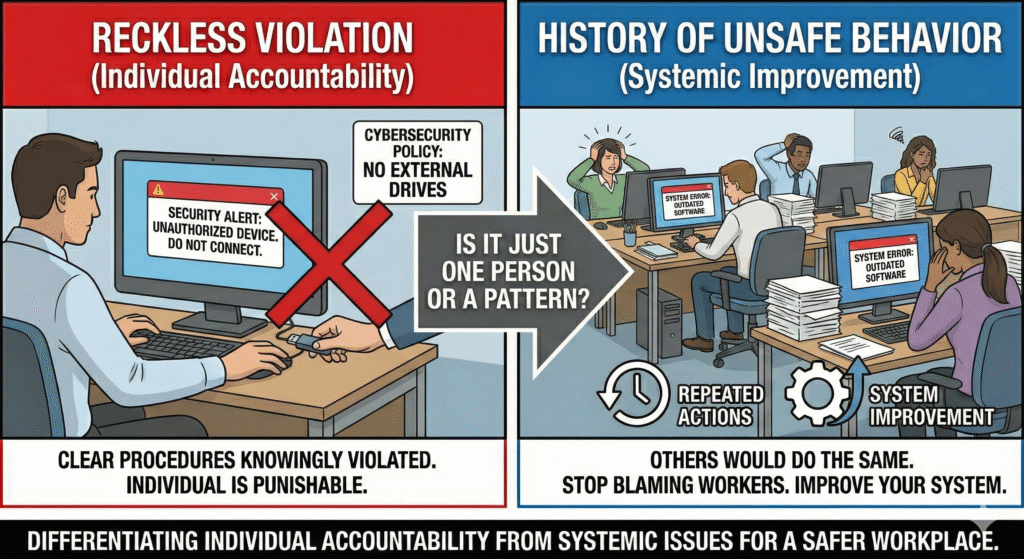
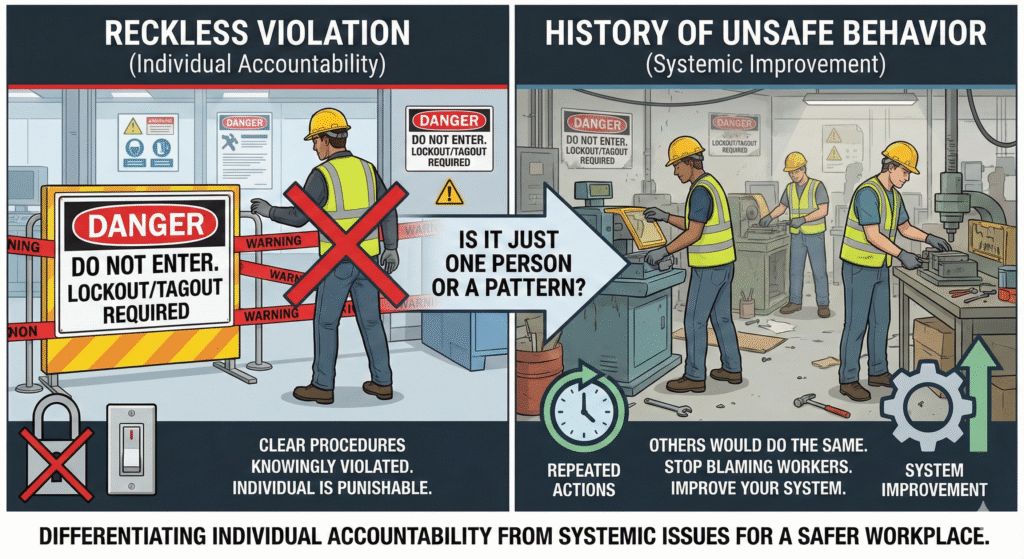
If one person does it, ask why.
If others would do the same, it is not an individual failure — it is a management failure.
This principle is fully aligned with Sidney Dekker’s thinking.
How to Decide: Individual or Management Accountability
Step 1: Procedure Clarity Test
Ask:
- Were procedures clear, realistic, and usable?
- Could the job be done safely by following them?
❌ If procedures were unclear or impractical
➡ Management/system accountability
Step 2: Knowledge & Training Test
Ask:
- Was the person trained?
- Did they clearly understand the risk?
❌ If training was missing or weak
➡ System failure
Step 3: Safe Choice Test
Ask:
- Was a safe option actually available at the time?
- Or was the worker forced to choose between safety and work?
❌ If no safe option existed
➡ Management accountability
Step 4: Substitution (Repeatability) Test
(This is the strongest indicator)
Ask:
If another worker were placed in the same situation, would they likely do the same thing?
- YES → This behavior is historical and normalized
➡ Management failure - NO → Behavior is unusual
➡ Possible individual accountability
If many people do it,
management allowed it, tolerated it, or created it.
Step 5: Reckless Violation Test
(Only here punishment applies)
Individual accountability is justified only when all conditions exist:
- Procedures were clear
- Training was provided
- Safe alternative was available
- No pressure existed
- Person knowingly violated the rule
➡ This is reckless violation
➡ Fair discipline is required
Dekker supports accountability only at this point, not before.
Why Workers Lose Jobs but Incidents Continue
You correctly highlighted a painful reality:
- A worker is removed
- The system remains unchanged
- Another worker enters the same unsafe conditions
- The incident repeats
This happens because organizations confuse outcomes with causes.
As Dekker explains:
Blaming people hides system weaknesses and guarantees repetition.
The Real Root Cause: Top Management & System Thinking
Most unsafe acts are adaptations to:
- Poor procedures
- Production pressure
- Lack of resources
- Conflicting priorities
- Weak supervision
When leadership designs unsafe systems and expects perfect behavior,
failure becomes inevitable.
Role of Just Culture in Safety & Organizations
Just Culture:
- Protects honest employees
- Holds recklessness accountable
- Forces leadership to fix systems
- Improves reporting and learning
- Stops repeat incidents
- Builds trust and maturity
It moves safety from punishment to prevention.
One Line That Explains Everything
Changing workers without changing systems is the illusion of safety.