

What Is an Emergency Response Team (ERT)?
An Emergency Response Team (ERT) is a group of trained employees assigned specific roles to manage workplace emergencies until the situation is controlled or external emergency services arrive. The ERT operates under a defined Emergency Response Plan (ERP) and follows recognized safety and legal standards. Its primary objective is to protect life, property, the environment, and business continuity.
How to Develop an Effective Emergency Response Team
Step 1: Identify Potential Emergency Scenarios
Before forming an ERT, management must conduct a detailed risk assessment to identify credible emergency situations such as fire and explosion, medical emergencies, chemical or gas leakage, electrical accidents, structural collapse, and natural disasters like earthquakes or floods. The nature and severity of risks determine the size, skills, and structure of the ERT.
Step 2: Define ERT Structure and Roles
An effective ERT must have clearly defined roles to prevent confusion during emergencies. Common roles include Incident Controller or ERT Leader, Firefighting Team, First Aid Team, Evacuation and Muster Point Team, Search and Rescue Team, and Communication and Coordination Team. Each role must have written responsibilities and clear authority.
Step 3: Select Suitable Individuals
ERT members should be selected based on physical fitness and medical clearance, mental alertness, ability to remain calm under pressure, willingness to take responsibility, job location and shift coverage, and basic literacy and communication skills. Selection should never be random or based purely on seniority.
Step 4: Provide Competency-Based Training
ERT training must be role-specific and include firefighting and extinguisher handling, first aid and CPR, emergency evacuation procedures, use of PPE and emergency equipment, and incident communication and reporting. Refresher training should be conducted at least annually.
Step 5: Conduct Drills and Mock Exercises
Regular drills help test team coordination, identify gaps in emergency response, improve employee awareness, and ensure compliance with legal and certification requirements. Drills should simulate realistic emergency scenarios rather than being treated as paperwork exercises.
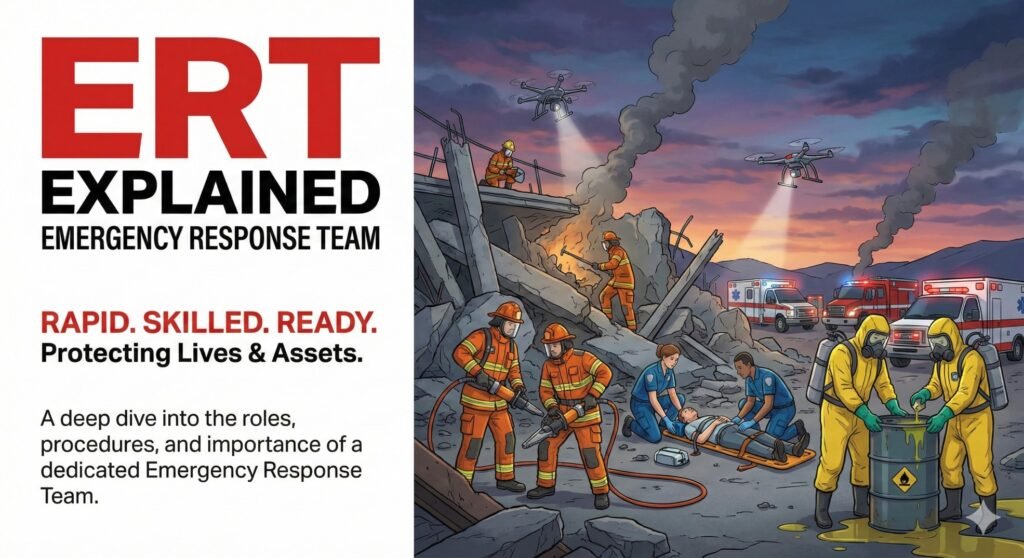
How an Emergency Response Team Helps Prevent Losses
A properly trained and active ERT significantly reduces loss of life through rapid evacuation and first aid, minimizes property damage through early fire control and isolation, reduces business interruption by controlling incidents quickly, limits environmental damage through spill containment, and lowers legal and regulatory penalties by ensuring compliance. Most major disasters escalate due to delayed or uncoordinated response, which an ERT is designed to prevent.
How an ERT Functions During an Emergency
When an emergency occurs, it is first identified and reported by any employee. The alarm is activated, and ERT members immediately mobilize to their assigned positions. The firefighting team controls the fire if safe, the first aid team assists injured persons, and the evacuation team clears the affected areas. The Incident Controller assesses the severity of the situation and decides whether external emergency services are required. After the situation is controlled, an all-clear is issued and incident reports are prepared for corrective and preventive action.
Role of ERT in Safety Management Systems
ERT plays a vital role in emergency preparedness and response under ISO 45001 and ISO 14001, compliance with fire and labor laws, strengthening employee confidence and safety culture, supporting NEBOSH, OSHA, and ISO audits, and reducing the severity of workplace accidents. An ERT is not just a response mechanism but a proactive safety control.
Manager’s Role in Building an Effective ERT
Managers are responsible for selecting ERT members based on risk exposure and workplace layout, ensuring coverage across all shifts, departments, weekends, and holidays, officially appointing and empowering ERT members with authority during emergencies, and monitoring ERT performance through drills, incident reviews, and audit findings.
Example of an ERT Structure in a Manufacturing Facility
In a manufacturing facility with 150 employees, three production blocks, a warehouse, and an administrative office, a typical ERT structure may include one Incident Controller, six firefighting team members, four first aiders, six evacuation and muster point wardens, four search and rescue members, and two communication coordinators. Each member has a defined role, training record, PPE allocation, and emergency responsibility.
Conclusion
An Emergency Response Team is not a formality but a critical life-saving system. Organizations that invest in proper ERT development reduce losses, improve legal compliance, and strengthen their overall safety culture. For management, building and maintaining a competent ERT is both a legal obligation and a moral responsibility.