
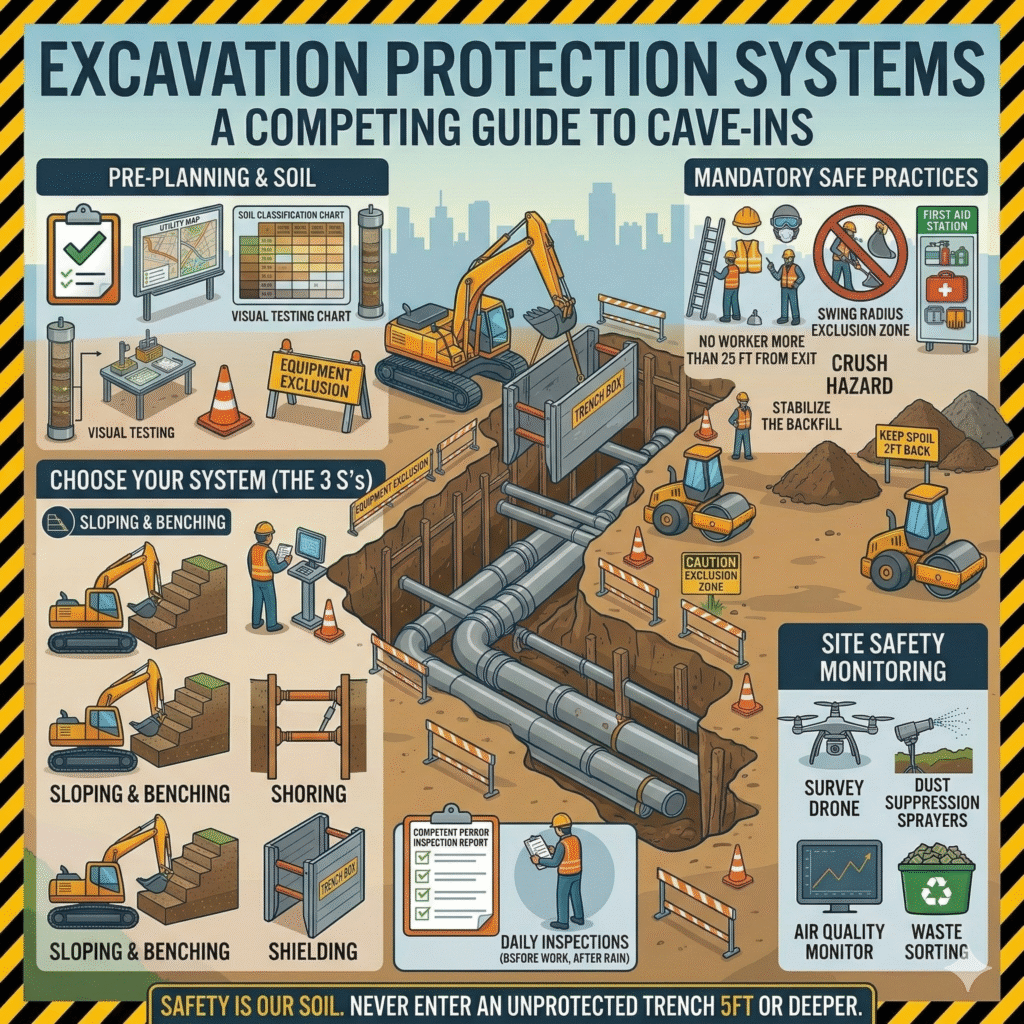
Excavation work creates serious hazards such as trench collapse, falling materials, and equipment accidents. Therefore, protective systems are used to prevent soil collapse and protect workers inside excavations or trenches. Safety authorities such as Occupational Safety and Health Administration recommend several protection methods for excavation work.
Below are the main excavation protection systems used in construction.
- Sloping
Sloping means cutting the sides of the excavation at an angle away from the trench instead of keeping them vertical. This reduces pressure on the trench walls and prevents soil collapse.
Example
Instead of a straight vertical wall, the soil is cut in a gradual slope shape.
Advantages
Reduces risk of trench collapse
Simple and cost-effective method
No special equipment required
Control Points
Slope angle depends on soil type (stable or loose soil).
A competent person should inspect the excavation before work begins.
- Benching
Benching means creating step-like levels (horizontal steps) on the sides of the excavation.
This technique divides the vertical height of soil into smaller sections, which reduces the risk of soil sliding.
Types of Benching
Single Bench
Multiple Bench
Advantages
Improves stability of excavation walls
Reduces soil pressure
Provides safer access for workers
- Shoring
Shoring is a support system that uses hydraulic supports, timber, or metal structures to hold the trench walls and prevent soil collapse.
Types of Shoring
Hydraulic shoring
Timber shoring
Mechanical shoring
Advantages
Provides strong support for trench walls
Suitable for deep excavations
Reduces risk of trench failure
- Shielding (Trench Box)
Shielding involves using a trench box or trench shield to protect workers from soil collapse.
A trench box does not prevent soil from collapsing, but it protects workers inside the trench if collapse occurs.
Advantages
High level of worker protection
Easy to install and move
Suitable for pipeline installation projects
- Barricading and Edge Protection
Excavation areas should be protected to prevent workers or equipment from falling into the trench.
Control Measures
Install warning barricades or guardrails around the excavation.
Use warning signs and hazard tape.
Provide adequate lighting at night.
- Safe Access and Egress
Workers must have safe entry and exit from the excavation.
Control Measures
Provide ladders, ramps, or stairs.
Ladders should be placed every 7.5 meters (25 feet) in trenches.
Ladders must extend at least 1 meter above the edge of the trench.
- Water Control
Water accumulation can weaken soil and increase the risk of collapse.
Control Measures
Use dewatering pumps.
Provide proper drainage systems.
Stop work during heavy rain if excavation becomes unstable.
✅ Conclusion
Excavation protection systems are essential to prevent accidents and ensure worker safety. Methods such as sloping, benching, shoring, and shielding help control soil collapse, while additional safety measures like barricading, safe access, and water control further reduce risks. Proper supervision and inspection by a competent person are critical for maintaining a safe excavation environment.