
Introduction
Safety Culture Maturity describes how deeply health, safety, and environmental (HSE) values are embedded into an organization’s daily operations, leadership decisions, and workforce behavior.
HSE Safety Culture Maturity Models provide a structured roadmap that helps organizations move from basic legal compliance to a proactive and continuously improving safety culture. These models are widely used across construction, oil & gas, manufacturing, power, and infrastructure projects to assess current culture, identify gaps, and drive long-term behavioural change.
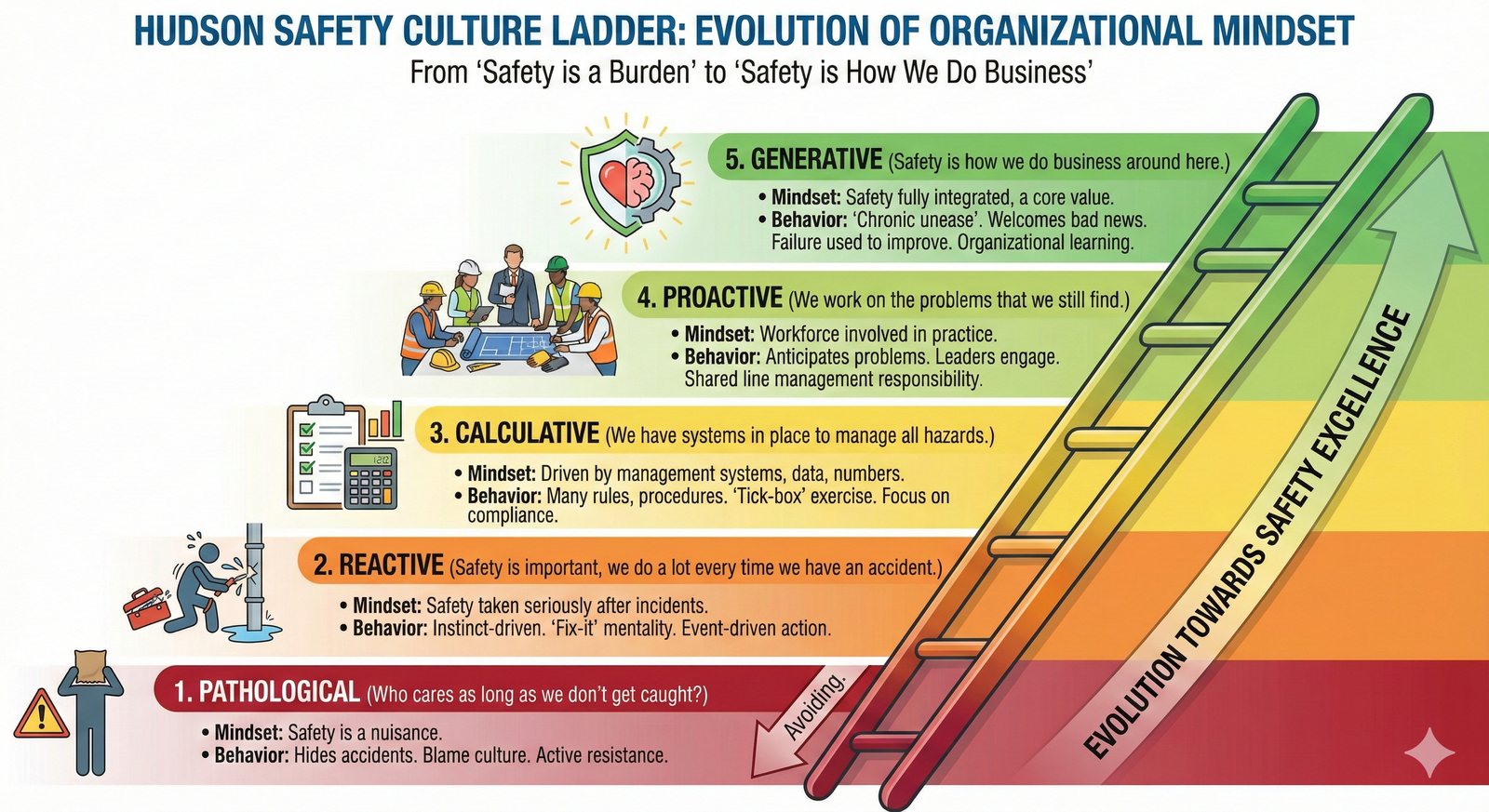
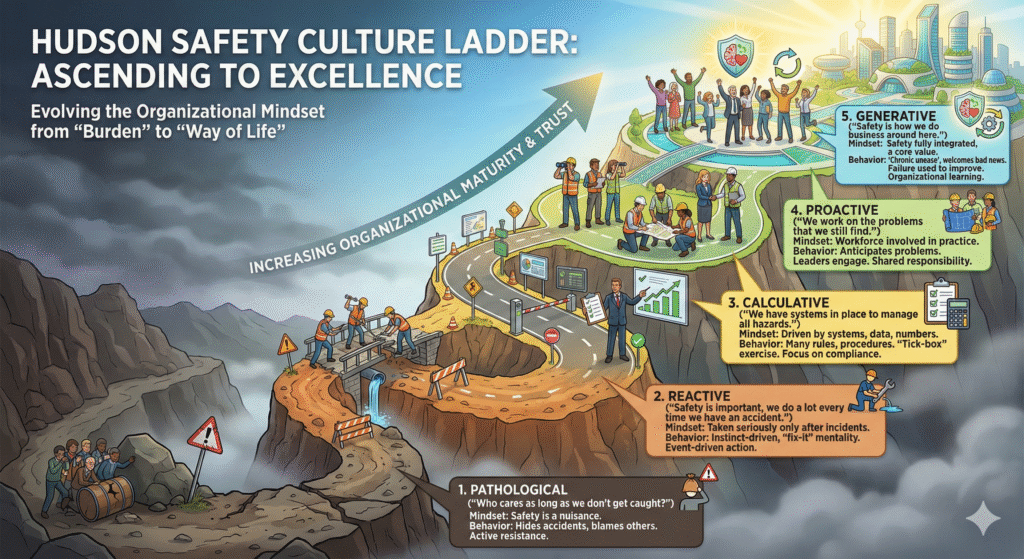
Most recognized frameworks—including the Hudson Safety Culture Maturity Model—define five progressive maturity levels, each representing a distinct mindset toward safety.
Level 01: Emerging (Reactive / Original)
Definition
At the Emerging level, safety exists mainly to satisfy legal or client requirements. It is often viewed as a cost or obligation, not a core value. Incidents are considered inevitable, and production is frequently prioritized over safety.
Key Characteristics
- Basic compliance-focused safety procedures
- Low leadership visibility in safety matters
- Incident reporting is weak or discouraged
- Safety is seen as the safety department’s responsibility
- Reactive response after accidents
Implementation Focus
Organizations at this level should focus on:
- Establishing basic HSE policies and procedures
- Visible leadership commitment to safety
- Mandatory safety induction and training
- Simple incident and near-miss reporting systems
Level 02: Managing (Compliance-Driven / Starting)
Definition
At the Managing level, organizations recognize safety as a risk to be controlled. Formal HSE systems are introduced, but safety performance is still driven mainly by rules and enforcement rather than values or engagement.
Key Characteristics
- Documented HSE systems and procedures
- Management-led compliance enforcement
- Heavy reliance on lagging indicators (LTIs, TRIR)
- Incident investigations focus on rule violations
- Limited employee ownership
Implementation Focus
To progress further, organizations should:
- Improve leadership involvement beyond paperwork
- Enhance quality of incident investigations
- Shift focus from blame to learning
- Begin engaging workers in safety discussions
Level 03: Involving (Responsive / Development)
Definition
At this stage, safety becomes everyone’s responsibility. Employees actively participate in identifying hazards and improving workplace safety. The organization moves beyond compliance toward engagement.
Key Characteristics
- Shared safety responsibility across workforce
- Improved safety communication and feedback
- Root cause analysis used in incident investigations
- Structured safety training programs
- Active hazard identification and reporting
Implementation Focus
Organizations should:
- Empower workers through safety committees
- Conduct regular toolbox talks and safety meetings
- Implement HIRA and Job Safety Analysis (JSA)
- Introduce behavioural safety awareness training
Level 04: Cooperating (Proactive / Completion)
Definition
At the Cooperating level, safety is proactively managed. Risks are identified and controlled before incidents occur. Leadership and employees collaborate across departments to continuously improve safety performance.
Key Characteristics
- Safety integrated into operational decisions
- Routine pre-task risk assessments
- Strong cross-functional collaboration
- Use of leading indicators (near misses, trends)
- Proactive hazard controls
Implementation Focus
To strengthen maturity at this level:
- Use predictive and leading safety metrics
- Conduct behavioural and system audits
- Recognize proactive safety behaviour
- Embed safety objectives into business strategy
Level 05: Continually Improving (Generative / Leading)
Definition
At the highest maturity level, safety is a core organizational value, equal to productivity and quality. Continuous learning, innovation, and shared accountability define the culture.
Key Characteristics
- Safety embedded in all business processes
- Everyone feels responsible for safety outcomes
- Continuous learning from near misses
- Advanced use of predictive safety data
- Strong leadership-driven safety culture
Implementation Focus
Leading organizations focus on:
- Continuous improvement systems
- Safety leadership development
- Regular culture surveys and maturity assessments
- Integration of safety into strategic planning
How Industries Implement Safety Culture Maturity Models
1. Assessment and Benchmarking
Organizations begin with safety culture assessments using surveys, interviews, audits, and performance data to determine their maturity level and priority gaps.
2. Tailored Improvement Plans
Action plans are aligned with the current maturity level:
- Levels 1–2: Compliance, leadership visibility, system foundations
- Levels 3–4: Behavioural safety, employee involvement, proactive risk control
- Level 5: Continuous learning and innovation
3. Leadership Commitment
Visible leadership engagement is the single most critical factor in advancing maturity—especially beyond Level 2.
4. Measurement and KPIs
Balanced scorecards include:
- Near-miss reporting rates
- Hazard closure timelines
- Safety observations
- Safety culture survey results
5. Training and Communication
Ongoing training, toolbox talks, and safety communications reinforce expectations and strengthen safety behaviour at all levels.
Conclusion
The HSE Safety Culture Maturity Model provides a clear, structured path from reactive compliance to a generative, continuously improving safety culture. By understanding each maturity level and applying targeted leadership actions, employee engagement strategies, and effective measurement systems, organizations can significantly reduce risk, enhance performance, and embed safety into everyday operations.
One Response
I enjoy your blogs. Such genius work and exposure!