
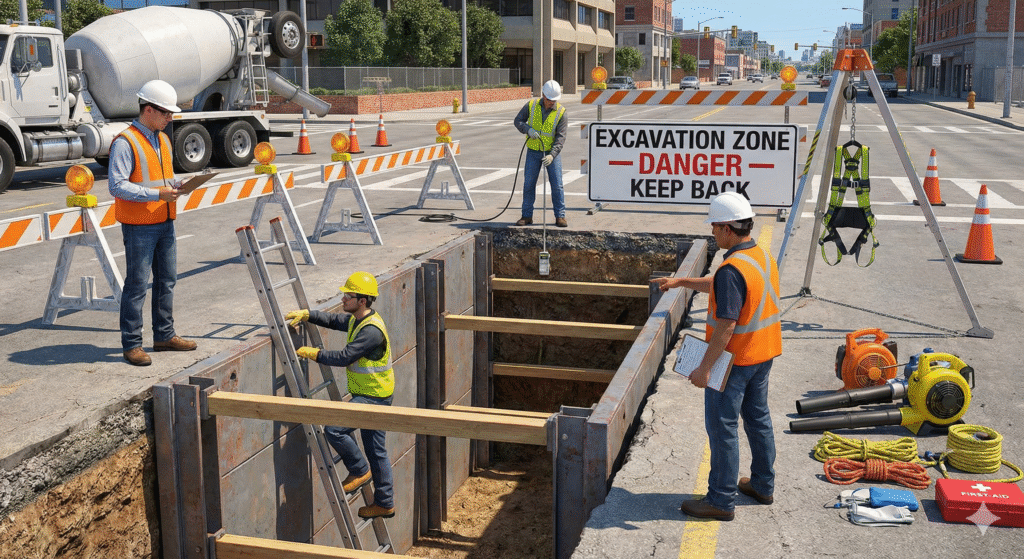
Excavation work is one of the highest-risk construction activities due to the potential for ground collapse, falls, engulfment, and striking utilities. Protective systems in excavation are engineering and administrative controls designed to prevent injury, fatalities, and property damage. International standards require that excavations deeper than specific limits must be protected using approved methods based on soil classification, depth, width, water conditions, and adjacent loads.
Excavation vs Trench (Technical Difference)
Aspect: Excavation
Definition: Any man-made cut, cavity, or depression in the earth
Width: Any width
Examples: Basements, foundations, pits
Risk Profile: Variable
Aspect: Trench
Definition: A narrow excavation
Width: Width ≤ depth, max 4.6 m (15 ft)
Examples: Utility lines, pipelines
Risk Profile: Higher collapse risk due to narrow geometry
Note: Every trench is an excavation, but not every excavation is a trench.
When Protection Is Mandatory
According to OSHA 29 CFR 1926 Subpart P:
Protection is required for excavations ≥1.5 m (5 ft) deep.
Shallower excavations also require protection if soil is unstable or water is present.
Major Excavation Hazards
- Cave-in / Soil Collapse
Responsible for the majority of excavation fatalities.
Failure modes: shear failure, sloughing, tension cracks. - Falls of Persons and Materials
Unprotected edges lead to falls from height.
Loose spoil may fall into excavation. - Water Ingress
Rain, groundwater, or broken utilities reduce soil shear strength. - Underground Services
Contact with gas, electric, water, fiber-optic lines. - Atmospheric Hazards
Oxygen deficiency, toxic gases in deep or confined excavations.
Types of Protection Used in Excavation
1. Sloping
Sloping involves cutting back excavation walls at an angle away from the excavation.
Typical sloping ratios (OSHA):
Type A soil: ¾:1 (≈53°)
Type B soil: 1:1 (45°)
Type C soil: 1½:1 (34°)
Economical.
Requires large horizontal space.
2. Benching
Benching is a stepped excavation where horizontal levels reduce soil pressure.
Allowed only in Type A and Type B soil.
Not permitted in Type C soil.
Bench height must not exceed 1.2 m (4 ft) unless engineered.
3. Shoring
Shoring uses structural supports to prevent soil movement.
Common shoring systems:
Timber shoring
Hydraulic aluminum shoring
Soldier piles and lagging
Suitable for restricted spaces.
Effective near buildings and roads.
4. Shielding (Trench Boxes)
Shielding does not prevent collapse; it protects workers if collapse occurs.
Designed for specific depth and soil types.
Workers must enter and exit safely.
Boxes must extend above excavation edge.
Edge Protection and Barricading
Guardrails at excavation edges: 1.0–1.1 m height.
Toe boards: ≥100 mm.
Spoil piles kept minimum 0.6 m (2 ft) from edge.
Night work requires warning lights and reflective barriers.
Inspection and Monitoring Requirements
As per HSE and ILO, excavations must be inspected:
Before each shift.
After rainstorms.
After vibrations or soil movement.
Inspections must be conducted by a competent person.
Control Measures (Hierarchy of Control)
Engineering Controls
Proper sloping, shoring, or shielding.
Dewatering systems.
Structural support near adjacent loads.
Administrative Controls
Excavation permit system.
Soil classification by competent person.
Utility detection and marking.
Emergency rescue plan.
PPE Controls
Safety helmets.
High-visibility vests.
Safety boots.
Respiratory protection (if required).
Role of Safety Officer in Excavation
A Safety Officer plays a critical supervisory and compliance role:
Verify soil classification.
Ensure correct protective system selection.
Conduct daily excavation inspections.
Monitor weather and water conditions.
Ensure access and egress: ladders within 7.5 m (25 ft) travel distance.
Stop work if cracks, bulging, or water seepage are observed.
Conduct toolbox talks on excavation hazards.
Maintain inspection and permit records.
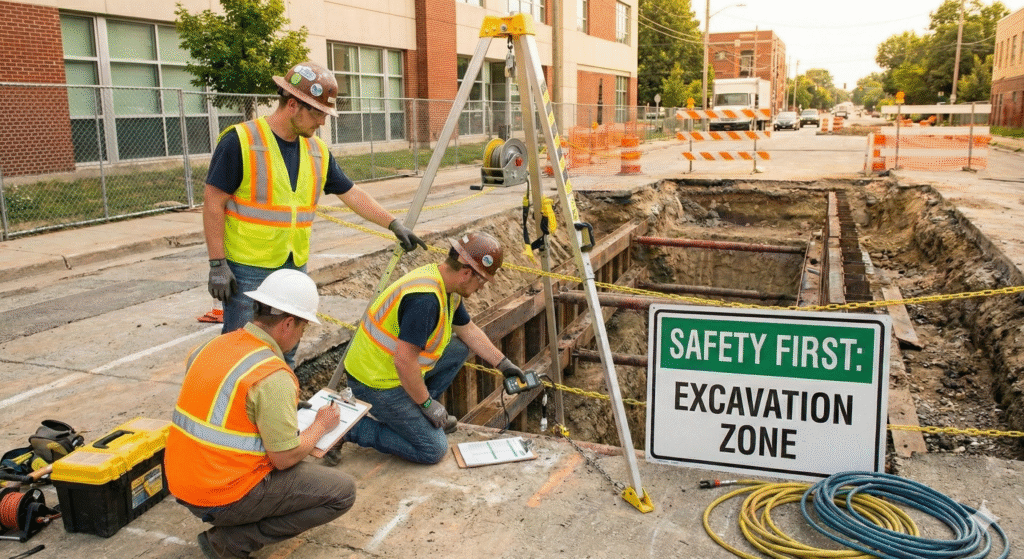
Real-World Incident Insight
Most fatal excavation incidents occur due to:
No protective system.
Improper soil classification.
Workers entering trenches briefly (“just for a minute”).
Water accumulation after rainfall.
Collapse time is often less than 5 seconds, leaving no chance for escape.
References (International Standards)
OSHA 29 CFR 1926 Subpart P – Excavations
HSE HSG185 – Health and Safety in Excavations
ILO Code of Practice – Safety and Health in Construction
Conclusion
Excavation protection is not optional—it is a legal and moral requirement. Proper selection of sloping, benching, shoring, or shielding, supported by competent inspections and strong supervision, directly saves lives. A well-trained Safety Officer ensures excavation work is executed within engineering limits, regulatory compliance, and best international practices.