
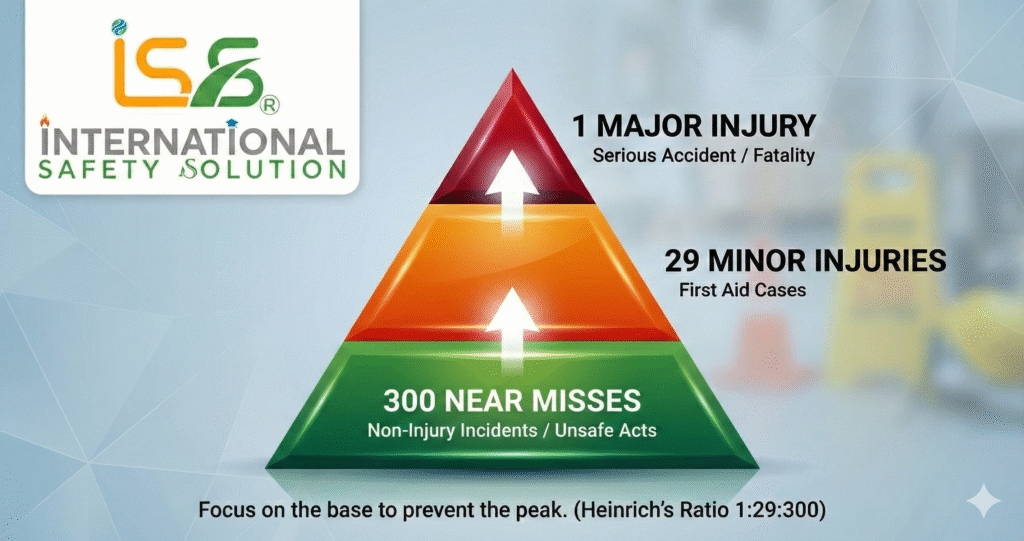
The Safety Triangle, also known as the Safety Pyramid, remains one of the most influential theories in occupational health and safety. Developed by American industrial safety pioneer Herbert William Heinrich, the model explains how serious workplace accidents are rarely sudden events. Instead, they are the final outcome of repeated unsafe acts, unsafe conditions, and ignored warning signs.
Heinrich developed this theory after analysing approximately 75,000 industrial accident cases during the early 20th century. His research revealed a consistent pattern showing that for every single fatal or serious injury, there are hundreds of near misses and thousands of unsafe acts occurring beforehand. This discovery reshaped how industries approach accident prevention.
According to Heinrich’s Safety Triangle, around 3,000 unsafe acts or unsafe conditions lead to 300 near misses. These near misses then result in approximately 30 minor or major injuries, ultimately culminating in one serious injury or fatal accident. The model clearly demonstrates that major accidents do not occur in isolation—they are built over time through neglect of smaller safety issues.
At the base of the triangle are unsafe acts and unsafe conditions such as failure to wear personal protective equipment, poor housekeeping, unsafe machinery, and ignoring safety procedures. These behaviours are often normalised in daily operations and overlooked because they do not immediately cause harm.
The next level consists of near misses—incidents that could have caused injury or damage but narrowly avoided doing so. Examples include slips without falls, falling objects missing workers, or electrical sparks without injury. Safety experts consider near misses as early warning signals that must be reported and investigated to prevent escalation.
As these unsafe conditions persist, actual injuries begin to occur. These may range from cuts and burns to fractures and medical treatment cases. Such incidents indicate that the organisation has failed to control the risks at an early stage.
At the top of the triangle lies the most severe outcome: fatalities and life-changing injuries. By the time an incident reaches this level, numerous opportunities for prevention have already been missed.
The Safety Triangle continues to play a critical role in modern safety management systems. It encourages organisations to focus on preventing unsafe acts rather than reacting only to accidents. By promoting near-miss reporting, behaviour-based safety, and proactive hazard control, industries can significantly reduce serious injuries and fatalities.
Despite advancements in technology and safety regulations, Heinrich’s Safety Triangle remains highly relevant today. It is widely used in HSE training, NEBOSH and IOSH qualifications, industrial safety programmes, and risk assessment frameworks worldwide.
Safety professionals emphasise that controlling the base of the triangle—unsafe acts and unsafe conditions—is the most effective way to prevent catastrophic outcomes. The core message remains unchanged: safety is not a matter of luck, but the result of consistent, correct actions taken at the right time.