

Effective communication is one of the most valuable skills a person can possess, both in personal and professional life. It is the foundation of relationships, teamwork, leadership, and career growth. Communication is not just about speaking; it includes listening, writing, understanding, and conveying ideas clearly and persuasively.
In today’s fast-paced world, where collaboration spans countries, cultures, and digital platforms, strong communication skills are essential. They allow individuals to express ideas clearly, avoid misunderstandings, and build trust and credibility in every interaction.
Why Communication Skills Matter
- Career Advancement: Strong communicators are often recognized as leaders and are more likely to secure promotions. Clear communication helps articulate goals, provide feedback, and influence decision-making.
- Professional Relationships: Effective communication strengthens workplace relationships. It fosters collaboration, teamwork, and mutual understanding.
- Problem Solving: Clear communication reduces errors, minimizes conflicts, and ensures that everyone is aligned on objectives and responsibilities.
- Personal Development: Good communicators can express themselves confidently in social, academic, and professional settings. They are more persuasive, empathetic, and influential.
- Global Opportunities: In multinational companies and international projects, communication is often conducted in a common language, usually English. Being able to communicate effectively opens doors to global exposure and networking.
The 7C’s of Communication
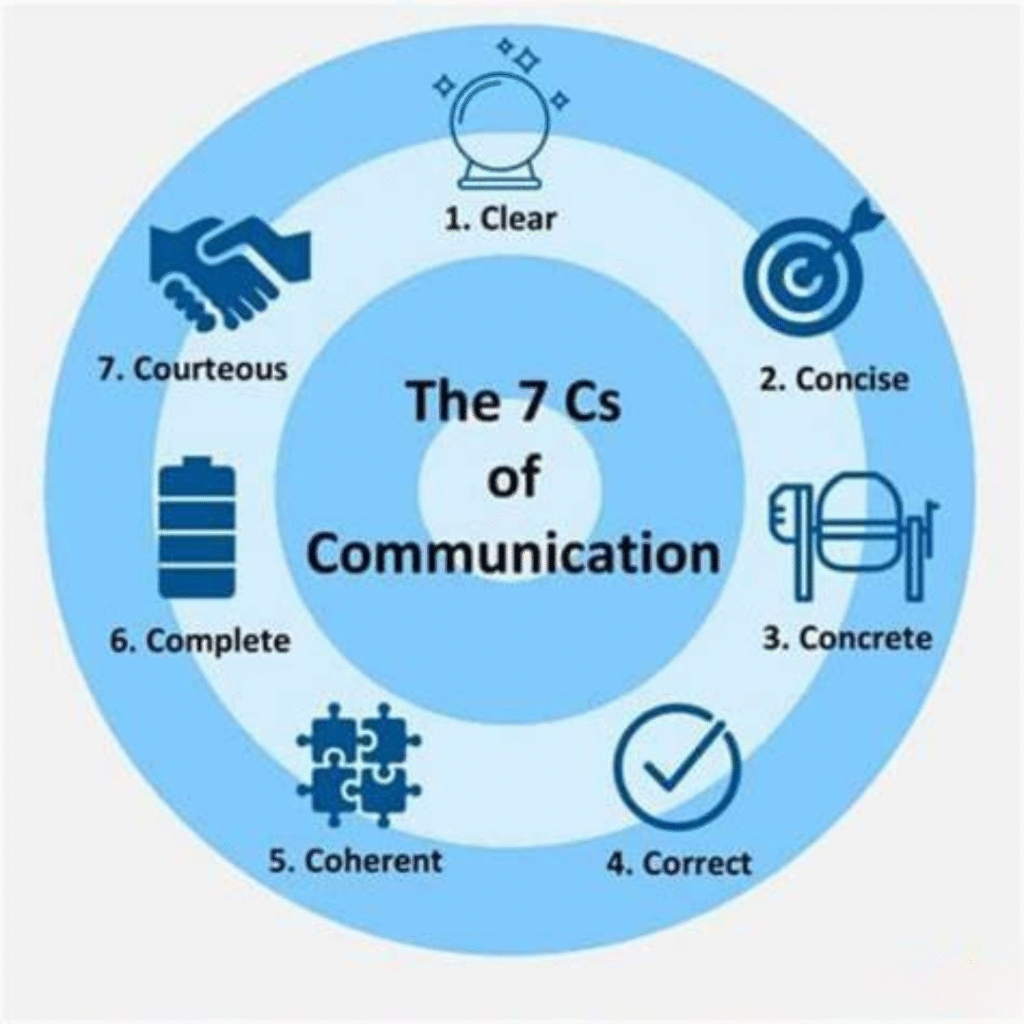
To communicate effectively, messages must follow certain principles. The 7C’s of Communication are widely recognized as a framework for clear, impactful communication. Let’s break them down:
1. Clarity
The message should be clear and easy to understand. Avoid jargon, ambiguity, and unnecessary complexity. A clear message reduces confusion and ensures the audience comprehends your intent.
Example: Instead of saying, “We might need to explore potential solutions to optimize operational efficiency,” say, “We need to find ways to improve efficiency in our operations.”
2. Conciseness
Keep messages brief and to the point. Avoid unnecessary words or lengthy explanations.
Example: “Submit the report by 5 PM today” is concise, while “I would like to request you, if possible, to submit the report sometime before the end of the day” is wordy.
3. Concreteness
Your communication should be specific and tangible, backed by facts, data, or examples.
Example: “Sales increased by 15% last quarter due to our new marketing strategy” is concrete, whereas “Sales did well last quarter” is vague.
4. Correctness
Use correct grammar, terminology, and facts. Errors can cause misunderstandings and damage credibility.
Example: Ensure names, dates, figures, and technical terms are accurate in reports or presentations.
5. Consideration
Focus on the audience’s perspective. Understand their needs, expectations, and feelings, and communicate accordingly.
Example: When giving feedback, instead of criticizing harshly, say, “I appreciate your effort on this project. Here’s how we can improve…”
6. Completeness
Provide all necessary information so the audience can make informed decisions or take action.
Example: “The meeting will be on Monday at 10 AM in Conference Room A. Agenda: project updates, budget review, and timelines for next quarter” gives all relevant details.
7. Courtesy
Use polite, respectful, and positive language. Courtesy fosters goodwill, collaboration, and trust.
Example: Use phrases like “please,” “thank you,” and “I appreciate your effort” to maintain a professional and friendly tone.
Applying the 7C’s in Daily Life
The 7C’s are not limited to corporate communication, they are valuable in every area of life:
- Emails and Reports: Make them clear, concise, and complete.
- Team Meetings: Listen actively, provide concrete examples, and consider colleagues’ perspectives.
- Presentations: Be correct, courteous, and concise to keep your audience engaged.
- Conflict Resolution: Use clarity, consideration, and courtesy to resolve issues effectively.
Conclusion
Communication skills are not optional, they are essential for success in every area of life. By following the 7C’s of communication, clarity, conciseness, concreteness, correctness, consideration, completeness, and courtesy; you can convey your ideas effectively, build strong relationships, and excel in your personal and professional endeavors.
Investing in your communication skills is an investment in your future, because how well you communicate often determines how far you go.