
Risk Management: Every workplace decision carries a degree of risk. Operating machinery, storing chemicals, hiring contractors or maintaining equipment can expose an organisation to injuries, property damage, operational disruption and financial losses.
Effective risk management helps organisations understand these exposures and choose appropriate responses before an incident occurs. It connects practical safety controls with financial planning, helping businesses protect people while maintaining operational resilience.
Four key strategies support this approach: risk avoidance, risk reduction, risk transfer and risk retention. Understanding how they work—and when to combine them—is an essential part of an effective health and safety management system.
What Is Risk Management?
Risk management is a structured process for identifying, assessing and responding to uncertainties that could affect an organisation’s objectives. Within workplace health and safety, it involves recognising hazards, assessing the likelihood and severity of harm, and implementing suitable controls.
A hazard is something with the potential to cause harm, such as an exposed moving machine part. Risk concerns how likely that harm is to occur and how serious the consequences could be.
A practical approach involves identifying hazards, assessing risks, implementing controls, recording relevant findings and reviewing whether those controls remain effective.
Risk management also considers how an organisation would fund recovery if a loss occurred despite its preventive measures.

Loss Control and Risk Financing: Understanding the Difference
The material provided groups risk responses into two broad areas:
| Area | Main purpose | Associated strategies |
|---|---|---|
| Loss control | Prevent incidents or reduce their likelihood and consequences | Risk avoidance and risk reduction |
| Risk financing | Arrange how the financial consequences of losses will be funded | Risk retention and risk transfer |
This distinction matters because financial protection and physical safety serve different purposes. An insurance policy may help pay for covered damage after a fire, while suitable storage arrangements and ignition controls help prevent the fire itself.
A complete strategy considers both.
1. Risk Avoidance: Preventing Exposure Before It Begins
Risk avoidance means deciding not to start, or to discontinue, an activity that creates a particular risk.
For example, an organisation may decide not to introduce a hazardous production process when a safer way of delivering the same product is available.
Avoidance is closely related to elimination, although the terms have a useful distinction:
- Avoidance removes exposure by not undertaking the activity.
- Elimination removes a particular hazard, potentially allowing the activity to continue.
Practical Example
A facility needs to inspect equipment installed at height. If the inspection can be completed effectively using a suitable ground-based system, the need for personnel to access the elevated location may be eliminated.

Check for New Hazards
Changing a process can introduce different risks. Automating a manual operation may reduce lifting injuries while creating hazards involving robotic movement, unexpected startup or maintenance access.
The revised process therefore needs its own assessment before implementation.
2. Risk Reduction: Controlling Risks That Remain
Risk reduction involves measures that lower the likelihood of an incident, the severity of its consequences, or both.
Where a hazard cannot be eliminated, organisations should select controls using the hierarchy of controls. This prioritises elimination, followed by substitution, engineering controls, administrative controls and personal protective equipment. PPE provides the lowest level of protection in this hierarchy because its effectiveness depends heavily on correct selection and use.
Examples of Risk Reduction
| Control approach | Workplace example |
|---|---|
| Substitution | Replacing a hazardous substance with a suitable, less hazardous alternative |
| Engineering controls | Installing suitable guards to prevent access to dangerous machine parts |
| Administrative controls | Introducing safe working procedures, access restrictions and task-specific training |
| Personal protective equipment | Providing appropriate eye, hearing or respiratory protection for the assessed exposure |
Practical Example: Machinery Operation
A workshop operates machinery with accessible moving components. Depending on the machine and task, suitable measures may include:
- Fixed or interlocked guarding.
- Safe isolation arrangements for maintenance.
- Planned inspection and preventive maintenance.
- Competent operators and clear working procedures.
- Appropriate PPE for remaining exposure.

The residual risk is the risk remaining after controls have been implemented. It should be assessed and monitored rather than assumed to be acceptable simply because controls exist.
3. Risk Transfer: Arranging Financial Protection and Specialist Support
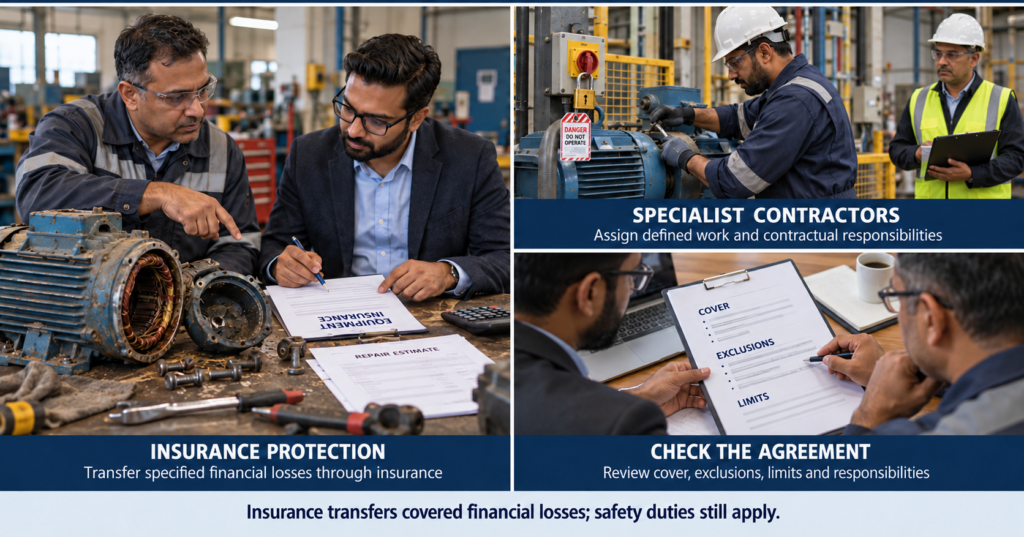
Risk transfer involves allocating specified financial consequences or contractual obligations to another party.
Insurance is a common example. In exchange for a premium, an insurer agrees to meet covered losses under the policy’s terms, limits and conditions.
Contractual arrangements can also allocate certain responsibilities between organisations. However, engaging another party does not automatically remove the original organisation’s exposure or safety obligations.
Insurance: Understanding the Actual Cover
When reviewing insurance, an organisation should examine:
- The activities, assets and events covered.
- Exclusions and policy conditions.
- The excess or deductible payable by the organisation.
- Maximum claim limits.
- Reporting requirements and other obligations.
A policy should be evaluated against realistic loss scenarios. The existence of insurance alone does not establish that a particular incident will be covered.
Using Specialist Contractors
A competent specialist contractor can provide expertise and equipment for work outside an organisation’s capabilities.
For example, a specialist may undertake hazardous maintenance or removal work. Effective arrangements still require coordination, exchange of hazard information and agreement on safe working methods. HSE guidance emphasises cooperation between the client and contractor so that the risks associated with the work are addressed.
Contracting out a task should be supported by competent selection and active oversight.
4. Risk Retention: Funding Losses Within the Organisation
Risk retention means that an organisation bears some or all of the financial consequences of a loss.
Retained losses may be funded through operating budgets, dedicated reserves or other planned financial resources.
Retention can arise through a deliberate decision or through an unnoticed gap in protection. This creates an important distinction between retention with knowledge and retention without knowledge.
Retention With Knowledge
This occurs when an organisation understands the exposure and consciously decides to fund the potential loss itself.
Examples include:
- Budgeting for minor, predictable equipment damage.
- Accepting an agreed insurance excess.
- Establishing a funded reserve for specified losses.
Such decisions should consider the potential size and frequency of losses, available funds and the effect on business continuity.
Retention Without Knowledge
This occurs when an organisation carries an exposure without recognising or assessing it.
Examples include:
- Assuming an excluded event is insured.
- Failing to update cover after purchasing equipment.
- Overlooking a policy limit.
- Failing to identify a business interruption exposure.
This can create a serious funding gap when an incident occurs.
Choosing to retain a financial loss does not justify leaving preventable workplace hazards uncontrolled.
Risk Sharing: Combining Retention and Transfer
Risk sharing distributes specified financial consequences between parties.
An insurance excess is a straightforward example: the organisation pays the agreed first portion of a covered loss, while the insurer responds to the remaining covered amount within the policy terms.
Other arrangements may involve agreed percentage contributions or multiple insurers. Their effect depends on the specific agreement.
For an organisation, the central question is whether its retained share is understood, affordable and supported by accessible funds.
Example: Applying Four Risk Strategies in a Maintenance Workshop
A maintenance workshop uses powered machinery and stores flammable cleaning products. Each risk strategy addresses a different part of this situation—from removing unnecessary hazards to funding losses that may still occur.
| Strategy | Practical workshop action | What makes it different? |
|---|---|---|
| Avoidance or elimination | Discontinue an unnecessary solvent-cleaning activity and remove the associated flammable product from use. | Removes the activity or hazard, preventing that particular exposure. |
| Reduction | Fit machine guards, provide suitable flammable-liquid storage and implement safe isolation procedures. | Lowers the likelihood or severity of harm where hazards remain. |
| Transfer | Arrange suitable insurance for specified equipment losses and clearly define responsibilities when appointing specialist contractors. | Allocates covered financial losses or defined contractual obligations to another party. Safety duties still apply. |
| Retention | Set aside company funds for insurance deductibles and assessed minor repair costs. | Keeps the financial burden within the organisation, with funds available to meet it. |
For example, removing an unnecessary flammable solvent eliminates that source of fire exposure. Guarding a machine reduces contact with its moving parts. If an insured equipment loss occurs, the insurer pays the covered amount according to the policy, while the workshop funds its agreed deductible and any other retained costs.
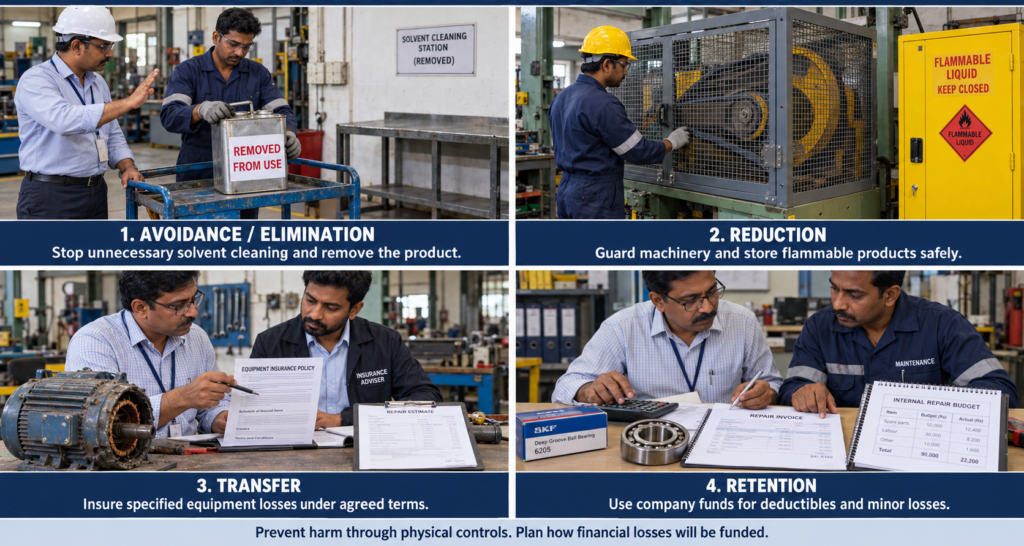
Avoidance and reduction help prevent harm; transfer and retention determine how financial losses are allocated and funded. Together, they support a more complete approach, with measures selected through a site-specific risk assessment.These measures perform different functions. Physical controls reduce exposure to harm, while financial arrangements help the organisation respond to covered and retained losses.
International Standards Supporting Workplace Risk Management
International standards provide a structured foundation for identifying risks, selecting suitable controls and reviewing their effectiveness. The following standards are particularly relevant to workplace risk management:
| Standard | Purpose and relevance |
|---|---|
| ISO 31000:2018 — Risk Management: Guidelines | Provides principles, a framework and a process for managing risk. It supports informed decisions about assessing and treating organisational risks. |
| ISO 45001:2018 — Occupational Health and Safety Management Systems | Establishes requirements for managing workplace health and safety, including hazard identification, risk assessment, worker participation, emergency planning and continual improvement. |
| IEC 31010:2019 — Risk Assessment Techniques | Provides guidance on selecting and applying risk assessment techniques to understand uncertainty and support better decisions. |
ISO 31000 provides the overall risk management framework, while ISO 45001 focuses specifically on preventing work-related injury and ill health. IEC 31010 supports the assessment process by helping organisations choose suitable analytical techniques.
Applying these standards can strengthen risk management, but mentioning them does not demonstrate compliance or certification. ISO 31000 is a guidance standard and is not intended for organisational certification.
How to Select the Right Risk Management Strategy
A sound decision considers more than the cost of an insurance premium or a safety upgrade.
Relevant factors include:
- Potential severity: Could the event cause serious injury, major damage or prolonged shutdown?
- Likelihood and exposure: How often does the activity occur, and who could be affected?
- Control effectiveness: Will the measure reliably address the hazard?
- Available expertise: Can the organisation safely manage the activity itself?
- Financial capacity: Could it absorb the retained loss without threatening operations?
- Insurance suitability: Do the cover, exclusions and limits match the exposure?
- Operational change: Could the proposed solution introduce new hazards?
- Applicable requirements: What safety, contractual and insurance requirements apply?
Incident records, inspection findings, maintenance history and worker feedback can help inform these decisions.
Keeping Risk Management Effective
Risk management needs regular attention as equipment, people and work processes change.
Assign responsibility for each action, confirm that controls are implemented and check their performance in practice. Review assessments when controls may no longer be effective, following relevant workplace changes, or when incidents and near misses reveal weaknesses.
A completed assessment becomes useful when its findings lead to maintained safeguards, informed workers and timely corrective action.
Building a More Resilient Workplace
Avoidance, reduction, transfer and retention each contribute to managing workplace exposure. Their value depends on choosing them deliberately and understanding their limits.
An effective organisation removes hazards where possible, controls the risks that remain, arranges appropriate financial protection and prepares for the losses it must fund itself.
The strongest risk management decisions protect people before an incident and support recovery if a loss still occurs.