
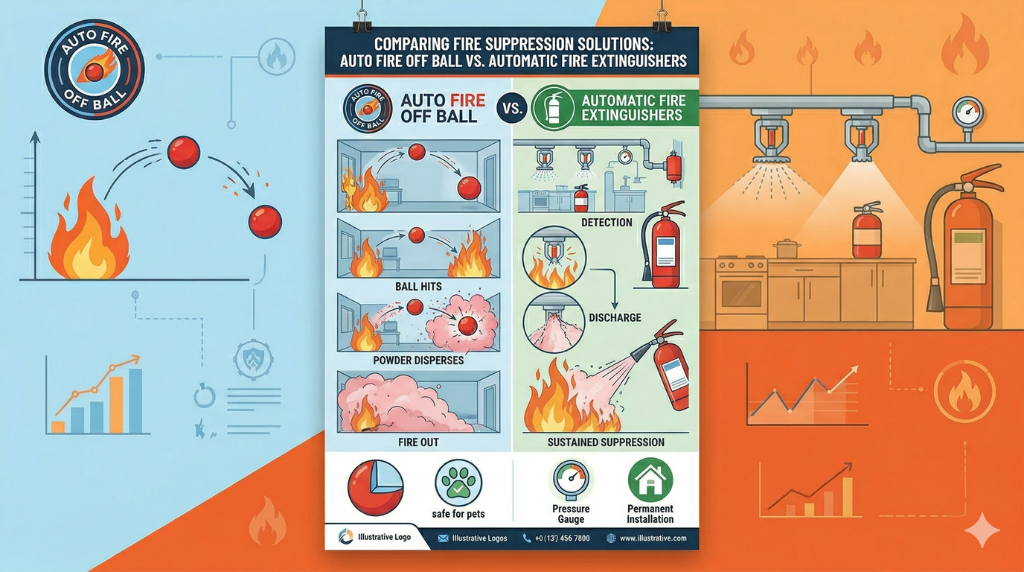
Fire protection systems are critical in minimizing damage, saving lives, and ensuring compliance with safety standards. Among modern solutions, Auto Fire Off Balls and Automatic Fire Extinguishers are widely used—but often misunderstood. This guide provides a clear, technical comparison to help safety professionals, facility managers, and students make informed decisions. Fire suppression systems are designed to detect and control fires at an early stage. These systems can be manual (operated by humans) or automatic (activated without human intervention). Both Auto Fire Off Balls and Automatic Fire Extinguishers fall under automatic fire protection, but their design, activation mechanism, and applications differ significantly.
An Auto Fire Off Ball is a self-activating fire suppression device that explodes when it comes into contact with fire. It contains dry chemical powder, usually ABC type, and activates within 3–5 seconds of flame exposure. Upon activation, it bursts with a loud sound and disperses the extinguishing agent in all directions. Key features include no installation requirement, lightweight portability, 360-degree coverage, and an audible explosion that acts as an alarm. These are commonly used in electrical panels, kitchens, vehicles, and small storage areas.
An Automatic Fire Extinguisher, on the other hand, is a fixed fire suppression system that activates when a preset temperature is reached. It uses a heat-sensitive element such as a glass bulb or fusible link and typically activates at temperatures like 68°C or 79°C. It releases extinguishing agents such as CO₂, clean agents, foam, or dry powder in a controlled manner. These systems are permanently installed, provide controlled discharge, and are suitable for enclosed or critical environments. They can also be integrated with fire alarm systems and are commonly used in server rooms, electrical panels, engine compartments, and industrial machinery.
The key differences between the two systems are significant. Auto Fire Off Balls activate through direct flame contact and respond very quickly within seconds, while Automatic Fire Extinguishers rely on heat detection and may have a slight delay depending on temperature rise. Fire Balls require no installation and disperse the agent explosively, whereas Automatic Extinguishers require proper installation and release the agent in a controlled manner. Coverage area in Fire Balls is limited and localized, while Automatic systems are designed for defined protection zones. Fire Balls produce a loud explosion that acts as an alarm, while Automatic systems are usually silent unless integrated with alarms. Maintenance requirements are minimal for Fire Balls but regular inspection is necessary for Automatic systems. In terms of professional acceptance, Automatic Fire Extinguishers are widely compliant with standards, whereas Fire Balls may not always meet strict industrial requirements.
Auto Fire Off Balls offer advantages such as ease of use, no training requirement, cost-effectiveness, quick activation, and portability. However, they are not suitable for large fires, offer less control over extinguishing direction, may not meet strict standards, and their explosion can cause minor disturbances. Automatic Fire Extinguishers provide reliable and controlled operation, are suitable for critical assets, comply with standards such as NFPA, and can be customized for different hazards. Their limitations include higher initial cost, need for installation and maintenance, and lack of portability.
From a compliance perspective, Automatic Fire Extinguishers are typically designed according to standards set by the National Fire Protection Association and ISO fire safety guidelines. Auto Fire Off Balls may not always comply with NFPA certification requirements and should be considered supplementary protection rather than primary systems.
Use Auto Fire Off Balls when the budget is limited, fire risk is small-scale, a quick and simple solution is needed, or an additional safety layer is required. Use Automatic Fire Extinguishers when protecting critical equipment, ensuring regulatory compliance, dealing with high or continuous fire risks, or implementing a professional fire protection system. From an HSE perspective, Automatic Fire Extinguishers should always be the primary protection system in industrial and commercial environments, while Fire Balls can be used as additional support, especially in electrical panels and confined spaces. They should never be relied upon as the sole protection method in high-risk areas.
Both systems serve important roles in fire safety but are not interchangeable. Auto Fire Off Balls provide a simple and quick supplementary solution, whereas Automatic Fire Extinguishers offer a reliable, compliant, and professional system. The right choice depends on risk level, environment, compliance requirements, and budget. Effective fire safety is not about choosing one device but implementing layered protection that includes detection systems, automatic suppression, and manual firefighting equipment to ensure maximum safety and risk reduction.