
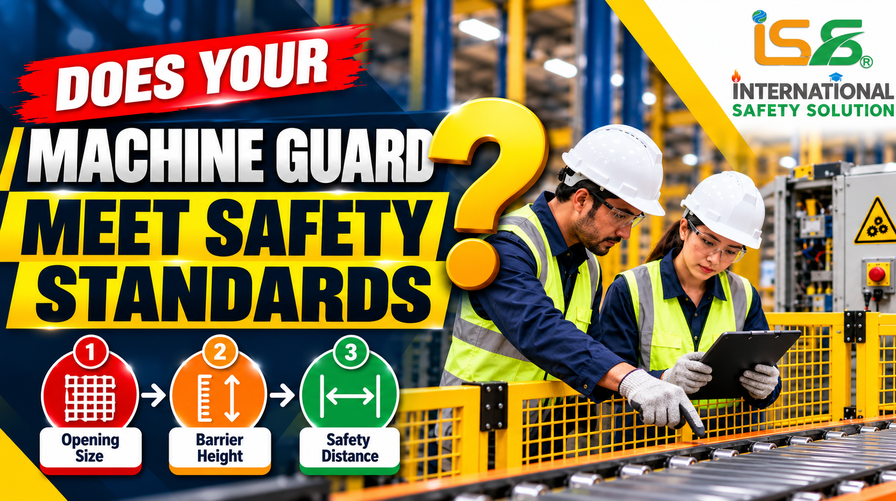
Machine Guarding often have moving parts that can injure someone if they get too close. Guards and barriers help keep people away from these parts. However, a guard must have the right opening size, height and position to provide effective protection.
A person may reach through a hole in a guard, stretch around its edge or lean over a barrier. This is why the size of the opening and the distance to the dangerous part must be considered together.
This guide explains these points in simple words, using the diagrams and tables below
What Is a Machine Guarding Safety Distance?
A safety distance is the minimum gap needed between a protective structure and a dangerous machine part to prevent someone from reaching it.
For example, a mesh guard may stop someone from walking into a machine. However, if its holes allow a hand through and the moving part is close behind it, the person may still get injured.
ISO 13857 provides safety distances to help prevent arms, hands, fingers and lower limbs from reaching machinery hazard zones. These distances apply where keeping people far enough away can provide suitable protection.
How Far Can an Arm Reach?
The first table shows how the movement of the arm affects the required safety distance.
When most of the arm can move freely, a person can reach farther. When a suitable structure supports and restricts the arm closer to the wrist or knuckles, the remaining reach becomes shorter.

These measurements apply to the arrangements shown in the diagram. They should not be treated as general distances for every machine guard.
The main point is simple: the more of the arm that can reach beyond a guard, the farther away the dangerous part must be.
Why Does the Size of a Guard Opening Matter?
An opening may allow a fingertip, a finger, a hand or a whole arm to pass through. A larger opening can therefore require a greater distance between the guard and the dangerous part.
The shape of the opening also matters. The second table covers three shapes:
- Slot: A long, narrow opening.
- Square: An opening with four equal sides.
- Round: A circular opening.

| Opening shape | Minimum safety distance |
|---|---|
| Slot | 80 mm |
| Square | 25 mm |
| Round | 20 mm |
This example shows why checking only the opening size is not enough. The shape must also be checked.
Any conditions or footnotes shown under the table must be read with the measurements.
Understanding Barrier Height and the Danger Zone
A person may also reach a dangerous machine part by leaning over a barrier. To understand this, three measurements are used: A, B and C.

A — Height of the Danger Zone
This is the height of the dangerous part above the level where the person stands.
The danger zone could be a moving belt, roller, blade or another part that may cause injury.
B — Height of the Protective Structure
This is the height of the guard or barrier above the same standing level.
C — Horizontal Distance to the Danger Zone
This is the sideways gap between the barrier and the dangerous part.
What Is the Reference Plane?
The reference plane is the surface on which the person normally stands. It may be the floor or a raised working platform.
This matters because a platform can allow someone to reach farther over a barrier. Heights must therefore be measured from the correct standing level.
Barrier height alone does not decide safety. The height of the dangerous part and its distance from the barrier must also be considered.
What Should Be Checked Before Installing a Guard?
Before choosing a guard, identify the dangerous parts and consider how someone could reach them during normal work, cleaning, adjustment or maintenance.
Check:
- The size and shape of every opening.
- The height of the guard and the dangerous part.
- The distance between them.
- Access around the sides and underneath the guard.
- Nearby platforms or surfaces where someone could stand.
- Whether the guard is securely fixed and remains in the correct position.
HSE guidance recommends fixed guards where practical. Where regular access is needed, suitable interlocked guards may be required. It also stresses safe isolation before work such as cleaning, adjustment or clearing blockages.
Choosing the Right Safety Distance
The required distance depends on the opening size, barrier height, position of the dangerous part and the assessed risk. These measurements should be selected using the relevant ISO 13857 tables and a machine-specific risk assessment.
Bringing the Measurements Together
Good machine guarding depends on how the whole arrangement works.
Opening size affects what can pass through the guard. Barrier height affects reach over the top. Safety distance keeps the dangerous part beyond that reach.
Using these measurements together helps create a safer working area. The tables and diagrams explain the principles, while the final guard design should follow the full applicable standard and a machine-specific risk assessment.
Practical Example — Conveyor Belt in a Packaging Factory
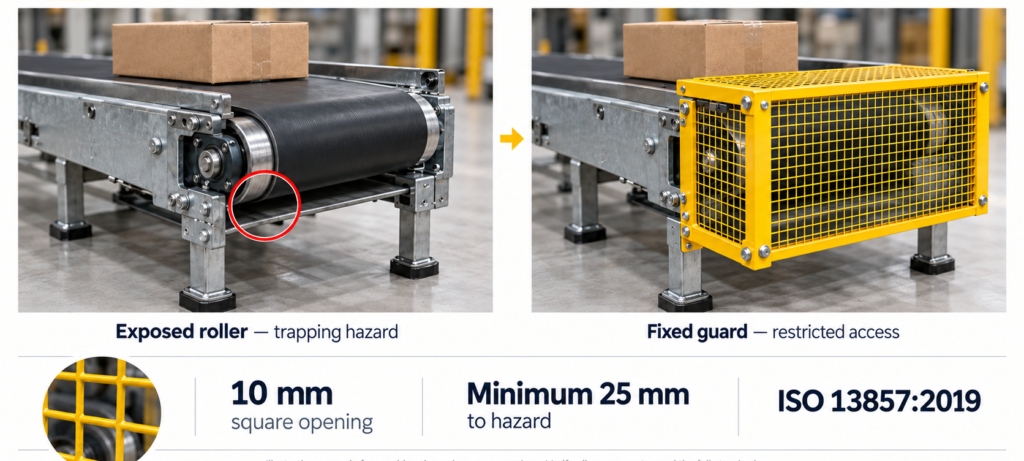
In a packaging factory, a conveyor belt moves boxes from one area to another. The belt passes over moving rollers. A worker’s fingers or hand could become trapped where the belt meets a roller.
A mesh guard can help prevent workers from reaching these dangerous parts. However, its openings must be small enough, and the rollers must be far enough behind the guard, to prevent access.
If a fence is used, its height and distance from the conveyor must also prevent workers from reaching over it. The safety tables help the designer select suitable measurements for the assessed risk.
Before cleaning or removing a stuck box near the rollers, the conveyor must be stopped and safely isolated.
Conclusion
Effective machine guarding keeps people away from dangerous moving parts. The size of guard openings, the height of barriers and the distance to the hazard must work together to prevent access. Using the correct safety tables and checking the actual machine helps ensure that the guard provides suitable protection. Guards should also be inspected regularly and reviewed whenever the machine or workplace layout changes.