
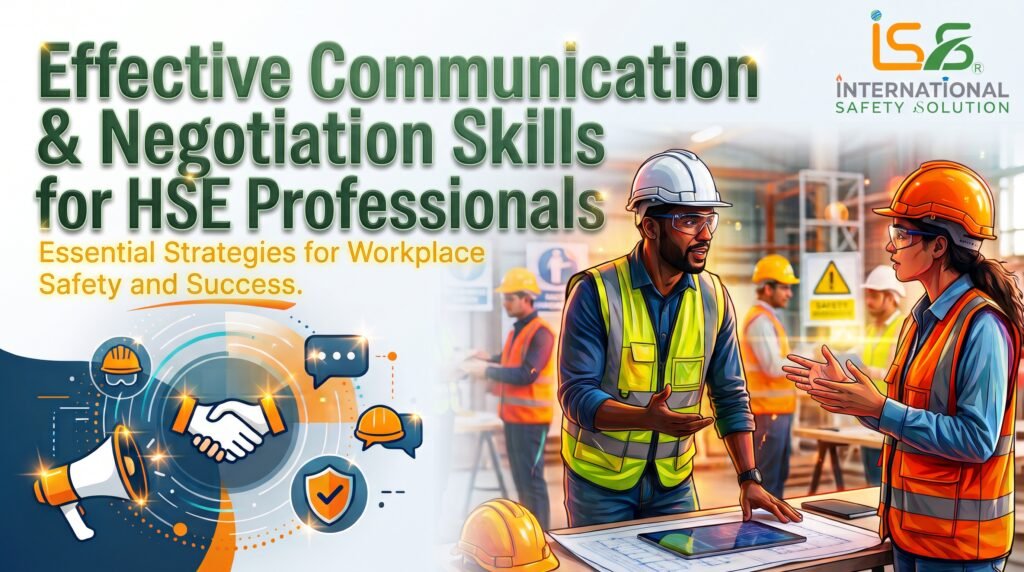
Health and Safety (HSE) professionals do more than identify workplace hazards, conduct inspections, and implement safety procedures. They must also communicate safety requirements clearly, influence workplace behaviour, resolve conflicts, and negotiate practical solutions with employees, managers, contractors, and other stakeholders. Effective communication and negotiation skills for HSE professionals are essential for building a positive safety culture and ensuring that health and safety objectives are understood, accepted, and implemented throughout an organisation.
Even the most effective safety policies can fail if they are not communicated properly or if people do not understand why they matter. HSE professionals therefore need strong interpersonal, communication, and negotiation abilities to turn safety knowledge into meaningful workplace action.
1. Why Communication Skills Matter in HSE
Communication is at the heart of successful health and safety management. HSE professionals regularly interact with people who have different responsibilities, levels of technical knowledge, attitudes, and priorities. They must explain hazards, communicate legal requirements, deliver training, report incidents, and recommend corrective actions.
Effective communication helps HSE professionals:
- Explain workplace hazards and associated risks.
- Communicate safety policies, procedures, and legal requirements.
- Deliver toolbox talks, inductions, and safety training.
- Encourage employees to report unsafe conditions and near misses.
- Present inspection findings and incident investigation results.
- Influence managers to provide resources for safety improvements.
- Promote employee participation and accountability.
Communication should not simply involve giving instructions. It should create understanding, encourage feedback, and ensure that safety information leads to action.
2. Essential Communication Skills for HSE Professionals
Verbal Communication
HSE professionals must communicate clearly and confidently during meetings, training sessions, site inspections, and emergency situations. Technical information should be explained in language that employees can understand.
For example, when explaining a risk assessment, an HSE professional should describe the hazard, who may be harmed, the possible consequences, and the control measures required rather than relying only on technical terminology.
Written Communication
Accurate written communication is equally important. HSE professionals prepare risk assessments, method statements, inspection reports, incident reports, audit findings, and safety procedures.
Good written communication should be:
- Clear and easy to understand.
- Accurate and supported by evidence.
- Structured and logically presented.
- Specific about required actions and responsibilities.
- Professional and free from unnecessary technical jargon.
Active Listening
Communication is a two-way process. HSE professionals must listen carefully to employees, supervisors, contractors, and management to understand their concerns and identify practical workplace issues.
Active listening involves asking relevant questions, avoiding interruptions, acknowledging concerns, and confirming understanding. It also helps build trust, making employees more comfortable reporting hazards and near misses.
Non-Verbal Communication
Body language, facial expressions, eye contact, posture, and tone of voice can influence how safety messages are received. A professional and approachable manner helps create open communication, particularly when discussing sensitive issues such as unsafe behaviour or poor safety performance.
3. Why HSE Professionals Need Negotiation Skills
Negotiation is the process of reaching an agreement between parties with different interests, priorities, or viewpoints. In health and safety management, HSE professionals often need to balance operational requirements with the organisation’s responsibility to protect workers.
For example, production managers may be concerned about delays, costs, or operational targets, while HSE professionals must ensure that suitable safety controls are implemented.
Negotiation helps HSE professionals find practical solutions without compromising essential safety standards.
Key situations where negotiation is required include:
- Convincing management to invest in safety improvements.
- Agreeing on corrective actions following inspections or audits.
- Resolving disagreements between employees and supervisors.
- Discussing safe working arrangements with contractors.
- Securing adequate resources for training and protective equipment.
- Addressing resistance to new safety procedures.
- Balancing operational deadlines with safe working practices.
The objective is not simply to win an argument. It is to achieve an agreement that supports legal compliance, risk reduction, and operational effectiveness.
4. Key Negotiation Skills for HSE Professionals

Preparation and Evidence-Based Arguments
Successful negotiation begins with preparation. HSE professionals should understand the issue, identify the risks, review relevant legislation and organisational procedures, and gather supporting evidence.
Incident statistics, audit findings, risk assessments, financial implications, and recognised safety standards can strengthen recommendations and make discussions more objective.
Persuasion and Influencing Skills
HSE professionals must be able to explain why a safety measure is necessary and how it benefits the organisation. Rather than simply telling management what must be done, they should communicate the consequences of inaction and the advantages of prevention.
Conflict Resolution
Disagreements can arise when safety requirements appear to conflict with production targets or when employees disagree with management decisions. HSE professionals should remain objective, understand different perspectives, identify the underlying problem, and work towards a reasonable solution.
Problem-Solving and Flexibility
A proposed safety measure may not always be practical in its original form. Negotiation allows HSE professionals to explore alternative controls while maintaining the required level of protection.
However, flexibility must never mean accepting an unacceptable level of risk or compromising mandatory legal requirements.
5. Communicating and Negotiating with Different Stakeholders
HSE professionals interact with different groups, and their communication approach should reflect each audience’s responsibilities and understanding.
| Stakeholder | Effective approach |
| Senior management | Present risk information, legal responsibilities, business benefits, and resource requirements. |
| Employees | Use clear instructions, practical demonstrations, and opportunities for feedback. |
| Supervisors | Discuss responsibilities, operational challenges, and corrective actions. |
| Contractors | Communicate site rules, hazards, permit requirements, and safe working expectations. |
| Regulatory authorities | Provide accurate documentation, evidence, and professional responses. |
Understanding the audience helps HSE professionals deliver messages that are relevant, clear, and persuasive.
6. Using Communication to Build a Positive Safety Culture
A positive safety culture develops when health and safety becomes a shared responsibility rather than an obligation managed only by the HSE department.
Effective communication supports this culture by encouraging:
- Open reporting of hazards and near misses.
- Employee consultation and participation.
- Regular safety briefings and toolbox talks.
- Constructive feedback and continuous improvement.
- Recognition of safe behaviour.
- Transparency during incident investigations.
HSE professionals should encourage employees to raise concerns without fear of blame or unfair treatment. When workers feel heard and respected, they are more likely to participate actively in improving workplace safety.
7. Common Communication and Negotiation Challenges
HSE professionals may face several barriers when communicating or negotiating safety requirements, including:
- Resistance to change and established working practices.
- Language and cultural differences.
- Lack of management support.
- Limited awareness of workplace hazards.
- Conflicting production and safety priorities.
- Poor employee engagement.
- Misunderstanding of legal and technical requirements.
These challenges can be addressed through appropriate training, clear communication, evidence-based discussions, active listening, and consistent management support.
8. Developing Communication and Negotiation Skills
Communication and negotiation are professional skills that can be improved through regular practice and development.
HSE professionals should:
- Participate in communication, presentation, and negotiation training.
- Practise delivering clear and engaging toolbox talks.
- Develop report-writing and professional documentation skills.
- Seek feedback from colleagues, employees, and managers.
- Improve their understanding of relevant health and safety legislation.
- Use evidence and practical examples when presenting recommendations.
- Develop confidence in handling difficult conversations and resolving conflicts.
Continuous professional development helps HSE professionals become more confident, influential, and effective in their roles.
Conclusion
Effective communication and negotiation skills are fundamental to successful HSE management. Technical knowledge alone cannot create a safe workplace; HSE professionals must also be capable of explaining risks, influencing decisions, resolving disagreements, and gaining the cooperation of different stakeholders.
By developing strong interpersonal, listening, communication, and negotiation abilities, HSE professionals can strengthen employee engagement, secure management commitment, improve safety performance, and contribute to a positive workplace safety culture.
A successful HSE professional does not simply communicate safety rules — they influence people to understand, accept, and practise safe behaviour.