
1. Introduction:
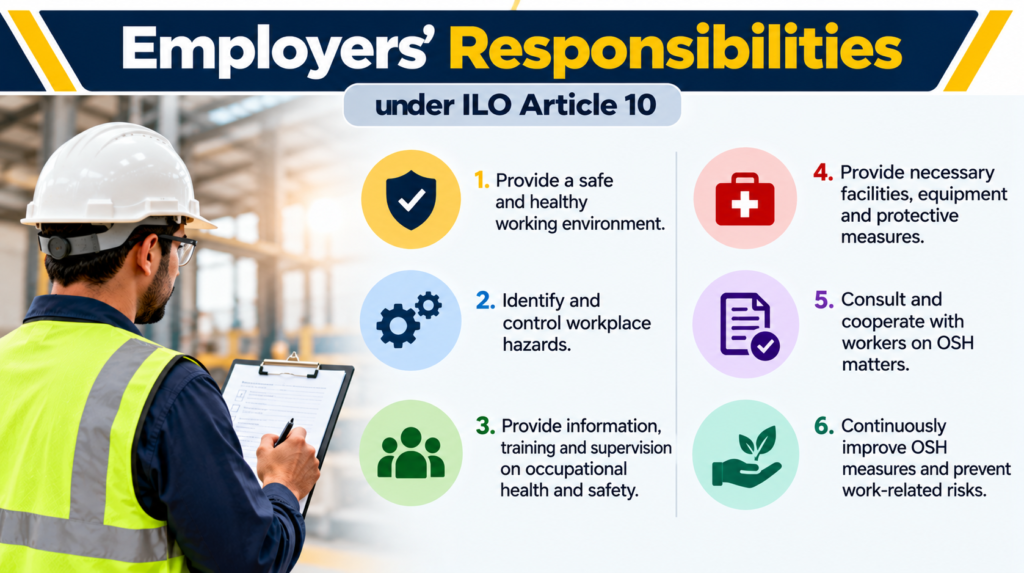
Employers’ Responsibilities: The supplied reference explains that the general employer duties in ILO Convention C155 are expanded in Recommendation R164. Article 10 of R164 gives eight practical obligations for employers. These points help meet the objective of Article 16 of C155.
| Employers should provide safe work, train and supervise workers, organise proper safety arrangements, provide necessary protective equipment free of charge, manage working hours and fatigue, and keep their safety knowledge up to date. |
2. Obligation 1 – Safe Workplace, Equipment and Work Methods:
Employers should provide workplaces and work equipment that are safe. The way work is carried out should also be safe and should not create a risk to workers’ health.
• Keep work areas and facilities safe.
• Make sure machines, tools and equipment are safe to use.
• Use safe work methods and systems.
• Correct unsafe conditions when they are found.
Practical example
If a machine has a damaged guard, the employer should not allow normal use until the hazard has been controlled and the machine is safe.

3. Obligation 2 – Appropriate Instructions and Training:
• Explain the safe way to do the job.
• Provide training that is suitable for the work and its risks.
• Make sure workers understand the instructions and training.

4. Obligation 3 – Necessary Supervision:
Employers should provide the supervision needed for the work. Supervision helps identify unsafe practices early and makes sure workers receive guidance when needed.
• Check that work is being carried out safely.
• Make sure safety procedures are followed.
• Give guidance when workers need help.

5. Obligation 4 – Suitable Health and Safety Arrangements:
Employers should put health and safety arrangements in place that are suitable for the size and nature of the undertaking.
• Use arrangements that fit the type of work and the risks involved.
• Organise responsibilities for health and safety clearly.
• Maintain practical arrangements for managing workplace safety.
| Key point A small workplace and a large industrial site may need different arrangements, but both need an organised system for health and safety. |

6. Obligation 5 – Necessary Protective Clothing and Equipment Free of Charge:
Where protective clothing or equipment is necessary, the employer should provide it to workers without charging them.
• Provide the PPE or protective clothing needed for the hazard.
• Make sure the protection is suitable for the work.
• Keep it usable and replace it when necessary.
• Do not charge workers for necessary protection.

7. Obligation 6 – Working Hours Must Not Harm Safety or Health:
Employers should ensure that working hours do not adversely affect employees’ safety and health.
• Consider how long workers are working.
• Organise work so tiredness does not create an unnecessary risk.
• Review working arrangements when hours are affecting safety or health.

8. Obligation 7 – Eliminate Extreme Physical and Mental Fatigue:
Extreme fatigue can affect concentration, judgement and physical ability. The reference specifically requires employers to take measures to eliminate extreme physical and mental fatigue.
• Look for work conditions that create extreme fatigue.
• Change the work arrangement when extreme fatigue becomes a risk.
• Use suitable measures to protect workers from excessive physical or mental strain.
Practical example
If a demanding task is causing extreme fatigue, the employer may need to change the way the work is organised so workers can perform it safely.

9. Obligation 8 – Keep Knowledge Up to Date:
Employers should stay up to date with knowledge so they can comply with all of the obligations above. Safety information and methods can change, so employers need current knowledge to manage risks properly.

10. The Eight Obligations at a Glance:
• 1. Provide safe workplaces, work equipment and safe work methods.
• 2. Provide appropriate instructions and training.
• 3. Provide necessary supervision.
• 4. Put in place health and safety arrangements suited to the size and nature of the undertaking.
• 5. Provide necessary personal protective clothing and equipment free of charge.
• 6. Ensure working hours do not adversely affect employees’ safety and health.
• 7. Take measures to eliminate extreme physical and mental fatigue.
• 8. Stay up to date with knowledge in order to comply with the above.
11. Conclusion:
The reference gives eight clear employer obligations under Article 10 of ILO Recommendation R164. Together, they cover the workplace itself, equipment and work methods, training, supervision, safety arrangements, protective equipment, working hours, fatigue and current safety knowledge.
The purpose is practical: employers should organise work so that risks to workers’ safety and health are prevented or controlled. These R164 obligations expand on what the general duties may mean in practice and support the objective of Article 16 of C155.
| Final takeaway Safe workplace. Clear training. Proper supervision. Suitable safety arrangements. Free necessary PPE. Safe working hours. Control extreme fatigue. Keep knowledge up to date. |