1. Introduction to Fault Tree Analysis (FTA)
Fault Tree Analysis (FTA) is a highly advanced, structured, and systematic risk assessment technique used in modern safety engineering, reliability analysis, accident investigation, and process safety management. It is a deductive methodology that begins with a clearly defined undesired event, known as the “Top Event,” and then works backward in a logical and hierarchical manner to identify every possible combination of failures, human errors, system malfunctions, and environmental conditions that could lead to that event. Unlike simple hazard identification tools, FTA does not only describe what went wrong; instead, it explains in detail how and why a series of interconnected failures were able to align and produce a serious accident or system breakdown.
In today’s industrial world, systems are highly complex and interdependent. Machines, humans, software systems, procedures, environmental conditions, and management controls all interact simultaneously. Because of this complexity, accidents rarely occur due to a single cause. Instead, they are the result of multiple failures that align at the same time. Fault Tree Analysis is designed specifically to handle this complexity by breaking down large systems into logical, manageable, and visually structured failure pathways. This allows safety professionals, engineers, and investigators to clearly understand accident causation at both surface and deep systemic levels.
2. Historical Development and Evolution of FTA
Fault Tree Analysis was originally developed in 1962 by Bell Telephone Laboratories for the United States Air Force. The main objective at that time was to analyze extremely complex missile launch control systems where even a single failure could lead to catastrophic mission failure or loss of life. Engineers required a systematic method that could represent multiple interacting failures in a structured logical format, allowing them to predict how combinations of faults could lead to system breakdown.
Following its success in defense systems, FTA was quickly adopted by other high-risk industries, including nuclear power generation, aerospace engineering, petrochemical industries, and aviation safety systems. Over the decades, it became an essential part of reliability engineering and process safety management frameworks. Today, Fault Tree Analysis is recognized globally and is integrated into international safety standards, risk assessment procedures, and engineering design methodologies. Its evolution reflects the shift from reactive accident investigation to proactive risk prevention and predictive safety analysis.
3. Core Philosophy and Conceptual Foundation of FTA
The fundamental philosophy behind Fault Tree Analysis is that accidents are never random events; they are always the result of logical and identifiable combinations of failures. This means that every major incident, whether it is a fire, explosion, structural collapse, or machinery failure, can be traced back to a structured chain of causation. FTA assumes that if these causal relationships are properly understood, future accidents can be predicted and prevented.
The technique is based on a deductive reasoning approach, meaning it starts from the final undesirable outcome and systematically breaks it down into intermediate and basic causes. This is different from many traditional methods that begin with individual failures and attempt to predict outcomes. The strength of FTA lies in its ability to map complex interactions between multiple system components and show how they collectively contribute to risk. This helps organizations move beyond simple blame culture and focus on systemic safety improvement.
4. Structure, Architecture, and Components of Fault Tree Analysis
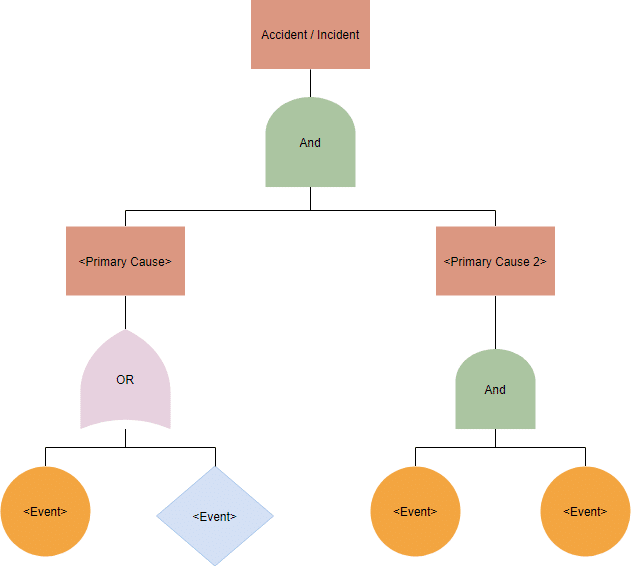
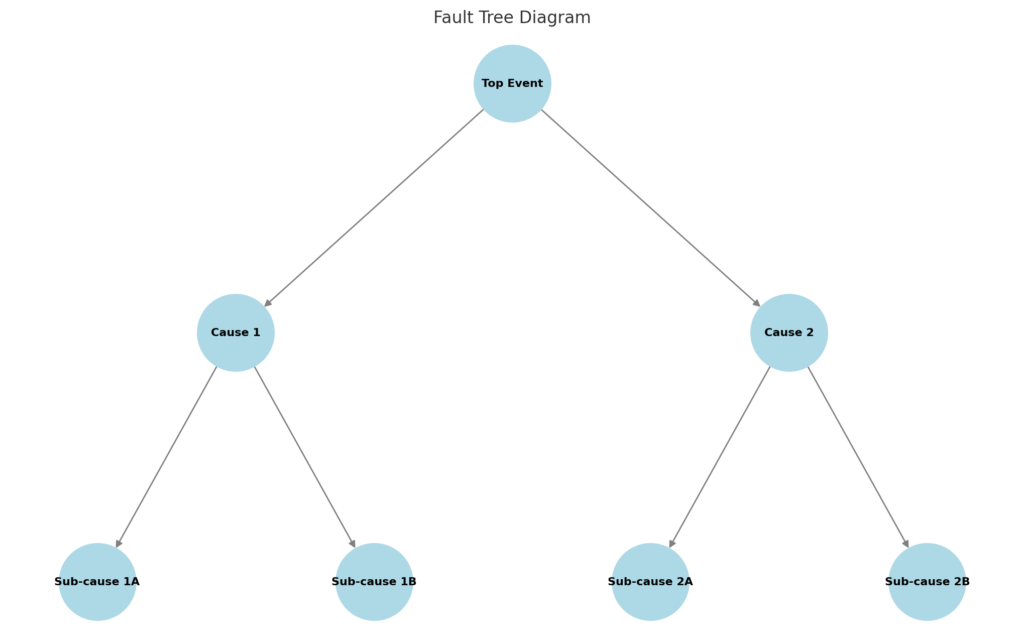
A Fault Tree is a structured graphical representation of failure logic that consists of several interconnected components. The most important element is the Top Event, which represents the final undesired outcome such as an explosion, fire, injury, or system shutdown. Beneath the top event are Intermediate Events, which represent contributing failures or conditions that directly lead toward the top event. At the lowest level are Basic Events, which represent root causes that cannot be broken down further within the scope of analysis.
These elements are connected using logical gates, which define how different events interact to produce higher-level failures. The structure of a fault tree allows complex systems to be visualized in a simplified yet highly logical form. It transforms complicated engineering and safety problems into a diagram that clearly shows relationships, dependencies, and critical failure pathways. This structured approach helps organizations identify weak points in systems and prioritize corrective actions effectively.
5. Understanding the Top Event in Depth
The Top Event is the foundation of Fault Tree Analysis because it defines the exact failure or accident being investigated. It is placed at the top of the diagram and acts as the starting point for all logical breakdowns. A well-defined top event is essential because it determines the entire scope and direction of the analysis. If the top event is too broad or unclear, the analysis becomes ineffective and may lead to incorrect conclusions.
Examples of top events include serious workplace injuries, chemical leaks, machinery failures, fire outbreaks, structural collapses, or process shutdowns. Each of these events must be clearly defined in terms of location, system, and conditions. The more precise the definition of the top event, the more accurate and useful the fault tree becomes. This ensures that investigators remain focused on the specific failure being analyzed rather than unrelated system issues.
6. Intermediate Events and Failure Progression
Intermediate events represent the progression stages between basic causes and the final top event. These events are extremely important because they show how failures escalate through the system. For example, in a fire scenario, intermediate events may include fuel leakage, presence of ignition sources, failure of detection systems, or delay in emergency response.
These events help break down complex systems into smaller logical sections that are easier to analyze and understand. By identifying intermediate events, safety professionals can pinpoint where in the system breakdowns occur and where preventive controls should be implemented. They also help in identifying critical control points where intervention can stop the progression toward a major accident.
7. Basic Events and Root Cause Mechanisms
Basic events represent the lowest level of analysis in Fault Tree Analysis and are considered the fundamental causes of system failure. These events are not broken down further because they represent root-level issues such as equipment malfunction, human error, procedural failure, design defects, or maintenance breakdowns.
However, modern safety thinking recognizes that even basic events often have deeper organizational causes behind them. For example, a human error may be linked to inadequate training, fatigue, or poor supervision. A mechanical failure may be linked to poor maintenance systems or design flaws. Therefore, identifying basic events is not the end of analysis but rather a step toward understanding deeper systemic weaknesses.
8. Logical Gates and Their Role in System Behavior
Logical gates are the core of Fault Tree Analysis because they define how different events interact. The AND gate represents situations where multiple failures must occur together for an accident to happen. For example, a fire requires fuel, oxygen, and an ignition source simultaneously. The OR gate represents situations where any single failure can trigger the top event, such as equipment failure caused by mechanical, electrical, or human error.
More advanced gates such as XOR, priority AND, inhibit, and voting gates are used in complex systems where sequence, timing, or conditional logic is important. These gates help accurately represent real-world system behavior where failures are not always independent. Logical gates transform the fault tree from a simple diagram into a powerful analytical model capable of representing complex industrial systems.
9. Step-by-Step Methodology of Fault Tree Construction
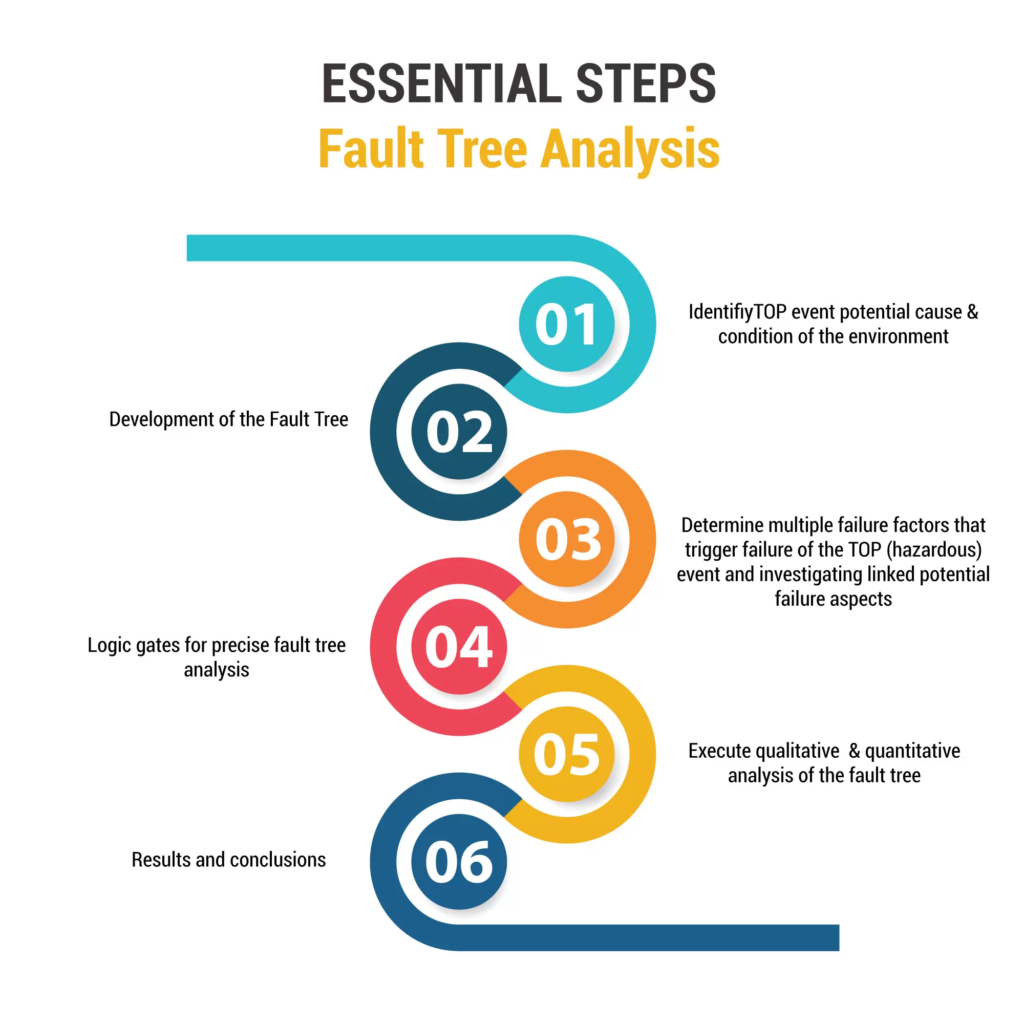
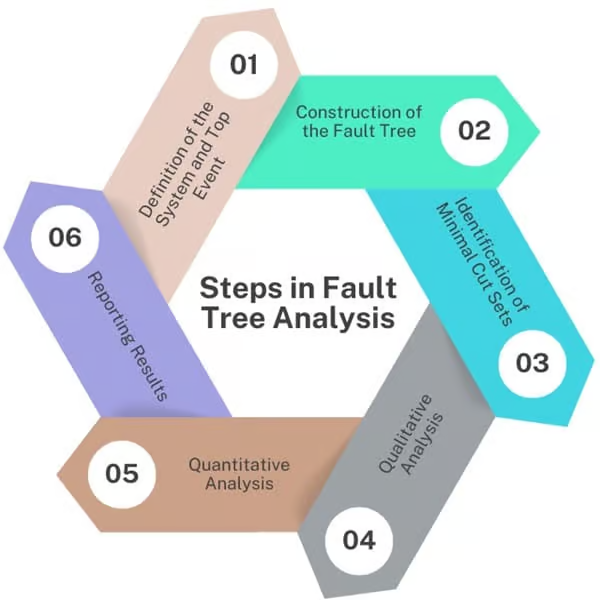
The process of Fault Tree Analysis begins with defining a clear and specific top event. Once this is established, system boundaries are defined to ensure the analysis remains focused and relevant. After this, detailed information is collected from maintenance records, incident reports, operational procedures, and technical documentation.
Next, investigators identify immediate causes and progressively break them down into intermediate and basic events. Each relationship is connected using logical gates to build a complete fault tree diagram. Once the diagram is constructed, failure pathways are evaluated to identify critical risk combinations. Finally, corrective actions are developed to eliminate or control these pathways, and the system is continuously reviewed for improvement and accuracy.
10. Industrial Applications of Fault Tree Analysis
Fault Tree Analysis is widely used across high-risk industries where system reliability and safety are critical. In construction, it is used to analyze structural failures, lifting accidents, and excavation hazards. In manufacturing, it helps investigate machine breakdowns and production failures. In oil and gas industries, it is essential for analyzing explosions, fires, and toxic releases.
In aviation, FTA is used to ensure aircraft reliability and prevent system failures. In healthcare, it is applied to patient safety incidents and medical equipment failures. In nuclear and power generation industries, it is critical for preventing catastrophic system failures. Its versatility makes it one of the most important tools in modern risk management.
11. Human Factors and Organizational Influences
Human factors play a major role in Fault Tree Analysis because many industrial incidents involve human actions or decisions. These include unsafe behavior, lack of training, fatigue, communication failures, and procedural violations. However, modern safety systems emphasize that human error is rarely the root cause; instead, it is usually a symptom of deeper organizational weaknesses.
FTA encourages investigators to explore why human errors occurred by examining factors such as supervision quality, training effectiveness, workload pressures, and organizational safety culture. This approach helps shift focus from blaming individuals to improving system design and organizational processes, leading to long-term safety improvements.
12. Benefits, Limitations, and Practical Challenges
Fault Tree Analysis offers significant benefits, including improved understanding of complex systems, enhanced risk identification, better decision-making, and stronger preventive safety measures. It helps organizations identify critical failure pathways and focus resources where they are most needed. It also improves communication between technical and management teams by providing a clear visual representation of risks.
However, FTA also has limitations. It can become extremely complex for large systems, requires high technical expertise, and depends heavily on accurate and complete data. If data is missing or incorrect, results may be misleading. Despite these challenges, FTA remains one of the most reliable and widely used tools for risk assessment and accident prevention.
13. Conclusion: Importance of FTA in Modern Safety Systems
Fault Tree Analysis is a powerful and essential tool in modern industrial safety management. It provides a structured and logical method for understanding how multiple failures interact to produce accidents. By using FTA, organizations can move beyond reactive investigation and adopt a proactive approach to risk prevention.
It enhances system reliability, improves hazard control, strengthens safety culture, and supports continuous improvement. In an increasingly complex industrial environment, FTA plays a vital role in protecting workers, assets, and the environment while ensuring safe and efficient operations.