
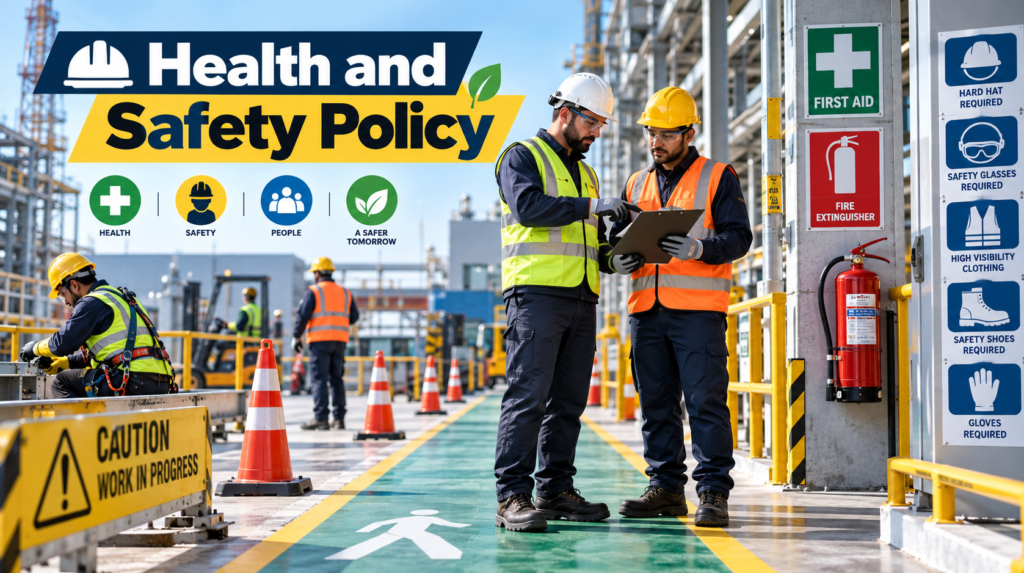
1. Introduction (Health and Safety Policy):
Health and safety policy is a written document that explains how an organisation protects its employees from workplace hazards and risks.
It provides clear safety rules, defines responsibilities, and helps create a safe and healthy working environment.
Every organisation should have a proper health and safety policy to prevent accidents and protect workers.
2. Purpose of a Health and Safety Policy:
The main purpose of a Health and Safety Policy is to protect employees and improve workplace safety.
Main Objectives:
Prevent workplace accidents and injuries.
Identify and control workplace hazards.
Provide a safe and healthy working environment.
Define health and safety responsibilities.
Follow relevant health and safety laws.
Improve safety awareness among employees.
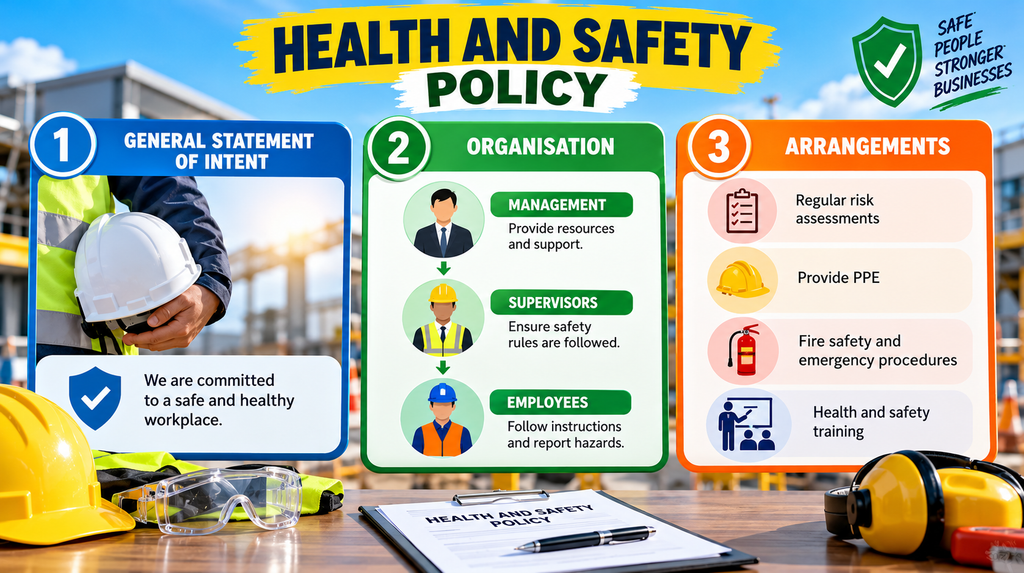
Health and Safety Policy has three main parts:
1. General Statement of Intent:
This is the first part of the policy. It explains the organisation’s commitment to protecting the health and safety of employees.
It shows that management is serious about providing a safe workplace and preventing accidents and injuries.
Example: A company promises to provide safe equipment, proper training, and a healthy working environment.
2. Organisation:
This part explains who is responsible for health and safety in the workplace.
It describes the duties and responsibilities of managers, supervisors, and employees.
Example:
Management: Provides safety equipment and resources.
Supervisors: Make sure safety rules are followed.
Employees: Follow safety instructions and report hazards.
3. Arrangements:
This part explains the practical steps taken by an organisation to maintain health and safety.
It describes how safety activities are planned and carried out to control workplace risks.
Examples:
Conducting regular risk assessments.
Providing Personal Protective Equipment (PPE).
Arranging fire safety and emergency procedures.
Providing health and safety training.
Ensuring the safety of visitor
3- How to Implement a Health and Safety Policy:
A policy is only effective when it is properly implemented.
Important Steps:
- Identify Hazards: Find possible dangers in the workplace.
- Assess Risks: Evaluate the likelihood and severity of harm.
- Apply Safety Controls: Take suitable actions to reduce risks.
- Provide Training: Educate employees about workplace safety.
- Monitor Performance: Conduct regular inspections and safety checks.
- Review the Policy: Update the policy when necessary to keep it effective.
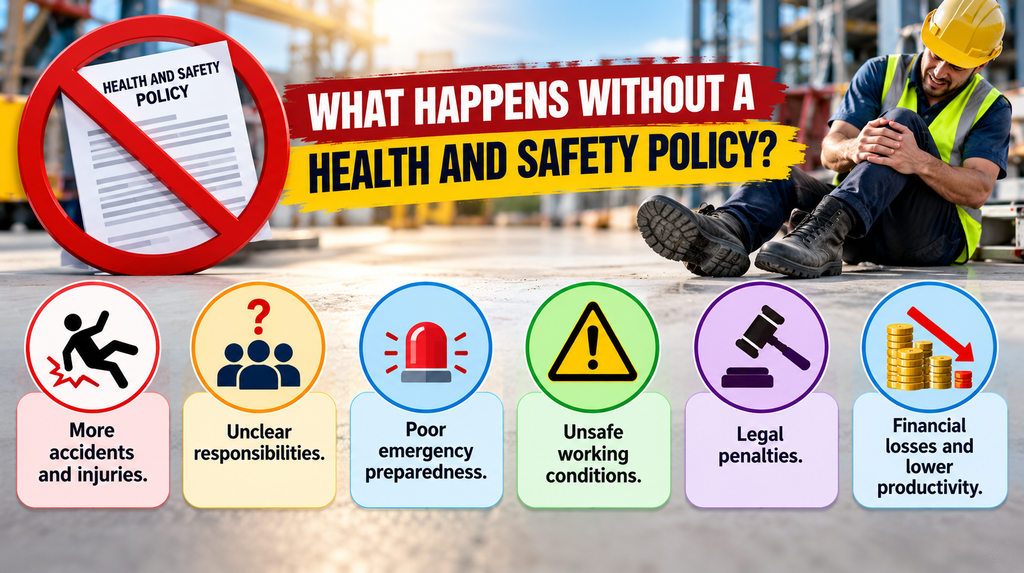
4- What Happens Without a Health and Safety Policy?
Without a proper health and safety policy, an organisation may face several problems.
– Increased workplace accidents and injuries.
– Unclear safety responsibilities.
– Poor emergency preparedness.
– Unsafe working conditions.
– Possible legal penalties.
– Financial losses and reduced productivity.
Example: If employees are not trained in fire safety, they may not know how to respond during a fire emergency.
5- When Should a Health and Safety Policy Be Reviewed?
A Health and Safety Policy should be reviewed regularly to ensure it remains suitable and effective.
It should also be reviewed when:
– Major workplace changes occur.
– New equipment or machinery is introduced.
– An accident reveals weaknesses in safety arrangements.
– Health and safety laws or requirements change.
– New hazards or risks are identified.
Conclusion:
A Health and Safety Policy is an essential part of workplace safety management. It provides clear guidelines for preventing accidents, controlling risks, and protecting employees.
The three main parts—General Statement of Intent, Organisation, and Arrangements—form the foundation of an effective policy.