
Leadership vs Management is an important topic for professionals who want to develop effective workplace skills, improve team performance, and achieve organisational success. Although leadership and management are often used interchangeably, they represent two different approaches to guiding people, managing responsibilities, and achieving organisational objectives. Understanding the difference between leadership and management helps professionals recognise how both skills contribute to a productive, organised, and safety-conscious workplace.
In today’s professional environment, effective leadership vs management practices are essential for building strong teams and maintaining high workplace standards. While leadership focuses on inspiring, motivating, and guiding employees towards a shared vision, management concentrates on planning, organising, monitoring, and controlling daily operations. In health and safety environments, both play a vital role in promoting safe working practices, managing workplace risks, ensuring compliance with relevant legislation, and developing a positive health and safety culture.
Effective leadership and management are essential for building a productive, organised, and safety-conscious workplace. Although the terms leadership and management are often used interchangeably, they represent two different but equally important approaches to achieving organisational success.
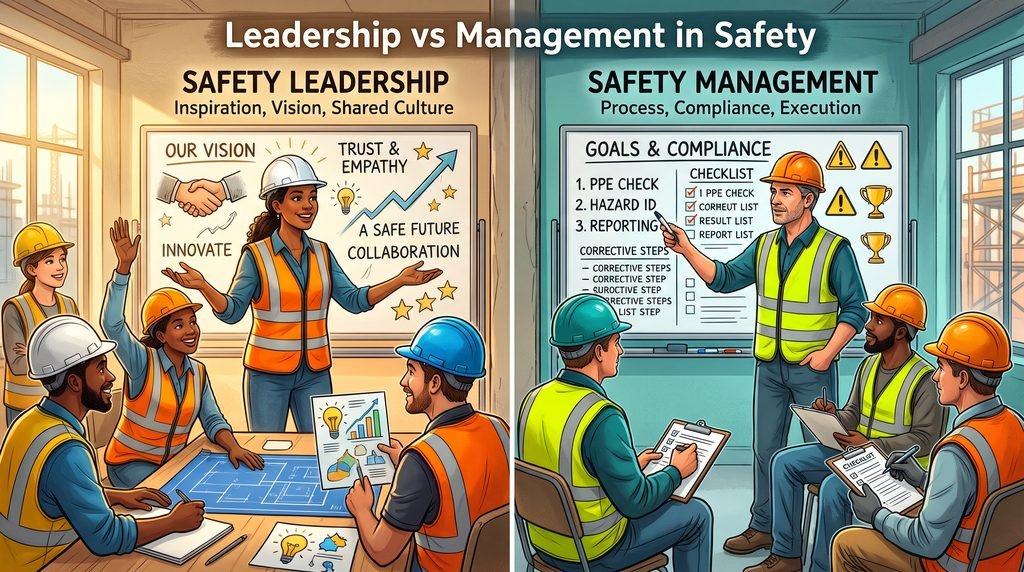
While management focuses on planning, organising, monitoring, and controlling daily operations, leadership focuses on inspiring people, building trust, motivating teams, and creating a shared vision.
Understanding the difference between leadership and management helps organisations develop stronger teams, improve workplace performance, and establish a positive health and safety culture.
In this blog, we explore the key differences between leadership and management, examine different management styles, and explain how both contribute to effective workplace practices.
1. What Is Leadership?
Leadership is the ability to influence, motivate, and guide individuals towards achieving common goals. A good leader provides direction, encourages teamwork, communicates a clear vision, and inspires employees to perform to their full potential.
Leadership is not simply about holding a senior position. It is about taking responsibility, making informed decisions, supporting employees, and setting a positive example.
In health and safety environments, effective leadership means promoting safe working practices, encouraging employees to report hazards, addressing workplace risks, and ensuring that safety remains a shared responsibility.
Key characteristics of effective leadership:
- Clear vision and direction.
- Strong communication and interpersonal skills.
- Ability to motivate and inspire others.
- Confidence in decision-making.
- Accountability and responsibility.
- Emotional intelligence and problem-solving.
- Commitment to continuous improvement.
2. What Is Management?
Management is the process of planning, organising, coordinating, and controlling resources to achieve specific organisational objectives.
Managers ensure that daily operations run efficiently, employees understand their responsibilities, deadlines are met, and organisational policies and procedures are followed.
In health and safety management, this includes implementing safety policies, conducting risk assessments, arranging training, monitoring compliance, and ensuring that appropriate control measures are in place.
Key characteristics of effective management:
- Planning and organising activities.
- Allocating resources and responsibilities.
- Monitoring employee performance.
- Setting targets and objectives.
- Implementing policies and procedures.
- Managing workplace risks.
- Ensuring legal and regulatory compliance.
3. Leadership vs Management: What Is the Difference?
Although leadership and management share the common objective of organisational success, their approaches differ.
| Leadership | Management |
| Focuses on people and vision. | Focuses on processes and objectives. |
| Inspires and motivates employees. | Organises and supervises employees. |
| Encourages innovation and change. | Maintains structure and consistency. |
| Builds trust and relationships. | Establishes systems and procedures. |
| Focuses on long-term direction. | Focuses on planning and daily operations. |
| Encourages individual development. | Monitors performance and productivity. |
| Leads through influence. | Coordinates through responsibility and authority. |
Why Are Both Important?
An organisation cannot rely entirely on leadership or management. It needs both to operate successfully.
Leadership provides direction and encourages employees to work towards a shared purpose, while management ensures that the necessary plans, resources, procedures, and systems are in place.
For example, a health and safety leader may encourage employees to develop a proactive safety culture. A health and safety manager ensures that risk assessments, safety training, inspections, and reporting procedures support that objective.
Together, leadership and management create a more effective and responsible workplace.
4. Different Types of Management Styles
Management styles refer to the different approaches managers use to supervise employees, make decisions, communicate expectations, and achieve organisational objectives.
There is no single management style that works in every situation. Effective managers understand their teams, assess workplace requirements, and adapt their approach accordingly.
Here are some of the most common management styles:
4.1 Autocratic Management Style
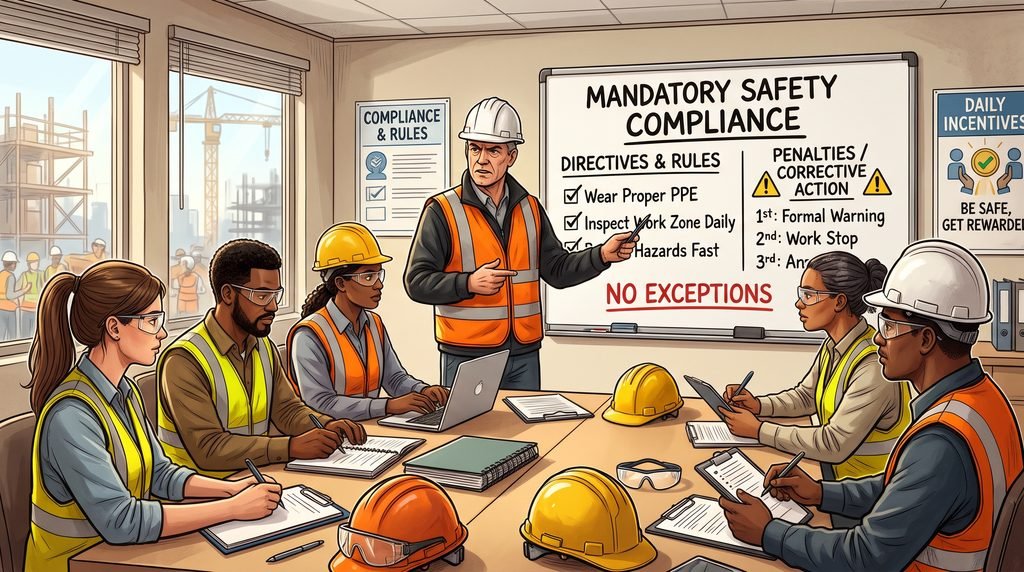
The autocratic management style involves making decisions independently, with limited input from employees. Managers provide clear instructions and expect employees to follow established procedures.
Advantages:
- Enables quick decision-making.
- Establishes clear authority and responsibilities.
- Useful in emergencies and high-risk situations.
- Ensures instructions are followed consistently.
Disadvantages:
- Can reduce employee participation.
- May affect motivation and job satisfaction.
- Limits opportunities for creative thinking.
Workplace application: This approach can be useful during an emergency evacuation, when employees need immediate instructions to protect themselves and others.
4.2 Democratic Management Style
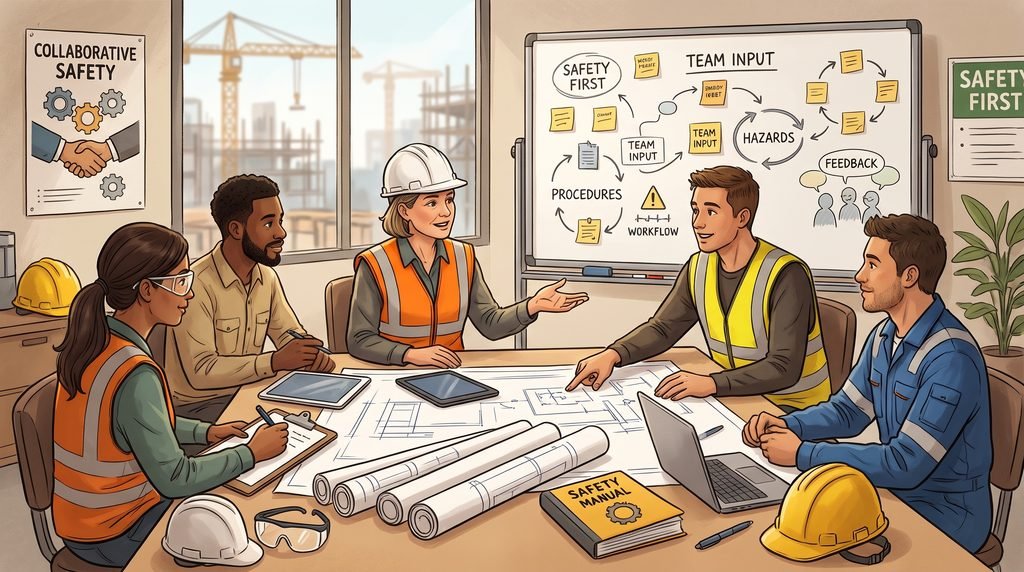
Democratic management encourages employee participation in decision-making. Managers actively seek feedback, consider different perspectives, and involve team members in finding solutions.
Advantages:
- Encourages teamwork and collaboration.
- Improves employee engagement.
- Promotes innovative ideas.
- Builds trust and communication.
Disadvantages:
- Decision-making can take longer.
- Reaching agreement may be challenging.
- Not always suitable for urgent situations.
Workplace application: A health and safety manager may consult employees when reviewing workplace risk assessments because workers often have practical knowledge of hazards and operational challenges.
4.3 Laissez-Faire Management Style

Laissez-faire management gives employees considerable independence in completing their responsibilities. Managers provide resources and general direction but allow team members to make many decisions independently.
Advantages:
- Encourages creativity and independence.
- Develops employee confidence.
- Gives skilled professionals greater responsibility.
- Promotes individual problem-solving.
Disadvantages:
- May create confusion without clear direction.
- Can result in inconsistent performance.
- Requires experienced and responsible employees.
Workplace application: This style may work well with experienced health and safety professionals who understand their responsibilities and can independently manage specific safety projects.
4.4 Transformational Management Style

Transformational management focuses on inspiring employees to improve performance, embrace change, and work towards long-term organisational goals.
Managers using this approach encourage professional development, innovation, and continuous improvement.
Advantages:
- Improves employee motivation.
- Encourages innovation and development.
- Creates a shared organisational vision.
- Supports positive workplace culture.
Disadvantages:
- Requires strong communication skills.
- Continuous change can create pressure.
- Employees may need additional support during transitions.
Workplace application: A transformational health and safety manager may introduce new safety initiatives, encourage behavioural change, and motivate employees to take greater ownership of workplace safety.
4.5 Transactional Management Style
Transactional management focuses on clearly defined responsibilities, performance expectations, rewards, and corrective actions.
Managers establish targets and monitor whether employees meet the required standards.
Advantages:
- Provides clear expectations.
- Establishes accountability.
- Helps maintain consistent performance.
- Supports compliance with workplace procedures.
Disadvantages:
- May limit creativity.
- Can focus too heavily on short-term targets.
- Employees may become motivated mainly by rewards or consequences.
Workplace application: A manager may monitor completion of mandatory safety training, workplace inspections, and equipment maintenance schedules to ensure that required standards are maintained.
4.6 Situational Management Style

Situational management involves adapting management behaviour according to the circumstances, employees’ experience, and the requirements of a particular task.
Rather than following one fixed approach, managers assess what their team needs and adjust their level of direction and support.
Advantages:
- Provides flexibility.
- Supports employees with different experience levels.
- Helps managers respond to changing situations.
- Encourages effective problem-solving.
Disadvantages:
- Requires strong judgement and adaptability.
- Inconsistent approaches may confuse employees.
- Managers need a good understanding of their teams.
Workplace application: A manager may provide close supervision to a newly recruited employee handling safety equipment while allowing an experienced professional greater independence.
5. How to Choose the Right Management Style
Choosing the right management style depends on several factors, including organisational objectives, employee experience, workplace risks, and the nature of the task.
Managers should consider:
1. Employee Experience: New employees may require more guidance, while experienced professionals may perform better with greater independence.
2. Workplace Requirements: High-risk activities may require direct supervision, clear instructions, and strict adherence to safety procedures.
3. Team Communication: Managers should consider how effectively employees communicate, collaborate, and contribute to decision-making.
4. Nature of the Task: Routine activities may benefit from structured management, whereas improvement projects may require greater employee participation.
5. Organisational Culture: Management approaches should support the organisation’s values, responsibilities, and long-term objectives.
An effective manager understands that flexibility is important. The ability to adapt management styles can improve team performance and organisational effectiveness.
6. The Importance of Leadership and Management in Health and Safety
Leadership and management play an essential role in developing and maintaining a strong workplace health and safety culture.
Health and safety is not simply about implementing policies or meeting legal requirements. It also involves influencing employee behaviour, promoting accountability, and ensuring that everyone understands their responsibilities.
Effective leadership and management contribute to:
- Improved safety awareness: Employees understand workplace hazards and the importance of following safe working practices.
- Better risk management: Workplace risks are identified, assessed, and controlled through appropriate procedures.
- Employee engagement: Workers are encouraged to participate in safety discussions and report unsafe conditions.
- Legal compliance: Organisations establish systems to meet applicable health and safety legislation.
- Effective communication: Safety instructions, responsibilities, and expectations are communicated clearly.
- Continuous improvement: Regular monitoring, feedback, and evaluation help strengthen workplace safety performance.
A strong safety culture develops when leaders demonstrate commitment through their actions and managers translate that commitment into effective policies, procedures, and daily practices.
7. How to Become an Effective Leader and Manager
Developing leadership and management skills requires continuous learning, practical experience, and a willingness to improve.
Professionals can strengthen their abilities by focusing on the following areas:
- Improve communication skills: Learn to communicate instructions clearly, listen actively, and provide constructive feedback.
- Develop decision-making abilities: Evaluate information, understand potential risks, and make informed decisions.
- Strengthen problem-solving skills: Identify challenges and develop practical solutions.
- Encourage teamwork: Build positive working relationships and promote collaboration.
- Understand health and safety legislation: Develop knowledge of relevant legal requirements and workplace responsibilities.
- Promote accountability: Take responsibility for decisions and encourage employees to fulfil their duties.
- Embrace continuous development: Stay updated with industry practices, professional training, and organisational requirements.
Effective professionals understand that leadership and management are not fixed abilities. They develop through experience, reflection, training, and continuous improvement.
8. Conclusion: Leadership and Management Work Best Together
Leadership and management are two essential elements of organisational success. While leadership inspires people, establishes direction, and encourages positive change, management provides the structure, planning, and coordination needed to achieve organisational objectives.
Understanding different management styles allows professionals to adapt their approach to employees, workplace conditions, and operational requirements.
In health and safety, combining effective leadership with strong management is particularly important. It helps organisations move beyond basic compliance towards a proactive safety culture where employees understand their responsibilities and actively contribute to creating safer working environments.
At ISS Safety, we believe that developing professional knowledge, effective communication, and strong leadership capabilities is essential for building safer and more responsible workplaces.