
Introduction
NFPA 291 provides essential guidance for fire hydrant flow testing, helping organisations assess water flow, pressure, and the reliability of their firefighting water supply. By following NFPA 291: Recommended Practice for Water Flow Testing and Marking of Hydrants, fire departments, safety professionals, and facility managers can evaluate hydrant performance, identify potential water supply limitations, and ensure that adequate water is available during emergencies. Regular testing and proper hydrant marking support effective fire protection planning and help firefighters respond confidently when every second counts.
An effective fire protection system depends on more than fire alarms, smoke detectors and extinguishers. One of its most important components is a reliable water supply that allows firefighters to respond effectively during emergencies.
Fire hydrants provide access to water for firefighting, but their presence alone does not guarantee that sufficient water pressure and flow will be available when needed.
This is where NFPA 291 becomes important.
Published by the National Fire Protection Association (NFPA), NFPA 291, titled Recommended Practice for Water Flow Testing and Marking of Hydrants, provides guidance on assessing fire hydrant water supply capacity, conducting flow tests and identifying hydrants through colour coding. https://www.nfpa.org/news-blogs-and-articles/blogs/2024/01/12/fire-hydrant-flow
For fire safety professionals, facility managers and fire protection engineers, understanding NFPA 291 is essential for evaluating firefighting water availability and maintaining effective fire protection arrangements.
1. What Is NFPA 291?
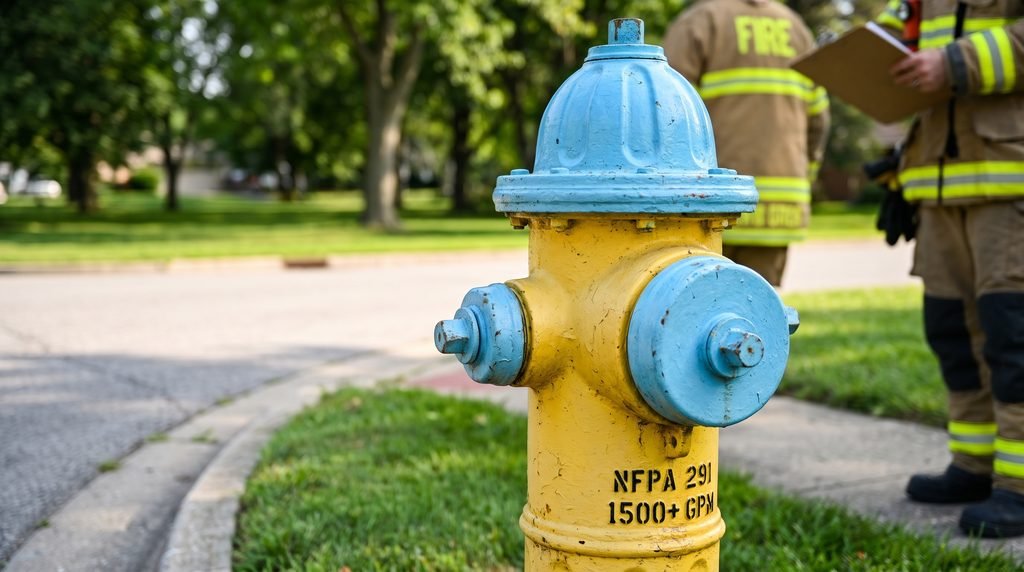
NFPA 291 provides guidance on determining the available fire service water supply through hydrant flow testing and marking hydrants according to their available capacity.
The standard is particularly relevant to:
- Fire protection engineers.
- Health and safety professionals.
- Facility and maintenance managers.
- Fire departments and emergency response teams.
- Industrial and commercial property owners.
- Water utility authorities.
The 2025 edition supersedes the 2022 edition and includes updated recommendations relating to hydrant inspection, testing, maintenance and colour coding, including private hydrants.
Note: NFPA 291 is a recommended practice. Its application depends on local regulations, adoption requirements and the Authority Having Jurisdiction (AHJ).
2. Why Is NFPA 291 Important?
Fire hydrants must provide adequate water to support firefighting operations. Insufficient pressure or flow can compromise emergency response, particularly in industrial facilities, warehouses and commercial buildings.
NFPA 291 helps organisations:
- Determine available firefighting water supply.
- Identify inadequate water pressure and flow.
- Evaluate hydrant performance.
- Support fire protection system planning.
- Improve emergency response preparedness.
- Identify maintenance and repair requirements.
Regular assessment helps ensure that hydrants remain reliable and suitable for their intended purpose.
3. Understanding Fire Hydrants
Fire hydrants are connection points within water distribution systems that allow firefighters to access water during emergencies.
Common types include:
Dry Barrel Hydrants: Designed to drain the main barrel after operation, making them suitable for areas where freezing temperatures are a concern.
Wet Barrel Hydrants: Remain filled with water and generally have individually operated outlet valves. They are commonly used in warmer climates.
Public Hydrants: Connected to municipal water distribution networks and generally managed by public authorities or water utilities.
Private Hydrants: Installed within privately managed properties such as factories, warehouses and commercial complexes.
Regardless of the type, hydrants must remain accessible, operational and properly maintained.
4. Understanding Fire Hydrant Flow Testing
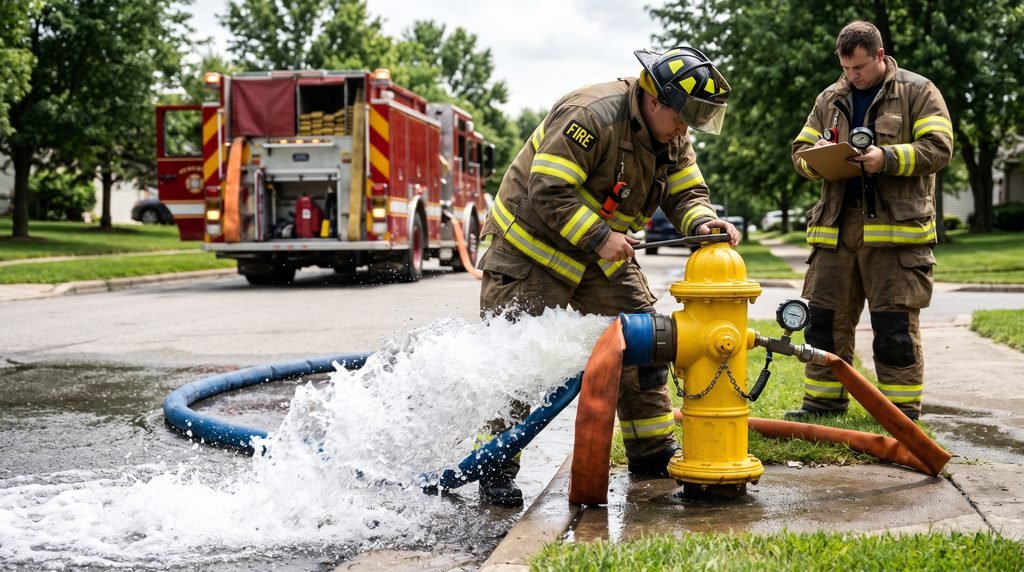
Fire hydrant flow testing determines how much water a hydrant or connected water distribution system can deliver under specified pressure conditions.
Three important pressure measurements must be understood.
Static Pressure
Static pressure is the pressure measured when no water is flowing through the test arrangement.
It establishes the initial pressure condition of the water distribution system.
Residual Pressure
Residual pressure is the pressure remaining in the system while water is being discharged through the flowing hydrant arrangement.
It helps determine how the water supply responds when demand increases.
Pitot Pressure
Pitot pressure is the velocity pressure measured in the flowing water stream using a Pitot tube.
It is used to calculate the discharge rate through the hydrant outlet.
| Measurement | Purpose |
| Static pressure | Measures pressure before discharge |
| Residual pressure | Measures pressure during discharge |
| Pitot pressure | Measures velocity pressure in the water stream |
| Flow rate | Determines water discharged per minute |
These measurements help professionals assess the availability and performance of firefighting water supplies.
5. NFPA 291 Fire Hydrant Flow Testing Procedure
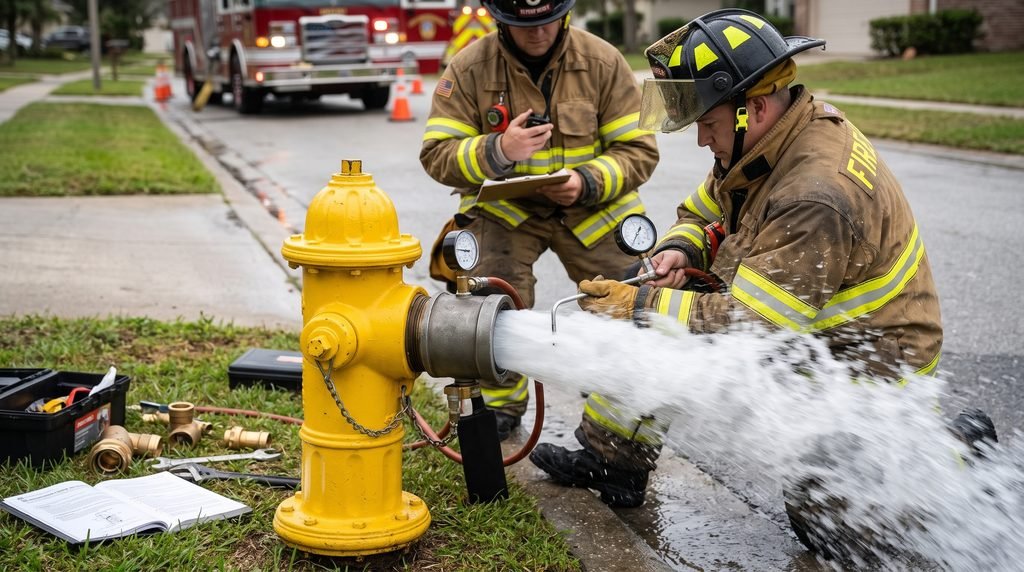
A typical water main capacity test involves the following activities:
Step 1: Identify the Hydrants
Select the appropriate hydrants and understand the layout of the water distribution network.
Step 2: Conduct a Visual Inspection
Check for corrosion, damage, leaking connections, blocked outlets and accessibility issues.
Step 3: Prepare Testing Equipment
Common equipment includes pressure gauges, Pitot tubes, flow nozzles, hydrant wrenches, diffusers and recording sheets.
Step 4: Measure Static Pressure
Record the pressure at the designated residual hydrant before opening the flowing hydrants.
Step 5: Discharge Water
Open the designated flow hydrant outlets using an appropriate testing arrangement.
Step 6: Measure Residual and Pitot Pressure
Record residual pressure at the designated residual hydrant and Pitot pressure at the flowing outlet or outlets.
Step 7: Calculate Available Fire Flow
Use the measured flow and pressure readings to estimate the available water supply at the required residual pressure.
Step 8: Document the Results
Prepare a report containing test readings, calculated flow, hydrant condition and recommendations for corrective action.
Important: A single-hydrant discharge test and a water main capacity test are different procedures. They should not be treated as interchangeable.
6. NFPA 291 Water Flow Calculations
Water flow calculations help determine the quantity of water discharged through a hydrant outlet and estimate the available firefighting water supply.
Hydrant Discharge Formula
The commonly used formula in US customary units is:
\[ Q=29.84 \times C \times d^2 \times \sqrt{p} \]
Where:
- Q = Discharge in gallons per minute (GPM).
- C = Discharge coefficient.
- d = Outlet diameter in inches.
- p = Pitot pressure in PSI.
Practical Example
Assume:
- Outlet diameter = 2.5 inches.
- Pitot pressure = 20 PSI.
- Discharge coefficient = 0.90.
Substituting the values:
\[ Q=29.84 \times 0.90 \times 2.5^2 \times \sqrt{20} \]
\[ Q\approx749\ GPM \]
CALCULATED DISCHARGE
749 GPM
Approximately 2,835 litres per minute.
This represents the illustrative discharge through one outlet, not the available fire flow of the entire water distribution network.
Available Fire Flow Calculation
The estimated available fire flow at a specified residual pressure can be calculated using:
\[ Q_R=Q_F \times \left(\frac{h_r}{h_f}\right)^{0.54} \]
Where:
- \(Q_R\) = Predicted flow at the desired residual pressure.
- \(Q_F\) = Measured flow during testing.
- \(h_r\) = Pressure drop corresponding to the desired residual pressure.
- \(h_f\) = Pressure drop measured during testing.
This calculation helps professionals estimate the water supply available at a specified pressure.
The applicable NFPA 291 edition should always be consulted for the correct testing procedure and calculation requirements.
7. NFPA 291 Fire Hydrant Colour Coding
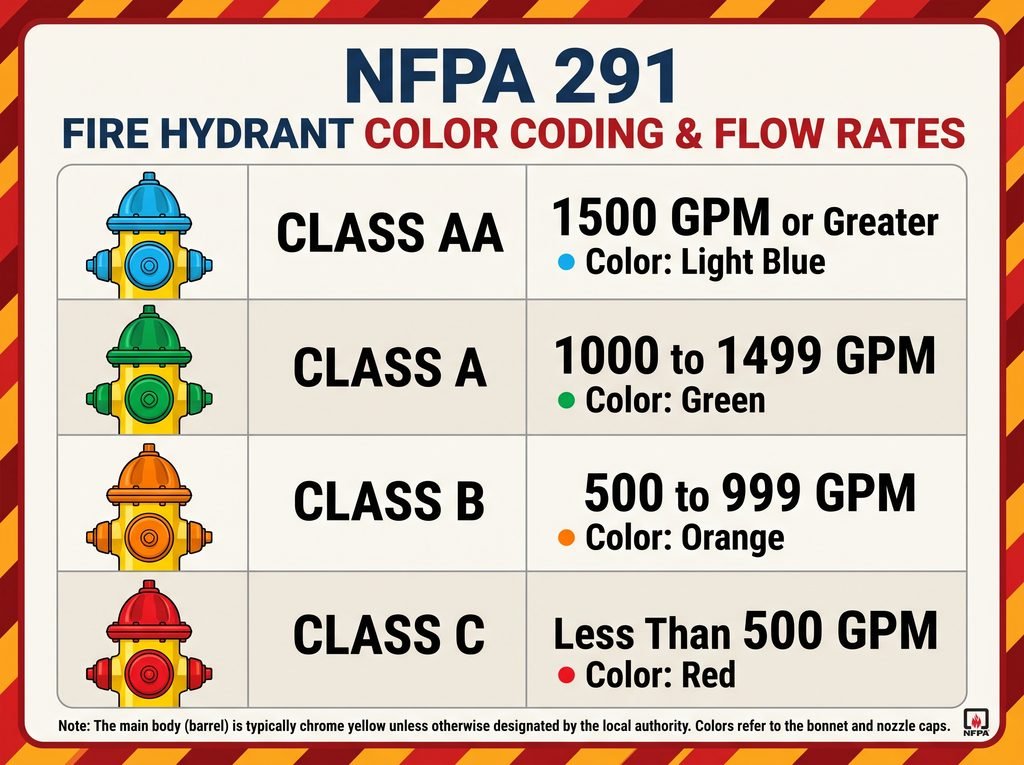
One of the most important features of NFPA 291 is its hydrant capacity classification system.
The colour coding helps firefighters identify the relative available water supply during emergencies.
| Classification | Rated Capacity | Colour |
| Class AA | More than 1,500 GPM | Light Blue |
| Class A | 1,000–1,499 GPM | Green |
| Class B | 500–999 GPM | Orange |
| Class C | Less than 500 GPM | Red |
Understanding the Classifications
- Class AA – Light Blue: Indicates a hydrant with a rated capacity exceeding 1,500 GPM.
- Class A – Green: Indicates a rated capacity between 1,000 and 1,499 GPM.
- Class B – Orange: Indicates a rated capacity between 500 and 999 GPM.
- Class C – Red: Indicates a rated capacity below 500 GPM.
Colour coding helps emergency response teams identify relative water availability and make informed decisions about water supply arrangements.
The colour of a hydrant’s body, bonnet and nozzle caps should be interpreted according to the applicable NFPA guidance and local authority requirements.
8. Inspection, Testing and Maintenance of Fire Hydrants
Fire hydrants require regular inspection and maintenance to ensure that they remain operational.
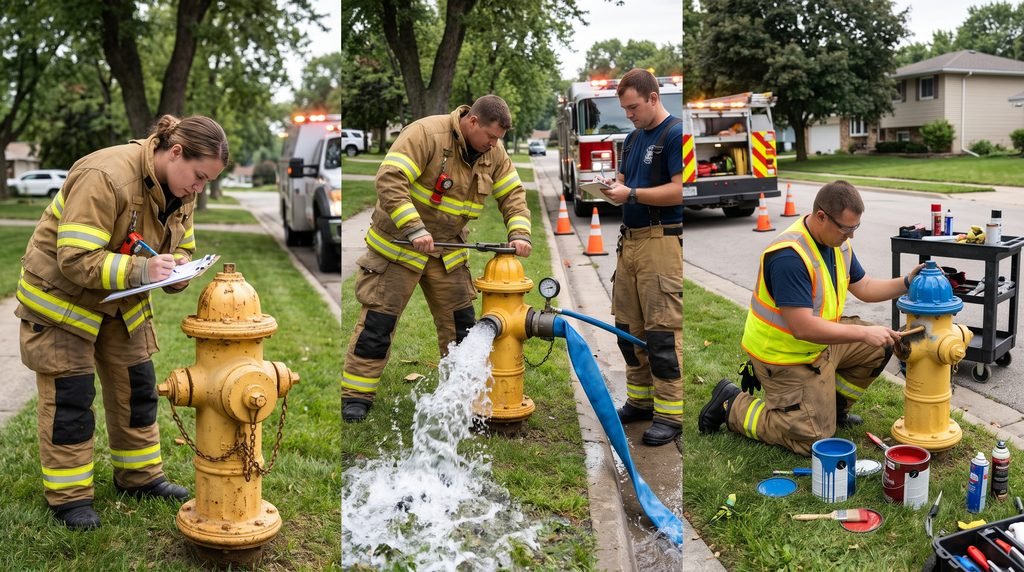
Important inspection activities include:
- Checking physical damage and corrosion.
- Inspecting outlet caps and connections.
- Checking for water leakage.
- Ensuring hydrants remain accessible.
- Checking operating valves and components.
- Conducting appropriate flow testing.
- Verifying identification and colour markings.
- Maintaining inspection and testing records.
Any identified defects should be investigated and corrected by competent personnel.
Organisations should establish inspection and maintenance programmes in accordance with applicable NFPA guidance, local regulations and AHJ requirements.
9. Relationship Between NFPA 291 and Other NFPA Standards
NFPA 291 works alongside other fire protection standards to support effective fire safety management.
| Standard | Main Purpose |
| NFPA 13 | Installation of sprinkler systems |
| NFPA 14 | Installation of standpipe and hose systems |
| NFPA 20 | Installation of stationary fire pumps |
| NFPA 24 | Installation of private fire service mains and hydrants |
| NFPA 25 | Inspection, testing and maintenance of water-based fire protection systems |
| NFPA 291 | Hydrant flow testing and marking |
These standards address different aspects of fire protection and should be considered together when developing a comprehensive fire safety strategy.
10. Common Problems Identified During Hydrant Testing
Hydrant testing can reveal several issues that may affect firefighting operations.
Low Water Pressure: May indicate supply limitations, high demand or pumping problems.
Restricted Water Flow: May result from blocked pipes, partially closed valves or internal deposits.
Corrosion and Damage: Can affect hydrant reliability and operating performance.
Water Leakage: May indicate damaged valves, connections or underground pipes.
Inaccessible Hydrants: Vehicles, vegetation and stored materials can obstruct emergency access.
Incorrect Colour Coding: Outdated markings may create confusion about hydrant capacity.
Identifying these issues allows organisations to arrange corrective measures before an emergency occurs.
11. Responsibilities of Health and Safety and Fire Safety Professionals
Health and safety professionals play an important role in ensuring that fire hydrant arrangements are properly managed.
Their responsibilities include:
- Ensuring hydrant availability is considered in fire risk assessments.
- Coordinating inspections and testing with competent specialists.
- Monitoring identified deficiencies.
- Maintaining relevant safety documentation.
- Supporting emergency preparedness arrangements.
- Ensuring corrective actions are followed up.
- Advising management about fire protection improvements.
Fire protection engineers and competent testing personnel should undertake the technical assessment and interpretation of hydrant flow test results.
Read more about NFPA Fire Safety Codes https://learner.internationalsafetysolution.com/blogs/nfpa-fire-safety-codes/
Conclusion: Why NFPA 291 Matters for Effective Fire Protection
An effective firefighting strategy requires more than installing fire hydrants. Organisations must ensure that these hydrants can deliver an adequate and reliable water supply when emergencies occur.
NFPA 291 provides essential guidance on fire hydrant flow testing, pressure measurements, water flow calculations and hydrant colour coding.
By understanding static pressure, residual pressure and Pitot pressure, fire protection professionals can better evaluate water supply conditions and identify potential deficiencies.
Its colour classification system also helps firefighters recognise the relative capacity of hydrants during emergency response.
For health and safety professionals, fire protection engineers and facility managers, understanding NFPA 291 is an important part of maintaining effective fire protection arrangements. https://www.nfpa.org/product/nfpa-291-recommended-practice/p0291code/nfpa-291-74-pdf/29174pdf
Test the Supply. Verify the Capacity. Protect Lives and Property.