
1. Introduction
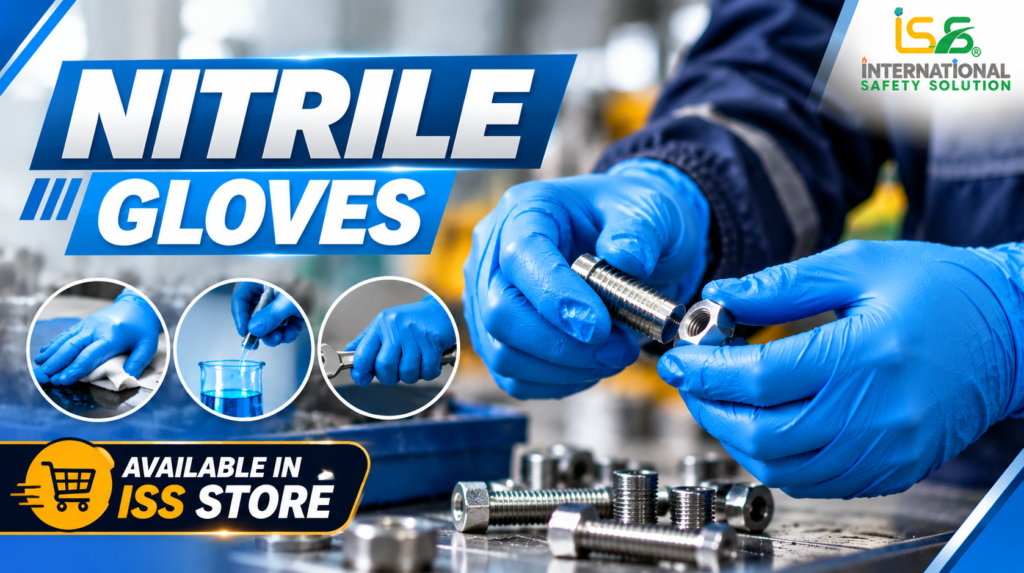
Nitrile Safety Gloves: Hand protection is essential in industries where workers are exposed to chemicals, oils, contaminants and other workplace hazards. Nitrile gloves are widely used as personal protective equipment (PPE) because of their flexibility, durability and protective barrier properties.
They are commonly used in healthcare, laboratories, food processing, automotive maintenance and selected industrial operations.
2. What Are Nitrile Gloves?
Nitrile gloves are protective gloves made from synthetic nitrile butadiene rubber (NBR). They provide a barrier against selected chemicals, oils, contaminants and microorganisms, depending on their design, thickness and certification.
Key Features:
- Latex-Free Material: Suitable for people with natural rubber latex allergies.
- Puncture Resistance: Helps resist punctures during suitable tasks.
- Chemical Resistance: Protects against selected substances when compatible.
- Flexible Design: Supports finger movement and precision work.
- Comfortable Grip: Textured models provide improved handling.
- Powder-Free Options: Commonly used in medical and hygiene-sensitive environments.

Nitrile Safety Gloves Available at International Safety Solution (ISS)
International Safety Solution (ISS) offers nitrile safety gloves for workplace hand protection across various industries, including healthcare, laboratories, food processing, automotive workshops and industrial maintenance.
Choose suitable nitrile gloves according to your workplace hazards and protection requirements.
Explore Nitrile Safety Gloves at ISS Store: 🌐 https://internationalsafetysolution.com/
Safety Today | Strong & Secure Tomorrow
3. Types of Nitrile Gloves
| Type | Features | Common Applications |
|---|---|---|
| Disposable Nitrile Gloves | Thin, flexible, single-use | Healthcare, laboratories, food handling |
| Heavy-Duty Nitrile Gloves | Thicker material, increased durability | Industrial cleaning, maintenance |
| Chemical-Resistant Nitrile Gloves | Tested protection against specified chemicals | Chemical handling and processing |
| Nitrile-Coated Work Gloves | Textile base with nitrile coating | Material handling, assembly, mechanical work |
4. Industrial Applications of Nitrile Gloves
| Industrial Application | Practical Use | Picture |
|---|---|---|
| Automotive & Mechanical Workshops | Oil changes, engine maintenance and handling greasy components. |  |
| Food Processing Industry | Hygienic food handling, preparation and packaging using food-contact-approved gloves. |  |
| Chemical & Laboratory Work | Handling laboratory samples and compatible chemicals. |  |
| Healthcare & Medical Facilities | Medical examinations, patient care and protection against biological contaminants. |  |
| Industrial Cleaning & Maintenance | Handling selected cleaning chemicals, detergents and contaminated equipment. |  |
5. Workplace Hazards and Protection
| Workplace Hazard | Role of Suitable Nitrile Gloves |
|---|---|
| Chemical splashes | Reduce skin contact with compatible chemicals |
| Oil and grease | Provide a barrier during mechanical tasks |
| Biological contaminants | Help limit direct exposure to potentially infectious material |
| Dirt and contamination | Reduce direct contact with contaminated surfaces |
| Minor abrasion | Some thicker or coated types offer limited mechanical protection |

6. Benefits of Using Nitrile Gloves
- Hand Protection: Reduces direct contact with selected workplace hazards.
- Better Hygiene: Helps control contamination when changed correctly.
- Latex-Free Alternative: Avoids natural rubber latex proteins.
- Improved Dexterity: Supports precise handling of small equipment.
- Versatile Applications: Available in different thicknesses and designs for various industries.
7. Nitrile Gloves vs. Latex Gloves
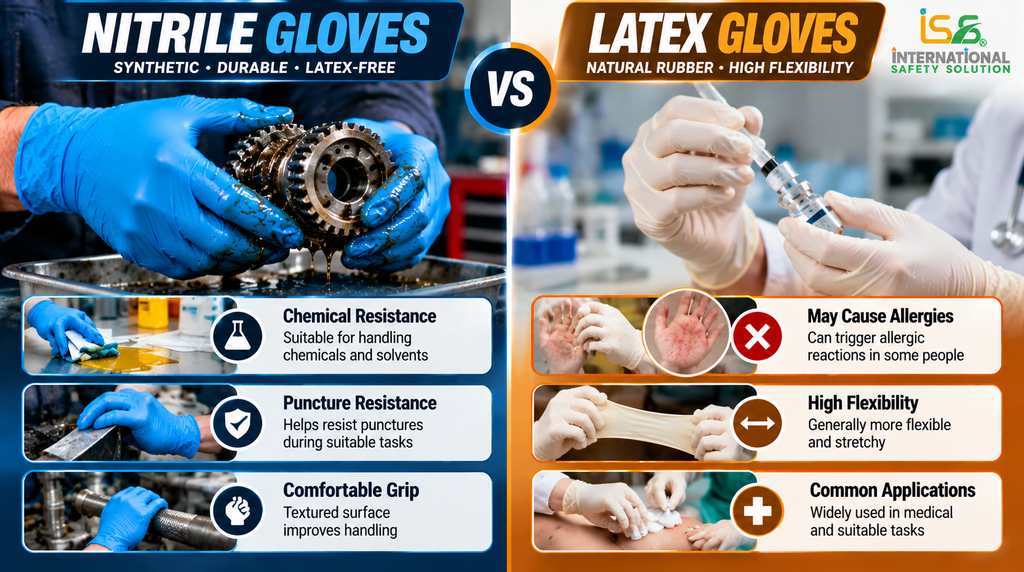
| Parameter | Nitrile Gloves | Latex Gloves |
|---|---|---|
| Material | Synthetic rubber | Natural rubber latex |
| Natural latex allergy | Latex-free | May cause allergic reactions |
| Flexibility | Good | Generally excellent |
| Chemical resistance | Depends on chemical and glove type | Depends on chemical and glove type |
| Common applications | Healthcare, laboratories, industry | Medical and other suitable tasks |
8. How to Select the Right Nitrile Gloves
Before selecting nitrile gloves, consider:
- Workplace Hazard: Identify chemicals, contaminants or physical hazards.
- Glove Thickness: Choose according to the task and required protection.
- Chemical Compatibility: Review the chemical Safety Data Sheet (SDS) and manufacturer’s resistance chart.
- Correct Size: Ensure proper fit and finger movement.
- Grip and Cuff Length: Select suitable grip performance and coverage.
- Safety Standards: Verify applicable product certifications and testing.
For chemical handling, evaluate both breakthrough time and expected exposure conditions. A thicker glove does not automatically protect against every chemical.
9. Inspection, Proper Use and Disposal
Before Use
- Check for holes, tears and deterioration.
- Select the correct size and glove type.
- Ensure hands are clean and dry.
During Use
- Avoid contact with incompatible chemicals.
- Replace damaged or excessively contaminated gloves.
- Avoid touching clean surfaces with contaminated gloves.
After Use
- Remove gloves without touching the contaminated outer surface.
- Dispose of single-use gloves appropriately.
- Wash or sanitize hands after glove removal.
- Clean and inspect reusable industrial gloves according to the manufacturer’s instructions.

Disposable medical gloves must not be washed or reused.
10. Limitations of Nitrile Gloves
Although nitrile gloves offer useful protection, certain limitations must be considered:
- Not suitable for every solvent or hazardous chemical.
- Disposable models can tear or puncture.
- Standard thin nitrile gloves do not provide reliable heat or flame protection.
- Prolonged chemical exposure can reduce barrier performance.
- Not a substitute for appropriate cut-resistant gloves when sharp blades are involved.
11. Conclusion
Nitrile gloves are an important part of workplace hand protection across healthcare, laboratories, food processing and industrial operations. Their flexibility, durability and range of protective properties make them useful for many professional applications.
However, effective hand protection requires selecting the correct glove for the specific hazard, inspecting it before use and following proper handling and disposal procedures.
International Safety Solution (ISS) promotes workplace safety through appropriate PPE selection, hazard awareness and safe working practices.