
1. Introduction
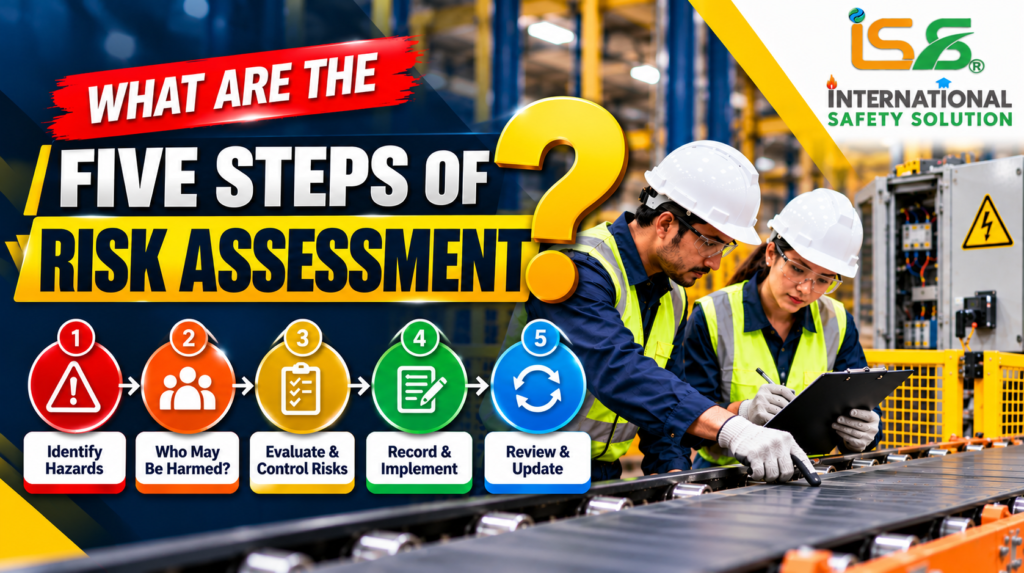
Risk assessment is a systematic process used to identify workplace hazards, evaluate potential risks and implement suitable control measures to prevent accidents, injuries and occupational illnesses.
The Health and Safety Executive (HSE) recommends a five-step approach to workplace risk assessment.
Five Steps to Fire Risk Assessment:
Following are the steps of fire risk assessment:

To understand these steps practically, we will follow one industrial example throughout the entire assessment.
2. Practical Workplace Scenario:
Example: Maintenance of an Industrial Conveyor Belt
A maintenance technician needs to repair a conveyor belt in a manufacturing factory. The conveyor is powered by electricity and contains moving rollers and mechanical components.
Before starting work, the HSE officer must assess the risks associated with the maintenance activity.
Step 1: Identify the Hazards:
The first step is to identify anything that could cause harm during conveyor maintenance.
Practical example:
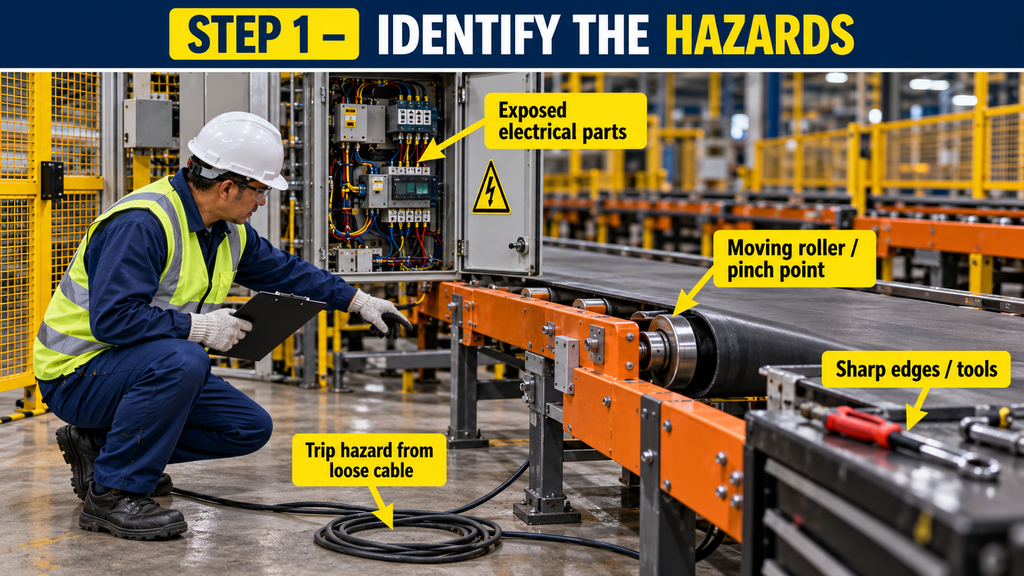
During inspection, the HSE officer identifies the following hazards:
- Unexpected conveyor startup
- Exposed moving rollers and pinch points
- Electrical energy and stored mechanical energy
- Tools and materials creating trip hazards
Key action: Inspect the workplace, equipment and maintenance activity before allowing work to begin.
Step 2: Identify Who Might Be Harmed and How:
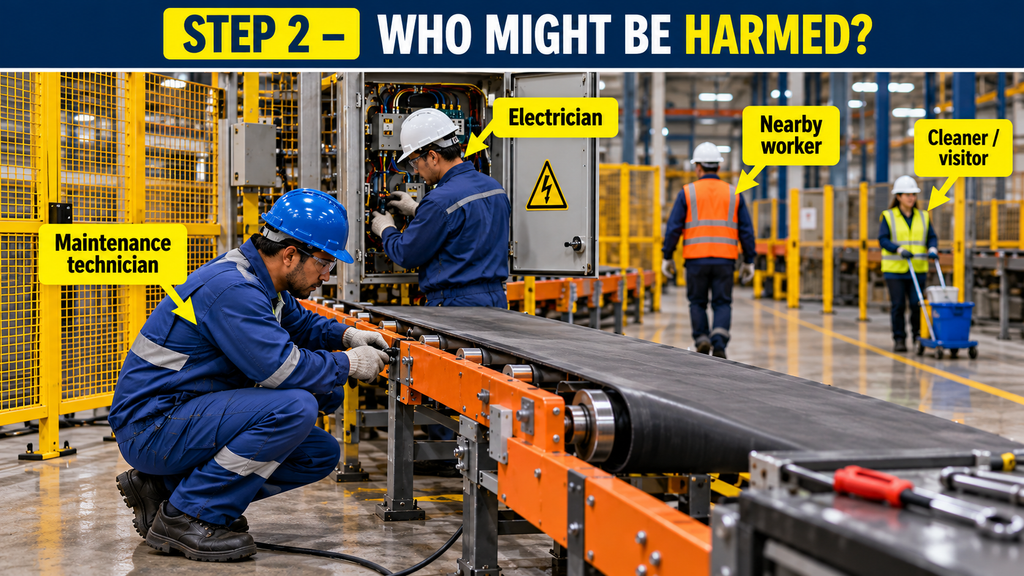
Determine which people may be exposed to the identified hazards and what injuries could occur.
| Person at risk | Possible harm |
|---|---|
| Maintenance technician | Hand crushing or entanglement |
| Electrician | Electric shock or burns |
| Nearby workers | Injury from unexpected movement |
| Cleaning staff | Trips or accidental contact with equipment |
Key action: Consider employees, contractors and anyone entering the maintenance area.
Step 3: Evaluate Risks and Decide on Controls:
Assess how likely each incident is and how severe its consequences could be.
For this example, unexpected conveyor startup is considered a high risk before controls because it may cause serious crushing injuries.
Required preventive measures:
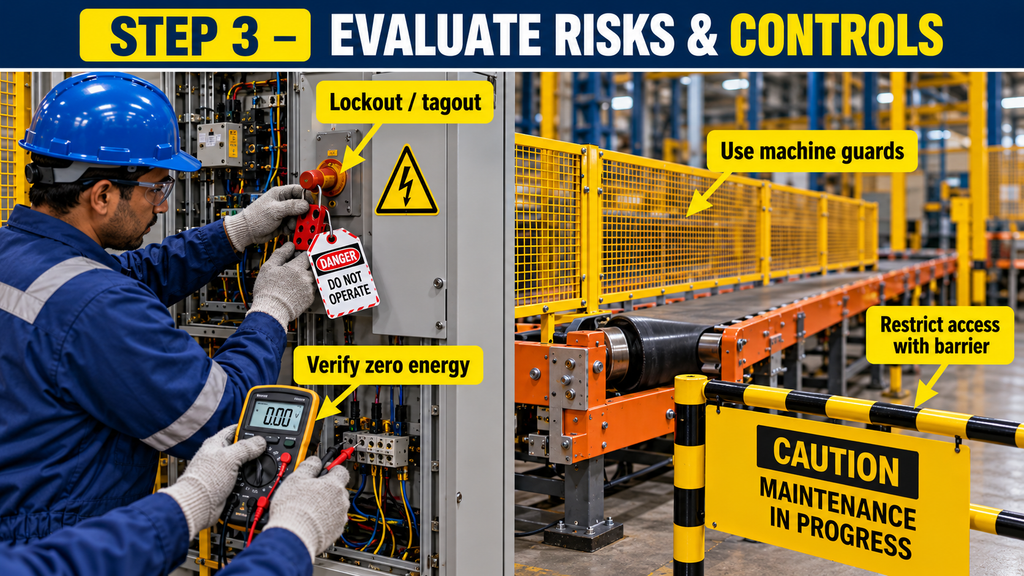
- Shut down the conveyor and isolate all relevant energy sources.
- Apply personal Lockout/Tagout (LOTO) in accordance with the approved isolation procedure.
- Release or secure stored mechanical energy and verify zero-energy state before work.
- Secure the maintenance area using barriers and warning signs.
- Use appropriate PPE and follow safe maintenance procedures.
Key action: Prioritize elimination and engineering controls rather than relying on PPE alone.
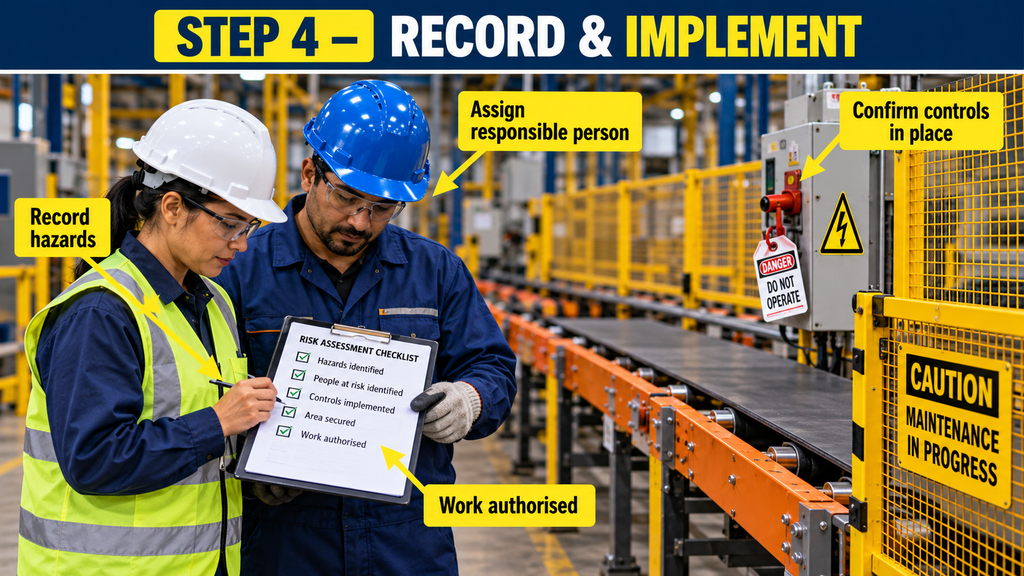
Step 4: Record Findings and Implement Controls:
Document the hazards, affected workers, risk levels, required controls and responsible persons.
Example risk assessment record:
| Assessment item | Recorded finding |
|---|---|
| Activity | Conveyor belt maintenance |
| Main hazard | Unexpected startup |
| Potential injury | Crushing or entanglement |
| Initial risk | High |
| Control measures | Isolation, LOTO, zero-energy verification, barriers |
| Responsible person | Maintenance Supervisor |
| Residual risk | Low, subject to verification |
The risk ratings are illustrative; the actual assessment must reflect site conditions and the effectiveness of controls.
Key action: Record the assessment and confirm that the recommended controls are actually implemented.
Step 5: Review and Update the Risk Assessment:
Risk assessment does not end after documentation. The effectiveness of implemented safety controls must be checked regularly.
Practical example:
Before and during maintenance, the supervisor verifies that:
- Isolation and LOTO arrangements remain effective.
- Workers follow the approved maintenance procedure.
- Barriers and warning signs remain in position.
- No new hazards have developed during the task.
If the maintenance procedure changes, a near miss occurs or existing controls become ineffective, the assessment must be reviewed and updated.
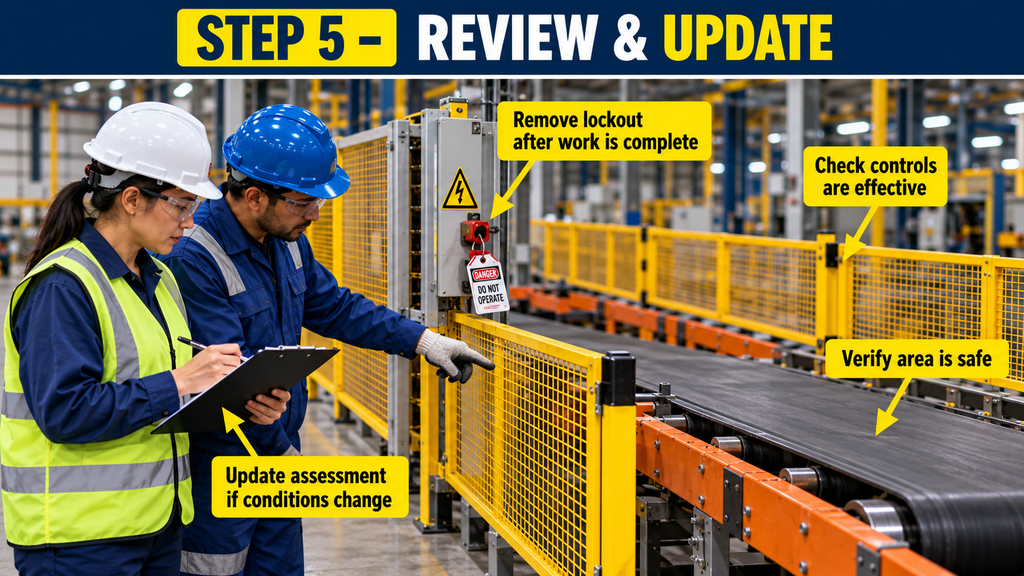
Key action: Continuously monitor safety controls and revise the assessment when required.
4. Conclusion:
The five steps of risk assessment provide a structured approach to preventing workplace accidents and improving occupational safety.
In our conveyor maintenance example, the process begins with identifying the hazards and ends with reviewing the effectiveness of the safety measures.
A successful risk assessment is not simply a document — it is a practical process that helps protect workers before, during and after hazardous activities.
Safety Today | Strong & Secure Tomorrow