
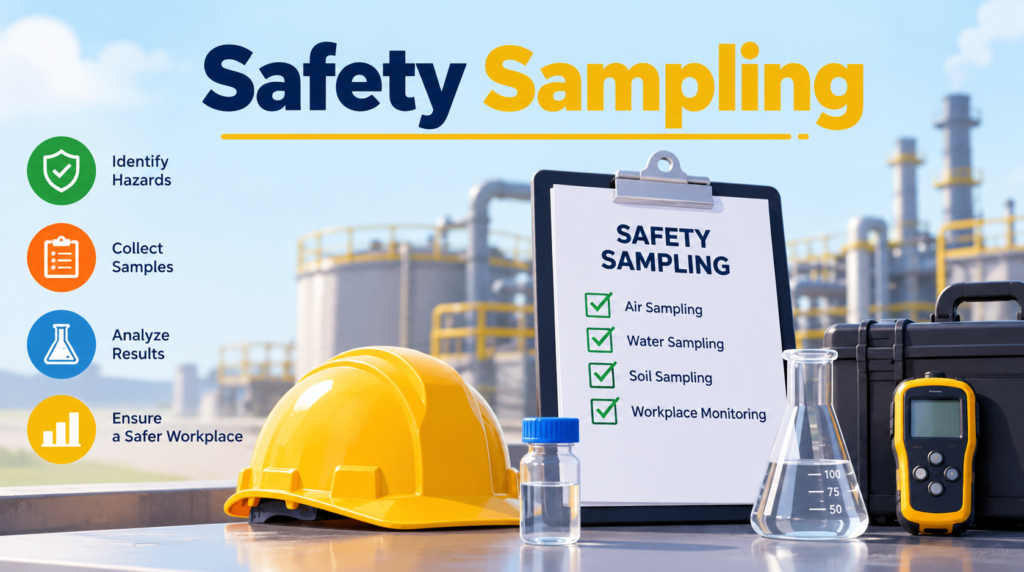
A practical guide of safety sampling to measuring unsafe acts, identifying trends, and preventing incidents before they happen.
What this guide covers:
Definition • purpose • sampling plan • field procedure • checklist • scoring • Pareto analysis • corrective action • best practices.
Prepared in the practical, easy-to-apply style used by International Safety Solution for HSE learners and workplace professionals.
What Is Safety Sampling?
Safety sampling is a structured workplace inspection technique in which selected activities, behaviors, processes, or areas are observed at planned or random times to measure how often safe and unsafe conditions occur. The United Kingdom Health and Safety Executive describes safety sampling as systematic sampling of particular dangerous activities, processes, or areas. Safety literature also uses the terms behavior sampling or activity sampling when the focus is on observable work practices.
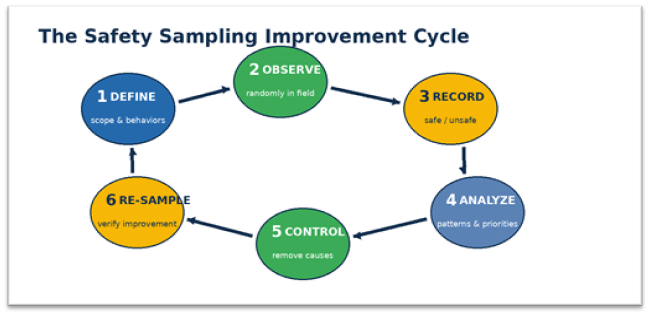
Unlike an accident investigation, safety sampling does not wait for harm to occur. It looks for leading indicators: the small deviations, repeated shortcuts, weak controls, and unsafe conditions that can exist long before an injury, fire, equipment damage, or occupational illness occurs.
Why Safety Sampling Matters
- It converts field observations into measurable safety information instead of relying only on opinions or injury statistics.
- It helps identify recurring unsafe acts and conditions across shifts, teams, locations, and tasks.
- It provides a practical leading indicator that can show deterioration or improvement before lagging indicators change.
- It supports focused coaching, better risk assessments, and better allocation of safety resources.
- It can strengthen worker involvement when the process is transparent, fair, and focused on learning rather than blame.
Important: safety sampling is a management and prevention tool. It does not replace legal inspections, competent risk assessment, exposure monitoring, engineering evaluation, or incident investigation where those are required.
Where Safety Sampling Fits in an HSE System
Organizations often use several inspection and monitoring methods. The terms can sound similar, but their purpose and depth are different. Safety sampling is strongest when it complements—not duplicates—other HSE activities.
| Method | Typical Scope | Primary Question | Main Output |
| Safety tour | Broad walk-through of the workplace | General condition and immediate issues | Usually qualitative |
| Safety sampling | Repeated observations of selected activities / areas | Frequency of safe and unsafe acts or conditions | Quantitative trend data |
| Safety survey | Detailed review of a defined hazard, system, or process | Depth and technical adequacy of controls | Detailed findings |
| Safety audit | Formal evaluation against a standard or management-system requirement | Compliance and system effectiveness | Evidence-based audit findings |
| Incident investigation | Triggered after an incident or near miss | Causes and lessons learned | Corrective / preventive actions |
What Can Be Sampled?
A good sampling program focuses on clearly observable items. The list should be specific enough that two trained observers would normally classify the same situation in the same way.
- PPE use: eye protection, helmets, hearing protection, gloves, respiratory protection, safety footwear.
- Machine safety: guards in place, interlocks not defeated, safe distance from moving parts.
- Energy control: lockout/tagout applied correctly, stored energy controlled before maintenance.
- Work at height: fall protection, ladder setup, scaffold access, edge protection.
- Housekeeping: clear walkways, spill control, material storage, waste removal.
- Manual handling and ergonomics: lifting method, posture, mechanical assistance, repetitive tasks.
- Traffic safety: pedestrian segregation, reversing control, seat belts, speed rules, parking.
- Tools and equipment: correct tool selection, guards, cables, inspection status, safe use.
Good observation category
“Safety glasses worn in designated eye-protection zone” is observable and specific. “Worker is careless” is subjective and should not be used as a sampling category.
Leading Indicator — Not a Blame Score
The purpose is to find system weaknesses and improvement opportunities. Unsafe observations may reflect unclear procedures, production pressure, poor design, missing equipment, weak supervision, fatigue, inadequate training, or a control that is impractical in real work. A mature program asks “What made this unsafe choice or condition possible?” rather than stopping at “Who did it?”
Planning a Reliable Sampling Program
Sampling quality depends on the plan. If observations are predictable, biased toward one shift, or based on vague criteria, the numbers may look precise while giving a misleading picture. Before field observations begin, define the six elements below.
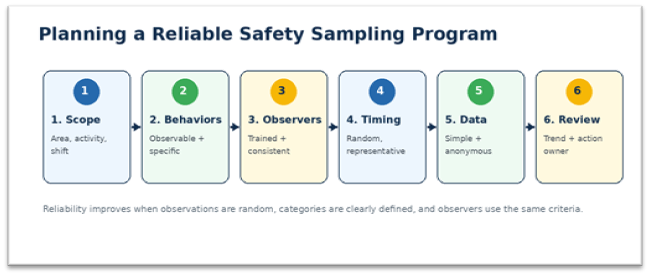
1. Define the Scope
Select the department, task, process, shift, contractor group, or hazard you want to understand. Start with a manageable scope—such as forklift operations in a warehouse or PPE compliance in a fabrication area—then expand after the method is stable.
2. Build the Observation List
Use accident history, near-miss reports, HIRAC/JSA findings, legal requirements, manufacturer instructions, and worker input. Each item should be visible, objective, and relevant to risk.
3. Train Observers
Observers should agree on definitions and practice using the sheet together. Calibration sessions—where two observers independently rate the same situations and compare results—help reduce personal interpretation.
4. Choose Random, Representative Times
Avoid sampling only when management is present or when work is easiest. Cover normal operations, busy periods, night shifts, start-up, shutdown, maintenance, and contractor activities where relevant. Randomization reduces the chance that people temporarily change behavior because they expect an inspection.
Sampling size
There is no universal “magic number” of observations for every workplace. More observations generally improve confidence, but the practical goal is a sample large and representative enough to reveal stable patterns and meaningful change.
How to Conduct Safety Sampling: Step by Step
The field method should be simple enough to repeat frequently and consistently. A useful rule is to observe facts first, intervene immediately only when there is imminent danger, and discuss improvement after the observation unless urgent action is needed.
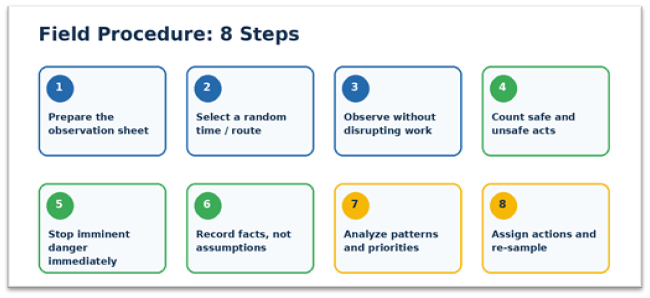
Observation Technique:
- Approach the area normally and avoid creating a “special inspection” atmosphere.
- Observe a defined activity for a short, consistent period. Count only what is visible during that sample.
- Record the behavior or condition—not the worker’s name—unless identification is essential for an immediate safety intervention or local procedure.
- If you see imminent danger, stop the activity and make the situation safe. Data collection must never take priority over protecting people.
- If a finding is unclear, record a note for verification rather than guessing.
- Give respectful feedback. Recognize safe practice as well as correcting unsafe practice.
Example:
During a 10-minute forklift sample, an observer records 12 relevant events: 10 safe and 2 unsafe. The two unsafe events are coded “seat belt not used” and “pedestrian entered vehicle route.” The observer does not convert this into a personal performance rating; the data are added to the site trend and reviewed for system-level action.
Observer Ethics and Trust:
Sampling works poorly when employees believe it is hidden surveillance or a disciplinary trap. Explain the purpose, involve worker representatives, keep the process consistent, and show that findings lead to real improvements. Trust increases the quality of both observations and feedback.
Safety Sampling Checklist and Scoring Example:
A short checklist is usually more useful than a long form that observers cannot complete consistently. The example below can be adapted to industry-specific risks.
| Category | Observation Standard | Rating | Example Unsafe Finding |
| PPE | Required PPE correctly worn | Safe / Unsafe / N.A. | Safety glasses missing |
| Housekeeping | Access route clear and dry | Safe / Unsafe / N.A. | Oil on walkway |
| Machine guarding | Guard present and effective | Safe / Unsafe / N.A. | Guard removed |
| LOTO | Energy isolated before maintenance | Safe / Unsafe / N.A. | No personal lock |
| Work at height | Fall control used as required | Safe / Unsafe / N.A. | Unprotected edge |
| Manual handling | Load controlled / aid used | Safe / Unsafe / N.A. | Twisting with heavy load |
| Traffic | Vehicle–pedestrian controls followed | Safe / Unsafe / N.A. | Crossing outside route |
| Tools | Correct tool in safe condition | Safe / Unsafe / N.A. | Damaged extension lead |
Simple Scoring:
One practical measure is the percentage of safe observations:
| Safe Observation %: Safe observations ÷ Total applicable observations × 100 |
Example: if 162 of 200 applicable observations are safe, the safe-observation rate is 81%. The remaining 38 observations (19%) are unsafe. The value is most useful for comparing the same scope and method over time—not as a universal “pass/fail” benchmark.
| Example Metric | Result |
| Total applicable observations | 200 |
| Safe observations | 162 |
| Unsafe observations | 38 |
| Safe observation rate | 81% |
| Unsafe observation rate | 19% |
What the Number Does Not Tell You:
A single percentage can hide risk severity. Ten unsafe observations involving housekeeping are not automatically more serious than one unsafe observation involving entry into a live electrical enclosure. Always combine frequency data with risk judgment and prioritize high-consequence hazards immediately.
Turning Observations into Safety Intelligence:
The value of safety sampling comes from analysis. Start with simple questions: Which categories occur most often? Where are they concentrated? Is performance improving? Did a corrective action change the trend?

In this example, PPE and housekeeping account for half of the unsafe observations. That does not mean other risks are unimportant; it means these two categories offer a strong starting point for understanding recurring causes. A Pareto chart helps direct attention, but severity and exposure must still be considered.

Questions to Ask During Analysis:
Are unsafe observations concentrated on a particular shift, area, task, machine, or contractor?
Do findings increase during overtime, shutdowns, maintenance, production peaks, or staff changes?
Is the same issue repeating after training—suggesting the problem may be design, availability, supervision, or workload rather than knowledge?
Did an engineering or procedural change reduce the relevant unsafe observations?
Are observers classifying the same behavior consistently? If not, retrain and refine definitions.
From Findings to Corrective Action:
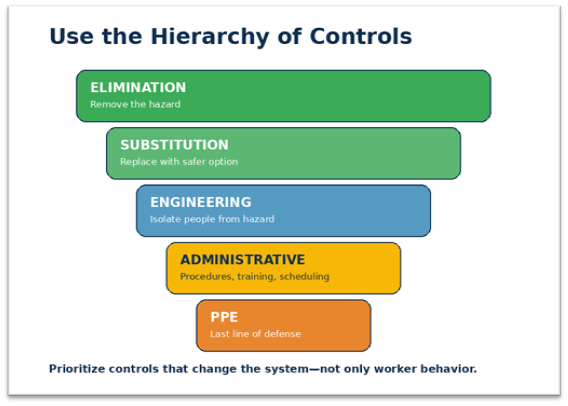
Safety sampling should trigger improvement, not just produce statistics. For each recurring or high-risk finding, identify the underlying reasons and select controls using the hierarchy of controls. Strong controls change the system so that safe work becomes easier and more reliable.
Best Practices, Common Mistakes and Final Takeaway
| DO | AVOID |
| Define observable standards | Use vague labels such as “careless” or “bad attitude” |
| Sample different shifts, times and work states | Observe only easy or highly visible activities |
| Recognize safe behavior as well as unsafe behavior | Use sampling only to catch people doing something wrong |
| Treat high-risk findings immediately | Wait for enough data when an imminent hazard exists |
| Analyze causes and apply stronger controls | Respond to every finding with training or PPE only |
| Track actions and re-sample | Publish percentages without verifying improvement |
Conclusion
Safety sampling turns everyday workplace observations into a practical leading indicator. When it is designed carefully, applied consistently, and linked to corrective action, it helps organizations detect weak signals before they become injuries or major losses. The goal is not to create a “perfect score.” The goal is to learn where the system is vulnerable, improve controls, and verify that work is becoming safer over time.