
Tanker Spillage: A single mistake during tanker loading or unloading can lead to a major spill, fire, toxic exposure or environmental damage. Safe operations depend on careful planning, suitable equipment, trained personnel and clear communication between the driver and the receiving or dispatching site.
Whether a tanker carries fuel, chemicals or other dangerous substances, every transfer should follow a risk assessment and a written procedure suitable for the product and the site.
What Is Tanker Loading and Unloading?
Loading is the transfer of a substance from a storage tank or processing facility into a road tanker or tank container.
Unloading is the transfer of that substance from the tanker into a receiving tank or another designated system.
The operation may involve pumps, valves, transfer hoses, couplings, vapour recovery systems and monitoring devices. Each component must be suitable for the substance, pressure and operating conditions.
A road tanker is designed to carry liquid or gaseous products by road. A tank container is a tank within a protective frame that can be transferred between different modes of transport, such as road, rail and sea.
Why Is Tanker Transfer Safety Important?
During transfer, a hazardous substance moves between two systems. A leak, wrong connection, incorrect valve position or overfilled tank can quickly create an emergency.
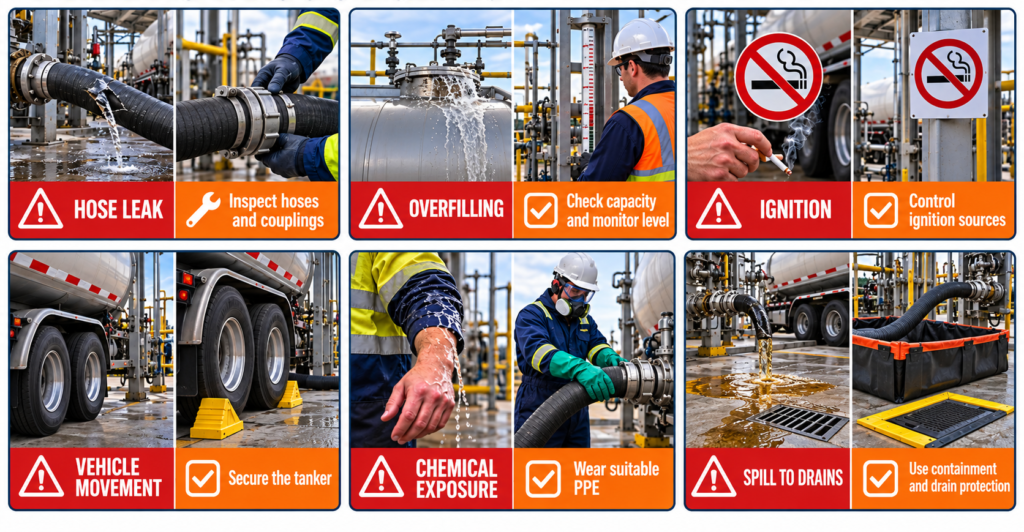
The main risks include:
- Fire or explosion from flammable vapours.
- Chemical burns or toxic exposure.
- Spills entering drains, soil or water.
- Tank overflow or product release.
- Falls while accessing the top of a tanker.
- Vehicle movement while hoses are connected.
- Injury from pressurised hoses or moving equipment.
Good transfer safety protects people, equipment, the environment and business operations.
Key Safety Principles for Tanker Loading and Unloading
1. Identify the Product and Its Hazards
Before starting, confirm exactly what is being transferred.
Check:
- Product name and delivery documentation.
- Relevant Safety Data Sheet (SDS).
- Fire, health and environmental hazards.
- Required personal protective equipment (PPE).
- Compatibility with the receiving tank and transfer equipment.
- Emergency actions for spills, exposure or fire.
Example: Petrol produces flammable vapours, so the transfer area must be controlled to prevent ignition. A corrosive chemical may require different PPE and equipment materials.
2. Confirm the Correct Tank and Available Capacity
Before connecting the hose, verify that:
- The product is being delivered to the correct receiving tank.
- The tank contains a compatible substance.
- Sufficient safe capacity is available for the planned delivery.
- Tank identification and connection points are clearly marked.
- Level indicators and overfill prevention systems are functional, where fitted.
Never rely only on the tanker’s delivery quantity. The receiving tank’s available capacity must also be checked.
3. Establish Clear Communication
The driver and the site operator should agree on the transfer plan before work begins.
They should understand:
- Who is responsible for each part of the operation.
- Which tank, hose and connection will be used.
- How the transfer will be started and stopped.
- How to communicate during the operation.
- Where emergency shutdown controls are located.
- What to do if a leak, alarm or other abnormal condition occurs.
A clear stop signal should be understood by everyone involved.
4. Position and Secure the Vehicle
The tanker should be positioned in the designated transfer area with safe access and a clear emergency exit.
Before transfer:
- Apply the parking brake.
- Use wheel chocks where required by the site procedure.
- Control other vehicles and pedestrians in the area.
- Ensure the tanker cannot move while hoses are connected.
- Follow the site procedure for engine operation and any equipment needed for pumping.
The transfer area should be suitable for the product, with effective ventilation, controlled access and appropriate spill drainage or containment.
5. Inspect Hoses, Couplings and Equipment
Transfer equipment must be suitable for the product and operating conditions.
Before use, inspect for:
- Cuts, cracks, bulges or other hose damage.
- Worn, missing or damaged seals.
- Loose or damaged couplings.
- Leaking or defective valves.
- Signs of corrosion or chemical deterioration.
- Incorrect connections or unsuitable equipment.
Do not use damaged equipment. Remove it from service and report the defect.
HSE guidance states that pumps, valves and hoses should be suitable for the liquid being handled and the conditions of use.
6. Control Ignition Sources
Flammable liquids can release vapours that may ignite if an ignition source is present.
Controls may include:
- Prohibiting smoking and naked flames.
- Controlling hot work in the surrounding area.
- Using electrical equipment suitable for the hazardous area.
- Managing vehicle and equipment ignition sources.
- Using bonding and earthing arrangements where required by the product, equipment and site procedure.
- Maintaining the required vapour recovery arrangements, where applicable.
Never assume a tanker is safe simply because it appears empty. Residual liquid and vapour may remain inside.
7. Prevent Falls and Confined-Space Incidents
Where possible, use transfer arrangements that avoid working on top of the tanker.
If access at height is necessary:
- Use suitable access equipment and fall protection.
- Check that platforms and walking surfaces are safe.
- Follow the site’s working-at-height procedure.
A tanker interior may contain toxic vapours, low oxygen or flammable atmospheres. Do not enter a tank unless a formal confined-space procedure, permit, isolation, atmospheric testing and rescue arrangements are in place.
8. Monitor the Transfer
The responsible personnel should remain alert throughout the operation and follow the agreed supervision procedure.
Monitor for:
- Leaks at hoses, valves or couplings.
- Abnormal pressure or flow.
- Unexpected tank level changes.
- Unusual sounds, smells or equipment behaviour.
- Alarms or signs of overflow.
- Unauthorised people or vehicles entering the area.
If anything appears unsafe, stop the transfer using the approved procedure and inform the responsible person immediately.
Common Hazards and Preventive Measures
| Hazard | Possible consequence | Preventive measure |
|---|---|---|
| Damaged hose or coupling | Product leak, chemical exposure or spill | Inspect equipment before use and replace defective parts. |
| Wrong tank connection | Chemical reaction, contamination or release | Verify product, tank identification and compatibility before connecting. |
| Tank overfilling | Overflow, fire or environmental contamination | Check available capacity and use suitable level monitoring and overfill protection. |
| Flammable vapour ignition | Fire, explosion and serious injury | Control ignition sources and follow required bonding, earthing and hazardous-area procedures. |
| Vehicle movement | Hose rupture and product release | Secure the tanker and prevent departure until the operation is complete. |
| Exposure to hazardous substances | Burns, inhalation injury or poisoning | Review the SDS, use appropriate PPE and control exposure at the source. |
| Work at height | Falls and serious injury | Avoid tanker-top access where possible and use suitable fall protection. |
| Pressurised hose disconnection | Hose movement and release of product | Isolate, drain and depressurise the system in accordance with the procedure. |
| Spill entering drains | Soil and water contamination | Use suitable containment, drain protection and emergency spill arrangements. |
| Poor communication | Incorrect valve operation or delayed response | Agree on responsibilities, signals and emergency actions before transfer. |
Hose Couplings: Why Correct Connections Matter
A hose coupling connects the tanker, hose and fixed transfer system. An incorrect or damaged coupling can cause leakage or separation under pressure.
Before making a connection:
- Confirm the coupling is compatible with the product and equipment.
- Inspect the coupling, seal and locking arrangement.
- Check that the connection point is correct.
- Secure the connection according to the manufacturer’s instructions and site procedure.
- Check for leaks when transfer begins.
After transfer, isolate the system and ensure pressure has been safely released before disconnecting.
Never force an incompatible connection or use a temporary repair as a substitute for suitable equipment.
Dangerous Goods: Labels, Placards and Identification
Dangerous goods may need specific labels, markings and transport documents so that workers and emergency responders can identify the hazards.
Depending on the substance and applicable regulations, a vehicle or package may display:
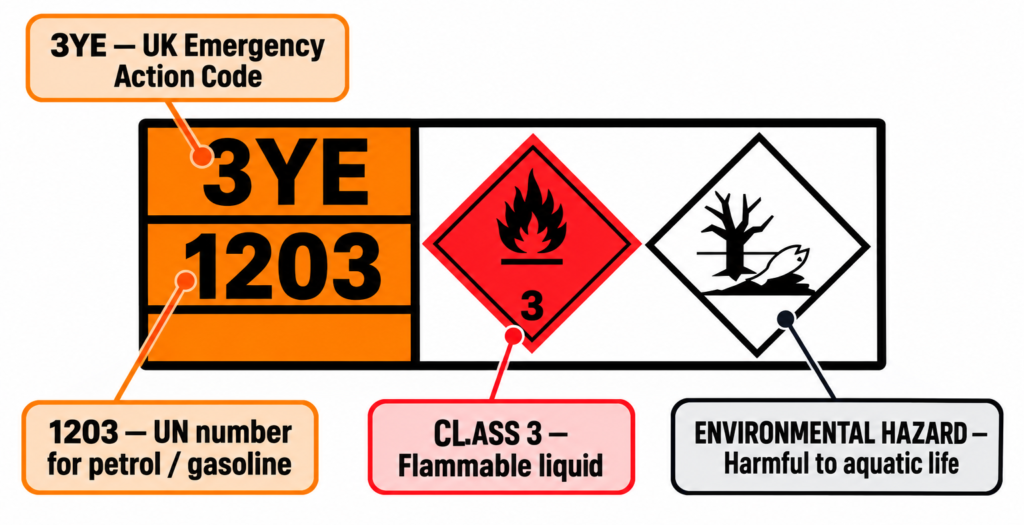
- UN number: Identifies a dangerous substance or group of substances for transport.
- Hazard label or placard: Indicates the main hazard, such as flammable liquid, corrosive substance or toxic material.
- Environmental hazard mark: Indicates a substance hazardous to the aquatic environment when applicable.
- Emergency information: Provides additional information where required by the relevant transport system.
Example
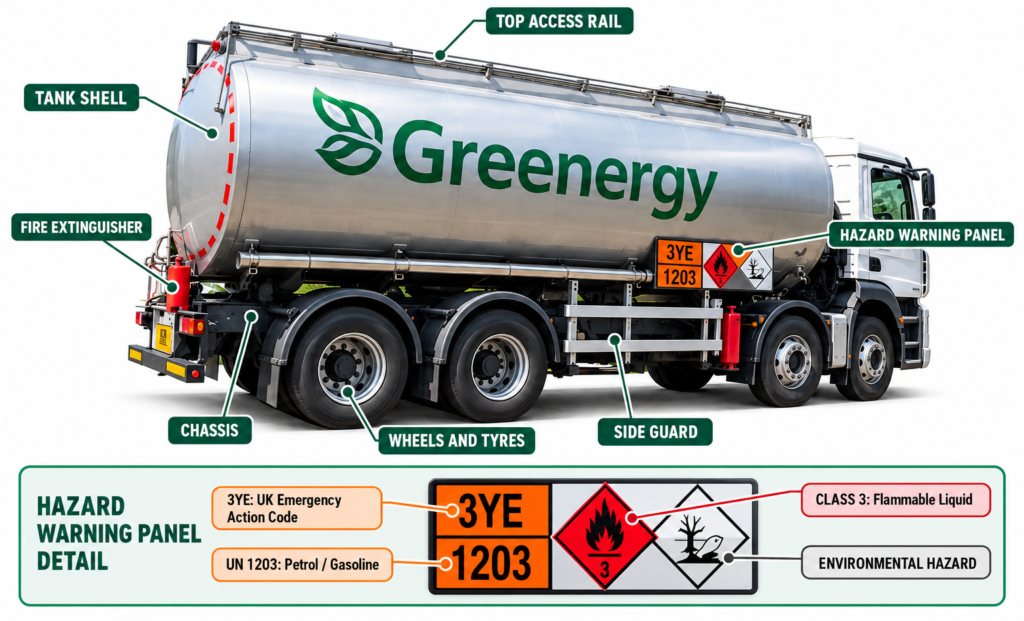
A tanker carrying petrol may display UN 1203 together with the relevant flammable liquid identification.
The exact marking arrangement depends on the substance, transport mode, jurisdiction and applicable regulations. Staff should be trained to recognise the markings used in their operation.
UN Packaging Marks
Dangerous goods transported in packages may require packaging designed and tested for the substance and transport conditions.
A UN packaging mark contains coded information about the package, such as its type and applicable performance details. The correct package must be selected using the substance classification and the relevant transport requirements.
A visible UN mark alone does not confirm that a package is suitable for every chemical. Compatibility, permitted use and condition must also be checked.

ADR and International Transport Requirements
The Agreement concerning the International Carriage of Dangerous Goods by Road (ADR) sets requirements for the international road transport of dangerous goods where it applies.
Its provisions cover areas such as:
- Classification of dangerous goods.
- Packaging and tank requirements.
- Marking, labelling and documentation.
- Loading, unloading and handling.
- Vehicle equipment and operation.
- Training and responsibilities of participants.
ADR also specifies written emergency instructions for vehicle crews in applicable operations. These must be readily available and provided in a language the crew can read and understand.
For operations in Pakistan: Check the applicable Pakistani laws, transport requirements, product-specific rules and site procedures. Do not assume that ADR requirements automatically apply to every domestic journey.
Driver and Operator Training
Drivers and site personnel should receive training appropriate to their role and the substances handled.
Training should cover:
- Product hazards and SDS information.
- Vehicle and equipment checks.
- Safe hose connection and disconnection.
- Loading and unloading procedures.
- Spill prevention and emergency shutdown.
- Correct PPE selection and use.
- Fire and emergency response.
- Recognition of dangerous goods labels and markings.
- Communication and incident reporting.
Training should be refreshed as required and updated when procedures, equipment or products change.
What to Do If a Leak or Spill Occurs
If a leak or spill is detected:
- Stop the transfer using the approved emergency procedure.
- Raise the alarm and inform the responsible site personnel.
- Keep people away and isolate the area.
- Remove or control ignition sources only if it is safe to do so.
- Contact emergency services where required.
- Prevent the substance from entering drains if trained personnel can do so safely.
- Follow the SDS and site emergency plan.
- Arrange cleanup by trained and properly equipped personnel.
- Report and investigate the incident before restarting work.
Do not attempt to handle a major spill, enter a vapour cloud or fight a fire unless trained, equipped and authorised to do so.

Tanker Loading and Unloading Safety Checklist
Before Transfer
- Product and associated hazards identified.
- SDS and delivery documents checked.
- Correct tank and connection point confirmed.
- Receiving tank capacity verified.
- Tanker positioned and secured.
- Hoses, seals, valves and couplings inspected.
- Required PPE available and worn.
- Ignition sources controlled.
- Spill and emergency equipment available.
- Responsibilities and stop signals agreed.
During Transfer
- Transfer monitored by responsible personnel.
- Hoses and connections checked for leaks.
- Tank level and flow monitored.
- Access to the area controlled.
- Transfer stopped if an unsafe condition develops.
After Transfer
- Transfer stopped and relevant valves secured.
- System isolated, drained and depressurised as required.
- Hoses disconnected and safely stored.
- Caps and connection points secured.
- Area checked for leaks or spills.
- Delivery documentation completed.
- Vehicle released only when it is safe to depart.
Conclusion
Safe tanker loading and unloading requires more than connecting a hose and opening a valve. Product identification, equipment inspection, vehicle security, communication and continuous monitoring all play a part in preventing incidents.
By following a clear procedure and responding immediately to unsafe conditions, organisations can reduce the risk of spills, fires, injuries and environmental harm.
Safety Today | Strong & Secure Tomorrow
International Safety Solution (ISS)