
1. Origins of Electrical Fires in Buildings: Understanding Causes, Risks, and Electrical Safety Standards
Electrical fires in buildings are a significant fire safety concern that can result in severe injuries, fatalities, extensive property damage, and operational disruption. Electrical systems are essential to modern buildings, powering lighting, heating, ventilation, appliances, machinery, and other critical equipment. However, when these systems are improperly installed, poorly maintained, misused, or operated without adequate safety precautions, they can become serious sources of ignition.
Understanding the origins of electrical fires in buildings is essential for building owners, facility managers, electrical engineers, maintenance personnel, fire safety professionals, and Health and Safety practitioners. Identifying electrical hazards at an early stage, following recognised electrical codes and standards, and implementing preventive maintenance programmes can significantly reduce the likelihood of electrical fires.
This blog explores the major causes of electrical fires in buildings, explains how electrical faults lead to ignition, and discusses internationally recognised electrical safety codes and standards that support safer electrical installations and operations.
2. Understanding How Electrical Fires Originate
Electrical fires generally begin when an electrical fault or abnormal operating condition generates enough heat or an electrical arc to ignite nearby combustible materials.
Electrical energy can produce ignition through several mechanisms:
2.1 Electrical Overheating
Electrical overheating occurs when electrical components operate beyond their designed temperature limits. This may happen because of excessive current, poor connections, inadequate conductor sizing, or insufficient ventilation around electrical equipment.
Prolonged overheating can:
- Damage cable insulation.
- Deteriorate electrical connections.
- Ignite nearby combustible materials.
- Damage distribution boards and electrical equipment.
- Increase the possibility of electrical fires.
2.2 Short Circuits
A short circuit occurs when electrical current takes an unintended path between conductors or between a conductor and another conductive part.
This can result in extremely high current flow, producing intense heat and electrical arcing. If protective devices are incorrectly selected, improperly installed, or fail to operate, the resulting heat may ignite surrounding materials.
2.3 Electrical Arcing
Electrical arcing occurs when electric current travels through an unintended gap between conductive components.
Arcing can generate extremely high temperatures, potentially igniting cable insulation, dust, plastics, paper, and other combustible materials.
Common causes include:
- Loose electrical connections.
- Damaged cables.
- Deteriorated insulation.
- Faulty switches and circuit breakers.
- Poorly maintained electrical panels.
2.4 Overloaded Electrical Circuits
An overloaded circuit occurs when electrical equipment draws more current than the circuit is designed to carry.
For example, connecting several high-power appliances to one extension lead or socket can exceed its rated capacity.
Continuous overloading may cause:
- Excessive heat generation.
- Insulation deterioration.
- Damage to sockets and plugs.
- Electrical equipment failure.
- Potential ignition of nearby combustible materials.
2.5 Insulation Failure
Electrical insulation prevents unintended contact between conductors and other surfaces. When insulation becomes damaged due to ageing, excessive heat, mechanical impact, moisture, or chemical exposure, it may allow current leakage or short circuits.
This can create dangerous conditions that contribute to electrical fires.
3. Major Origins of Electrical Fires in Buildings
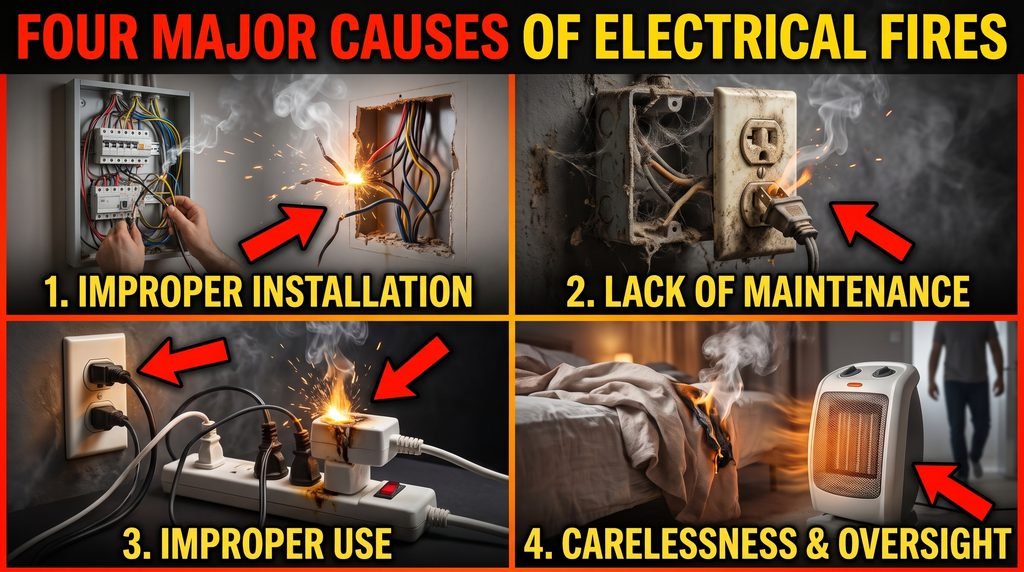
The origins of electrical fires in buildings can generally be associated with four major contributing factors:
Four Major Causes of Electrical Fires
1. Improper Installation
Incorrect wiring, unsuitable components and poor workmanship.
2. Lack of Maintenance
Neglected inspections, deteriorated connections and damaged equipment.
3. Improper Use
Overloading, unsuitable equipment and misuse of electrical appliances.
4. Carelessness and Oversight
Ignoring warning signs, unsafe practices and failure to report defects.
3.1 Improper Electrical Installation
Improper electrical installation is one of the major contributing factors to electrical fires in buildings.
Electrical installations must be designed and completed according to the applicable electrical codes, manufacturer specifications, and engineering requirements.
When electrical installations are carried out by unqualified personnel or without appropriate technical supervision, serious hazards can develop.
Common installation-related causes include:
- Incorrect cable sizing: Using conductors that cannot safely carry the expected electrical load can result in overheating.
- Poor connections: Loose terminals and improperly tightened connections can create resistance and generate excessive heat.
- Inadequate circuit protection: Incorrectly selected or installed fuses and circuit breakers may fail to provide suitable protection.
- Poor earthing and bonding: Inadequate protective earthing can increase electrical shock and fault-related risks.
- Substandard electrical components: Low-quality or unsuitable cables, sockets, switches, and distribution equipment may deteriorate prematurely.
- Improper cable routing: Installing cables near heat sources or exposing them to mechanical damage can compromise insulation.
- Incorrect installation of electrical panels: Poor spacing, unsuitable enclosures, and inadequate ventilation may contribute to overheating.
Example: In a commercial building, an electrical contractor installs undersized cables to supply several high-power machines. During normal operations, the electrical load exceeds the safe carrying capacity of the cables. The resulting heat gradually damages the insulation and may eventually ignite nearby combustible materials.
Preventive measures:
- Employ qualified and competent electrical professionals.
- Conduct proper electrical load calculations before installation.
- Select cables and electrical components according to their ratings and intended applications.
- Install suitable overcurrent and earth-fault protection.
- Follow applicable electrical codes and standards.
- Inspect and test electrical installations before commissioning.
3.2 Lack of Electrical Maintenance
Electrical systems require regular inspection, testing, servicing, and maintenance to ensure that they remain safe throughout their operational life.
Even a correctly installed electrical system can become hazardous when maintenance is neglected.
Over time, electrical equipment experiences wear and deterioration due to heat, vibration, moisture, dust, corrosion, mechanical damage, and continuous operation.
Common maintenance-related causes include:
- Loose or deteriorated electrical connections.
- Damaged cable insulation.
- Corroded terminals and electrical contacts.
- Dust accumulation inside electrical panels.
- Defective circuit breakers and protective devices.
- Overheating transformers and distribution equipment.
- Damaged sockets, switches, and electrical outlets.
- Failure to identify and repair electrical defects.
One particularly dangerous situation is the failure to identify overheating connections. A loose terminal can develop high resistance, resulting in localised heating even when the overall circuit current is within its normal operating range.
Preventive measures:
- Establish a documented electrical preventive maintenance programme.
- Conduct periodic inspections of electrical distribution boards.
- Check electrical connections and terminations.
- Use thermal imaging where appropriate to identify abnormal temperature patterns.
- Test protective devices according to applicable requirements.
- Replace damaged cables and defective electrical components.
- Maintain inspection, testing, and repair records.
- Ensure that maintenance work is carried out by qualified personnel.
NFPA 70B, Standard for Electrical Equipment Maintenance, provides a recognised framework for establishing and implementing electrical equipment maintenance programmes.
3.3 Improper Use of Electrical Equipment
Improper use of electrical equipment is another significant origin of electrical fires in buildings.
Electrical appliances and equipment are designed to operate within specified voltage, current, temperature, and environmental limits. Using them outside these limits can create hazardous conditions.
Examples of improper electrical equipment use include:
- Connecting multiple high-power appliances to a single extension lead.
- Using damaged plugs, sockets, and extension cords.
- Operating electrical appliances with exposed conductors.
- Using equipment with unsuitable voltage ratings.
- Covering electrical equipment and restricting its ventilation.
- Using indoor-rated equipment in wet or hazardous environments.
- Operating electrical appliances beyond their recommended capacity.
- Using counterfeit or uncertified electrical accessories.
- Running cables beneath carpets or through locations where they can be crushed or damaged.
Example: Employees connect multiple heaters, computers, and other appliances to one overloaded extension board in an office. The excessive electrical load causes the extension board to overheat, potentially igniting nearby furniture or other combustible materials.
Preventive measures:
- Follow manufacturers’ operating instructions.
- Never exceed the rated capacity of sockets, extension leads, or electrical equipment.
- Avoid using damaged electrical appliances.
- Use suitable electrical equipment for the intended environment.
- Ensure adequate ventilation around electrical equipment.
- Provide employees with electrical safety awareness training.
- Remove defective equipment from service until repaired or replaced.
3.4 Carelessness and Oversight
Carelessness and oversight can turn minor electrical defects into major fire incidents.
Electrical fire hazards are not always caused by technical failures. In many situations, unsafe human behaviour, poor supervision, inadequate awareness, and failure to follow established procedures contribute to the development of dangerous conditions.
Examples include:
- Ignoring sparks, burning smells, or unusual noises from electrical equipment.
- Continuing to use damaged electrical cables.
- Failing to report overheating electrical outlets.
- Leaving defective electrical equipment in operation.
- Allowing unauthorised individuals to carry out electrical repairs.
- Ignoring inspection and maintenance recommendations.
- Failing to isolate electrical equipment before maintenance.
- Storing combustible materials close to electrical distribution panels.
- Neglecting electrical safety procedures during workplace operations.
Preventive measures:
- Develop clear electrical safety procedures.
- Train employees to recognise electrical hazards.
- Establish a system for reporting electrical defects.
- Conduct regular workplace safety inspections.
- Ensure appropriate supervision of electrical work.
- Implement permit-to-work and isolation procedures where applicable.
- Encourage employees to stop unsafe activities and report hazardous conditions.
Electrical safety must be treated as a shared responsibility involving building owners, management, maintenance teams, contractors, and occupants.
4. Other Common Sources of Electrical Fires in Buildings
In addition to the four major contributing factors, several electrical components and building conditions can create ignition hazards.
4.1 Faulty Wiring and Damaged Cables
Ageing, damaged, or incorrectly installed wiring can cause short circuits, electrical arcing, and overheating. Concealed wiring is particularly concerning because defects may remain unnoticed behind walls, ceilings, or within service ducts.
4.2 Defective Electrical Appliances
Defective appliances, including refrigerators, heaters, washing machines, air-conditioning units, and other electrical equipment, can develop internal faults that generate heat or sparks.
4.3 Faulty Electrical Distribution Boards
Distribution boards contain circuit breakers, busbars, terminals, and other components responsible for distributing electrical power.
Loose connections, overloaded circuits, damaged components, and inadequate maintenance can increase the possibility of electrical fires.
4.4 Transformers and Power Supplies
Transformers and power supply equipment can become ignition sources due to insulation breakdown, overheating, internal faults, or inadequate protection.
4.5 Lighting Equipment
Incorrectly installed lighting fixtures, unsuitable lamps, excessive heat generation, and the proximity of combustible materials can create fire hazards.
4.6 Extension Cords and Power Strips
Improperly used extension cords and power strips can overheat when overloaded or damaged. Their temporary nature should not be confused with suitability for permanent electrical installations.
4.7 Electrical Equipment in Hazardous Areas
Industrial and commercial buildings may contain areas where flammable gases, vapours, combustible dust, or other hazardous substances are present.
Electrical equipment that is unsuitable for the hazardous area classification can become an ignition source. Appropriate equipment selection, installation, inspection, and maintenance are therefore essential.
5. Electrical Safety Codes and Standards for Preventing Electrical Fires
Compliance with recognised electrical codes and standards is fundamental to preventing electrical fires in buildings.
These codes establish technical requirements and safety principles for electrical design, installation, operation, inspection, maintenance, and workplace practices.
Different countries and jurisdictions adopt different electrical standards. Therefore, organisations must identify the applicable national regulations, local authority requirements, and adopted editions before implementing an electrical safety programme.
The following are important internationally recognised codes and standards.
5.1 ANSI/NFPA 70 – National Electrical Code (NEC)
NFPA 70 – National Electrical Code
Current edition: 2026
Publisher: National Fire Protection Association (NFPA)
The National Electrical Code (NEC), published as NFPA 70, is one of the most widely recognised electrical installation codes.
It establishes requirements for the safe design, installation, and inspection of electrical systems to protect people and property from electrical hazards.
The NEC addresses electrical installations in residential, commercial, and industrial buildings.
Key areas covered include:
- Electrical wiring methods and materials.
- Conductor sizing and ampacity.
- Overcurrent protection.
- Grounding and bonding.
- Electrical equipment installation.
- Receptacles, switches, and outlets.
- Special occupancies and hazardous locations.
- Electrical system inspection and safety requirements.
The NEC is revised periodically to address technological developments and emerging electrical safety concerns. The applicable edition depends on the jurisdiction’s adoption and enforcement arrangements.
Importance in preventing electrical fires:
Following NEC requirements helps reduce the likelihood of improper wiring, overloaded circuits, inadequate protection, and unsafe electrical installations.
Official reference: NFPA 70 – National Electrical Code.
5.2 ANSI C2 – National Electrical Safety Code (NESC)
IEEE C2-2023 – 2023 National Electrical Safety Code(R) (NESC(R))
ANSI C2 – National Electrical Safety Code
2023 edition
Publisher: IEEE Standards Association
The National Electrical Safety Code (NESC), designated ANSI C2, establishes safety requirements for electric supply and communication systems.
Unlike the National Electrical Code, which primarily addresses premises electrical installations, the NESC focuses on electric utility infrastructure and associated supply systems.
Key areas covered include:
- Electric supply stations.
- Overhead electrical supply lines.
- Underground and buried electrical cables.
- Communication lines and associated equipment.
- Grounding requirements.
- Safe installation and maintenance of utility systems.
- Safety practices for personnel working on electric supply infrastructure.
Importance in electrical safety:
The NESC helps establish safe practices for the generation, transmission, and distribution infrastructure that supplies electricity to buildings.
Although it is not a substitute for building electrical installation requirements, it plays an important role in the wider electrical safety framework.
Official reference: IEEE C2 – National Electrical Safety Code.
5.3 Canadian Electrical Code (CEC) – CSA C22.1
CSA C22.1:24 Canadian Electrical Code Part I 2024
Canadian Electrical Code (CEC)
2024 edition: CSA C22.1:24
Publisher: CSA Group
The Canadian Electrical Code, Part I, is published as CSA C22.1 and establishes safety requirements for electrical installations in Canada.
It provides technical guidance and requirements for designing, installing, and maintaining electrical systems in buildings and other premises.
Key areas covered include:
- Electrical wiring installations.
- Protection against electrical shock.
- Overcurrent protection.
- Grounding and bonding.
- Electrical equipment selection.
- Installation of electrical devices.
- Special electrical installations.
- Requirements for hazardous locations.
Importance in preventing electrical fires:
The Canadian Electrical Code helps minimise electrical hazards associated with improper installation, unsuitable equipment, defective wiring, and inadequate electrical protection.
Its requirements are implemented through applicable provincial and territorial regulatory frameworks.
The 2024 edition is designated CSA C22.1:24, while CSA Group also lists a 2027 edition. Organisations should verify the edition adopted by the relevant authority.
Official reference: CSA Group – Electrical Codes and Standards.
5.4 NFPA 70B – Standard for Electrical Equipment Maintenance
NFPA 70B focuses on the maintenance of electrical, electronic, and communication systems and equipment.
While NFPA 70 provides requirements for electrical installations, NFPA 70B supports the continued safety and reliability of these systems through preventive, corrective, and predictive maintenance.
Key areas include:
- Development of electrical maintenance programmes.
- Inspection and testing of electrical equipment.
- Maintenance procedures.
- Equipment condition assessment.
- Maintenance intervals.
- Documentation and recordkeeping.
- Identification and correction of electrical defects.
Importance in preventing electrical fires:
Regular electrical maintenance helps identify deterioration, overheating, loose connections, and equipment defects before they develop into serious failures.
Official reference: NFPA 70B – Standard for Electrical Equipment Maintenance.
5.5 NFPA 70E – Standard for Electrical Safety in the Workplace
NFPA 70E establishes workplace electrical safety requirements and safe work practices to protect employees from electrical hazards.
It focuses on the risks associated with electrical work, including electric shock, electrocution, arc flash, and arc blast.
Key areas include:
- Electrical hazard identification.
- Electrical risk assessments.
- Safe work practices.
- Establishment of electrically safe work conditions.
- Lockout/tagout procedures.
- Personal protective equipment (PPE).
- Training and competency requirements.
- Electrical safety programmes.
Importance in preventing electrical fires:
NFPA 70E helps organisations control risks associated with electrical work, equipment operation, inspection, and maintenance. Its safe work practices support the prevention of incidents that may lead to injuries, equipment damage, or fires.
Official reference: NFPA 70E – Standard for Electrical Safety in the Workplace.
5.6 Understanding the Difference Between the Major Electrical Codes
| Code / Standard | Primary focus |
| NFPA 70 (NEC) | Safe electrical design and installation |
| ANSI C2 (NESC) | Safety of electric supply and communication systems |
| CSA C22.1 (CEC) | Electrical installations in Canada |
| NFPA 70B | Electrical equipment maintenance |
| NFPA 70E | Electrical safety in the workplace |
An important distinction is that these documents do not all serve the same purpose. NEC and CEC primarily address premises electrical installations, NESC addresses utility supply infrastructure, NFPA 70B addresses equipment maintenance, and NFPA 70E addresses workplace electrical safety.
NFPA describes the combination of NFPA 70, 70B, and 70E as its Electrical Cycle of Safety: install, maintain, and protect.
6. Electrical Fire Prevention and Risk Control Measures
Preventing electrical fires in buildings requires a systematic approach that combines safe electrical design, competent installation, regular maintenance, employee awareness, and effective fire protection arrangements.
The following preventive measures should be incorporated into building safety management programmes.
6.1 Conduct Electrical Risk Assessments
Electrical risk assessments help identify potential ignition sources, evaluate associated risks, and determine appropriate control measures.
A comprehensive assessment should consider:
- Electrical distribution boards and panels.
- Wiring systems and cable routes.
- Electrical appliances and machinery.
- Circuit loading and power requirements.
- Electrical equipment condition.
- Areas containing flammable or combustible materials.
- Environmental conditions, including moisture, heat, and dust.
- Maintenance and inspection arrangements.
The assessment should be reviewed whenever significant changes are made to electrical installations, equipment, or building operations.
6.2 Implement Preventive Electrical Maintenance
A documented preventive maintenance programme should be established for all critical electrical installations.
Recommended activities include:
| Maintenance activity | Purpose |
| Visual inspections | Identify visible damage and deterioration |
| Thermal imaging | Detect abnormal heating patterns |
| Electrical testing | Identify electrical defects and insulation problems |
| Connection inspections | Identify loose or deteriorated connections |
| Circuit breaker testing | Verify protective device performance |
| Cable inspections | Identify damaged insulation and conductors |
| Maintenance documentation | Maintain records of inspections and corrective actions |
Maintenance frequency should be determined according to equipment condition, manufacturer recommendations, risk assessment, applicable standards, and operating conditions.
6.3 Ensure Proper Circuit Protection
Appropriate electrical protection devices should be installed to minimise risks associated with electrical faults.
These may include:
- Circuit breakers: Protect circuits against specified overcurrent conditions.
- Fuses: Interrupt excessive current when their rated operating conditions are exceeded.
- Residual Current Devices (RCDs): Provide protection against certain earth-leakage conditions.
- Arc-Fault Circuit Interrupters (AFCIs): Detect specified hazardous arcing conditions and interrupt the circuit.
- Surge Protective Devices (SPDs): Protect equipment against certain transient overvoltage conditions.
The selection, installation, coordination, and testing of protective devices must comply with the applicable electrical design requirements.
It is important to understand that no single protective device prevents every type of electrical fire. Different devices address different electrical hazards.
6.4 Maintain Good Housekeeping Around Electrical Equipment
Combustible materials should be controlled around electrical installations and potential ignition sources.
Good housekeeping practices include:
- Keeping electrical panels accessible.
- Avoiding storage of combustible materials near electrical equipment.
- Removing unnecessary waste from electrical rooms.
- Preventing dust accumulation in equipment enclosures.
- Maintaining suitable ventilation.
- Avoiding obstruction of electrical distribution equipment.
6.5 Train Employees and Maintenance Personnel
Employees should understand the common signs of electrical faults and the correct actions to take when hazards are identified.
Training should cover:
- Recognising damaged cables and exposed wiring.
- Identifying overheating plugs and sockets.
- Recognising burning smells, unusual sounds, and sparks.
- Reporting electrical defects.
- Avoiding overloaded extension leads.
- Safe use of electrical appliances.
- Emergency response procedures.
- Restrictions on unauthorised electrical repairs.
Only appropriately qualified and authorised personnel should undertake electrical installation and maintenance work.
6.6 Integrate Electrical Safety with Fire Protection Systems
Electrical fire prevention should be integrated into the building’s wider fire protection strategy.
This includes:
- Suitable fire detection and alarm systems.
- Appropriate fire extinguishers for identified electrical hazards.
- Emergency isolation arrangements.
- Clearly identified electrical distribution boards.
- Safe evacuation routes.
- Emergency response procedures.
- Periodic inspection and testing of fire protection equipment.
Personnel should never attempt to extinguish an energised electrical fire using water or an unsuitable extinguishing agent. Electrical supplies should be isolated when this can be done safely, and appropriate firefighting equipment and trained responders should be used.
7. Electrical Fire Safety: Statistics and the Importance of Prevention
Electrical fire incidents demonstrate why electrical safety must remain a priority for building owners and facility managers.
According to the US Fire Administration (USFA), its 2024 national estimates recorded approximately 26,400 residential building fires caused by electrical malfunctions in the United States.
U.S. Fire Administration
NFPA research also highlights the scale of the problem. During 2020–2024, US fire departments responded to an estimated annual average of 46,652 home structure fires involving electrical failure or malfunction, or electrical distribution, lighting, or power-transfer equipment as a factor or ignition source. These fires resulted in an estimated annual average of:
527
Civilian deaths
Estimated annual average
1,580
Civilian injuries
Estimated annual average
$2.4 billion
Direct property damage
Estimated annual average, 2020–2024
Source: NFPA, Electrical Home Fire Safety. These figures cover fires involving electrical failure or malfunction or electrical equipment involved in ignition, rather than exclusively fires attributed to faulty wiring.
These statistics demonstrate that electrical fire prevention is not simply a technical requirement. It is a critical element of protecting human life, property, business continuity, and organisational assets.
8. Electrical Fire Safety in Pakistan: Practical Considerations
For organisations and building owners in Pakistan, electrical fire prevention requires attention to local regulatory requirements, applicable building and electrical rules, and recognised international good practices.
Commercial buildings, factories, educational institutions, hospitals, warehouses, and residential properties should establish electrical safety arrangements based on their specific operational risks.
Important considerations include:
- Ensure electrical installations are designed and installed by competent professionals.
- Follow applicable national and local electrical regulations and authority requirements.
- Use appropriately rated cables, switches, distribution boards, and protective devices.
- Arrange periodic inspection and testing of electrical systems.
- Avoid unauthorised modifications to electrical installations.
- Establish preventive maintenance schedules.
- Provide electrical safety training to employees and maintenance personnel.
- Integrate electrical fire risks into the building’s overall fire risk assessment.
International standards such as NFPA 70, NFPA 70B, and NFPA 70E can provide useful technical and management references where adopted or specified by the relevant authority, client, or organisation.
However, international standards should not automatically be treated as legally mandatory in Pakistan. Organisations must verify the applicable local requirements and the editions formally adopted by the relevant authorities.
9. Responsibilities of Health and Safety Professionals in Preventing Electrical Fires
Health and Safety professionals play an important role in identifying electrical fire hazards and ensuring that appropriate preventive arrangements are implemented.
Although electrical engineering and technical maintenance activities must be performed by competent specialists, HSE professionals help coordinate and monitor the wider safety management process.
Their responsibilities include:
1. Hazard Identification: Recognising electrical fire hazards during workplace inspections and risk assessments.
2. Risk Assessment: Evaluating the likelihood and consequences of electrical fires and recommending suitable control measures.
3. Monitoring Compliance: Checking whether electrical safety procedures and applicable standards are being followed.
4. Maintenance Coordination: Working with engineering and maintenance teams to ensure that electrical defects are reported, prioritised, and corrected.
5. Employee Training: Promoting awareness of electrical hazards and safe equipment usage.
6. Contractor Management: Ensuring electrical contractors are competent, authorised, and working under appropriate safety arrangements.
7. Emergency Preparedness: Supporting the development of electrical fire emergency procedures, evacuation arrangements, and response plans.
8. Incident Investigation: Investigating electrical incidents and near misses to identify root causes and prevent recurrence.
An effective HSE professional does not simply identify unsafe electrical conditions but also works with relevant departments to ensure that corrective actions are implemented and monitored.
10. Conclusion: Preventing Electrical Fires Starts with Electrical Safety
The origins of electrical fires in buildings can often be traced to preventable conditions such as improper installation, inadequate maintenance, misuse of electrical equipment, and carelessness or oversight.
Faulty wiring, overloaded circuits, electrical arcing, defective equipment, and deteriorated connections can all create ignition sources capable of causing serious fires.
Preventing these incidents requires more than installing electrical equipment correctly. It demands continuous monitoring, competent maintenance, employee awareness, effective risk assessments, and compliance with applicable electrical codes and standards.
Standards such as ANSI/NFPA 70 (National Electrical Code), ANSI C2 (National Electrical Safety Code), CSA C22.1 (Canadian Electrical Code), NFPA 70B, and NFPA 70E provide important frameworks for addressing different aspects of electrical safety.
Remember: Electrical fire prevention begins with proper installation, continues through regular maintenance, and depends on safe practices every day.
For building owners, facility managers, electrical engineers, and Health and Safety professionals, understanding electrical fire hazards is an essential step towards creating safer buildings and protecting lives.
Recommended Reading: CFPS Reference Book – Chapter 13, Unit 8, Electrical Systems and Appliances, Pages 135–137.
References and Further Reading
The following official resources can support further learning and technical understanding: