
Introduction
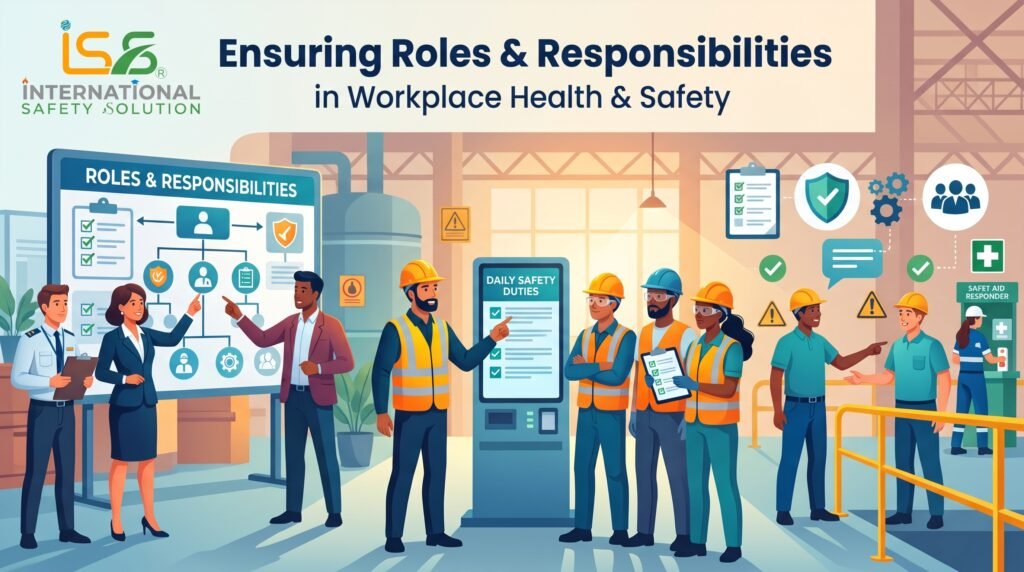
Ensuring roles and responsibilities are clearly defined, understood by all workers and effectively implemented is a fundamental requirement of successful workplace health and safety management. Every individual within an organisation, from top management to frontline employees, has a role in preventing workplace accidents, controlling occupational hazards and maintaining a safe working environment.
An effective health and safety management system cannot operate successfully when employees are uncertain about their duties, supervisors do not understand their authority, or management fails to establish accountability. Clearly defined health and safety roles and responsibilities ensure that everyone understands what is expected of them, who is responsible for specific activities, who has the authority to make decisions and how safety-related duties should be performed.
Organisations must go beyond simply preparing job descriptions or distributing safety policies. They must ensure that responsibilities are communicated, understood, supported through appropriate training and resources, monitored through supervision and consistently implemented in everyday operations.
This is particularly important in complex workplaces involving multiple departments, contractors, subcontractors, different levels of management and high-risk activities. Without clear accountability, important safety tasks such as risk assessments, equipment inspections, permit-to-work arrangements, emergency preparedness and incident reporting may be overlooked.
This article explores the importance of ensuring roles and responsibilities in workplace health and safety, methods of defining and communicating responsibilities, management accountability, worker participation, implementation strategies and the benefits of establishing a clear safety responsibility framework.

1. Understanding Roles and Responsibilities in Health and Safety
Roles and responsibilities refer to the specific duties, obligations, authority and expectations assigned to individuals or groups within an organisation.
In workplace health and safety, these responsibilities establish who must perform particular safety activities, who supervises them, who makes decisions and who ensures that required safety standards are maintained.
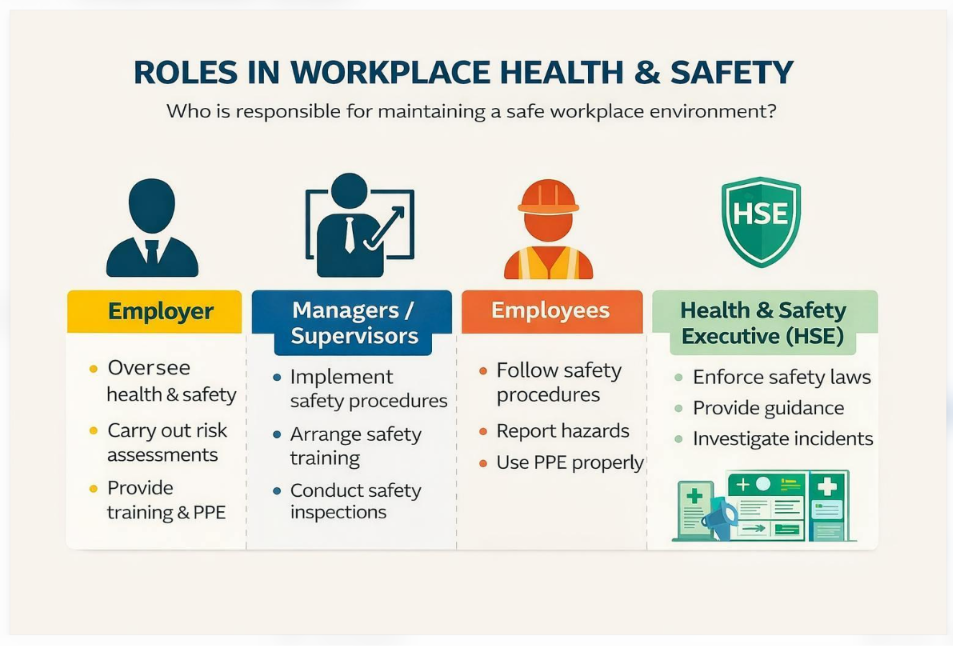
Although health and safety is a shared responsibility, different organisational positions have different duties and levels of authority.
For example:
- Top management establishes the organisation’s health and safety direction, policies and objectives.
- Department managers ensure that safety requirements are integrated into departmental operations.
- Supervisors monitor workplace activities and ensure that workers follow safe systems of work.
- Health and safety professionals provide technical guidance, monitoring and advice.
- Employees follow established procedures, use protective equipment and report hazards.
- Contractors comply with relevant site safety requirements and agreed work arrangements.
Clearly defined responsibilities prevent confusion, overlapping duties and gaps in safety management.
1.1 Difference Between Roles, Responsibilities and Authority
These three concepts are closely connected but have different meanings.
| Element | Meaning | Workplace Example |
| Role | The position or function an individual performs within an organisation. | Production Supervisor |
| Responsibility | The duties and tasks an individual is expected to perform. | Ensuring machinery is operated safely. |
| Authority | The power or permission to make decisions and take action. | Stopping unsafe production activities. |
| Accountability | The obligation to explain and answer for the performance of assigned duties. | Reporting on machinery inspection compliance. |
An organisation must ensure that responsibilities are supported by appropriate authority. Assigning a supervisor responsibility for workplace safety without giving them the authority to stop unsafe work creates a significant management weakness.
2. Why Is It Important to Ensure Roles and Responsibilities Are Clear?
Clearly defined roles and responsibilities establish a structured approach to managing workplace health and safety.
When workers understand their duties and management understands its obligations, safety activities can be performed more consistently and effectively.
The following are some major reasons why organisations must establish clear safety responsibilities.
2.1 Establishing Accountability
Accountability ensures that individuals understand their obligations and are answerable for performing their assigned safety duties.
For example, if a department supervisor is responsible for ensuring that machinery guards remain in place, there must be a clear process for checking, reporting and correcting any deficiencies.
Without accountability, employees may assume that someone else is responsible for addressing safety issues.
Clearly assigned responsibilities eliminate this uncertainty and ensure that safety-related tasks have designated owners.
2.2 Preventing Gaps in Safety Management
Unclear responsibilities can result in important safety activities being neglected.
For example, if nobody is specifically assigned responsibility for inspecting fire extinguishers, checking emergency exits or reviewing risk assessments, these activities may not be completed on time.
A clear responsibility framework ensures that every essential safety activity is assigned to an appropriate person or department.
2.3 Improving Communication and Coordination
Workplace safety frequently involves cooperation between different departments and levels of management.
For example, maintenance teams, production supervisors, contractors and HSE professionals may all be involved in controlling machinery-related hazards.
Clearly defined responsibilities help each department understand its contribution and coordinate activities with other stakeholders.
2.4 Strengthening Legal and Regulatory Compliance
Employers and other duty holders must understand and fulfil their applicable legal obligations.
Depending on the jurisdiction and industry, legal responsibilities may relate to:
- Providing safe working conditions.
- Conducting suitable risk assessments.
- Providing information, instruction, training and supervision.
- Maintaining safe machinery and equipment.
- Providing appropriate personal protective equipment.
- Establishing emergency arrangements.
- Monitoring workplace health and safety performance.
Clearly allocated responsibilities help organisations translate legal requirements into practical workplace arrangements.
2.5 Supporting Effective Risk Management
Risk management requires different individuals to perform specific activities.
For example, identifying workplace hazards, assessing associated risks, implementing control measures and monitoring their effectiveness may involve workers, supervisors, managers and competent HSE professionals.
When responsibilities are clearly allocated, risk control measures are more likely to be implemented and maintained.
3. Defining Health and Safety Roles at Different Organisational Levels
One of the most effective ways of ensuring roles and responsibilities are understood is to define them according to organisational structure.
3.1 Top Management Responsibilities
Top management has a leading role in establishing and maintaining an effective health and safety management system.
Its responsibilities generally include:
- Establishing and approving the health and safety policy.
- Providing strategic direction and leadership.
- Defining organisational health and safety objectives.
- Allocating adequate financial, human and technical resources.
- Establishing clear accountability throughout the organisation.
- Ensuring compliance with applicable legal requirements.
- Reviewing health and safety performance.
- Supporting worker consultation and participation.
- Ensuring that health and safety considerations are integrated into business decisions.
Top management must demonstrate commitment through its decisions and actions rather than simply delegating all health and safety matters to the HSE department.
3.2 Department Managers’ Responsibilities
Department managers translate organisational safety objectives into departmental activities.
Their responsibilities may include:
- Implementing health and safety policies within their departments.
- Ensuring that risk assessments are conducted and reviewed.
- Providing adequate resources for safety activities.
- Ensuring workers receive appropriate training.
- Monitoring departmental safety performance.
- Coordinating with HSE professionals.
- Addressing reported hazards and unsafe conditions.
- Ensuring corrective actions are completed.
3.3 Supervisors’ Responsibilities
Supervisors are responsible for monitoring day-to-day workplace activities and ensuring that employees follow established safety procedures.
Their responsibilities include:
- Conducting workplace inspections.
- Monitoring safe working practices.
- Ensuring appropriate PPE is used.
- Delivering toolbox talks and safety briefings.
- Identifying and reporting unsafe conditions.
- Monitoring permit-to-work activities where assigned.
- Stopping unsafe work when necessary.
- Reporting incidents and near misses.
- Ensuring corrective actions are implemented.
3.4 Health and Safety Professionals’ Responsibilities
Health and safety professionals provide specialist advice and support to help organisations manage occupational risks.
Their responsibilities may include:
- Advising management on applicable health and safety legislation.
- Developing and reviewing risk assessments.
- Conducting workplace inspections and audits.
- Investigating incidents and identifying root causes.
- Developing health and safety procedures.
- Organising safety training and awareness programmes.
- Monitoring health and safety performance indicators.
- Advising on emergency preparedness.
- Supporting consultation and worker participation.
- Recommending appropriate preventive and corrective actions.
The HSE professional’s role is generally advisory, monitoring and supportive unless specific operational authority is formally assigned. Legal accountability remains with the relevant duty holders.
3.5 Employees’ Responsibilities
Employees play an essential role in maintaining workplace safety because they directly interact with workplace equipment, machinery, materials and operational processes.
Their responsibilities generally include:
- Following established safety procedures and instructions.
- Using machinery and equipment correctly.
- Wearing appropriate personal protective equipment.
- Attending required health and safety training.
- Reporting hazards, incidents and near misses.
- Cooperating with supervisors and management.
- Participating in safety consultations.
- Avoiding unsafe acts that may endanger themselves or others.
- Not interfering with or misusing safety equipment.
3.6 Contractors’ Responsibilities
Contractors and subcontractors must understand and comply with the organisation’s health and safety requirements while performing their assigned activities.
Their responsibilities may include:
- Following site-specific safety procedures.
- Conducting task-specific risk assessments.
- Ensuring workers are competent for assigned activities.
- Complying with permit-to-work requirements.
- Providing appropriate PPE.
- Reporting incidents and unsafe conditions.
- Coordinating activities with the principal employer and other contractors.
4. Methods of Ensuring Roles and Responsibilities Are Clearly Defined
Defining responsibilities requires a structured approach. Organisations should use documented systems and practical communication methods to ensure that every individual understands their assigned duties.
4.1 Establishing Clear Job Descriptions
Job descriptions should clearly identify the health and safety responsibilities associated with each organisational position.
Safety duties should not be treated as separate or optional activities. They should be integrated into the normal responsibilities of managers, supervisors and employees.
For example, a maintenance technician’s job description may include:
- Following electrical isolation and lockout/tagout procedures.
- Inspecting tools and equipment before use.
- Reporting damaged electrical components.
- Using appropriate PPE.
- Ensuring maintenance work is performed according to approved procedures.
Job descriptions should be reviewed whenever responsibilities, organisational structures or operational requirements change.
4.2 Developing a Responsibility Assignment Matrix (RACI)
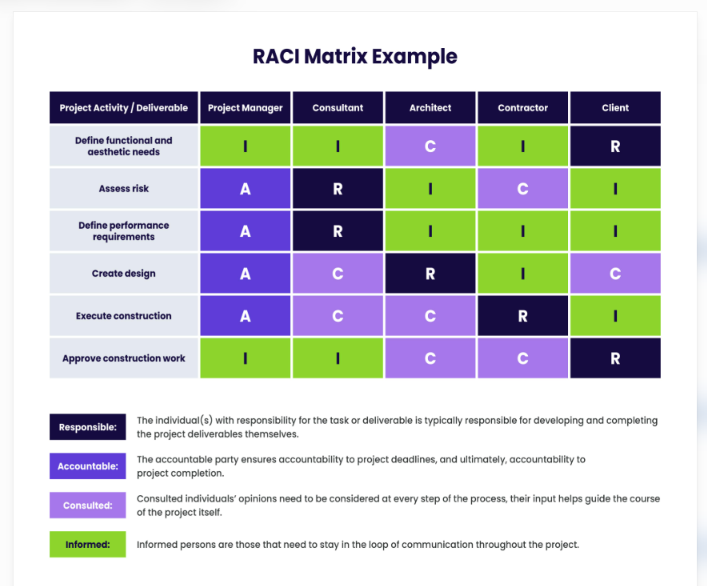
A Responsibility Assignment Matrix is a useful management tool for clarifying who performs, approves, supports and receives information about specific activities.
One commonly used approach is the RACI matrix.
RACI stands for:
- R – Responsible: The person who performs the task.
- A – Accountable: The individual ultimately answerable for ensuring the task is completed.
- C – Consulted: Individuals whose advice or input is required.
- I – Informed: Individuals who must receive information about the activity.
Example of a Health and Safety RACI Matrix
| Health and Safety Activity | Top Management | HSE Manager | Department Manager | Supervisor | Employees |
| Approving HSE Policy | A | R | C | I | I |
| Developing Risk Assessments | I | C | A | R | C |
| Workplace Inspections | I | C | A | R | C |
| Safety Training | I | A/R | C | R | I |
| Reporting Hazards | I | C | A | R | R |
| Incident Investigation | I | R | A | C | C |
| Providing Safety Resources | A | C | R | I | I |
| Monitoring Safety Performance | A | R | R | C | I |
Note: This is an illustrative matrix. Actual assignments should reflect organisational structure, competence, authority and applicable legal requirements. Each activity should have one clearly identified accountable owner.
4.3 Developing Written Health and Safety Procedures
Written procedures help employees understand how specific safety responsibilities should be performed.
For example, an organisation may develop procedures for:
- Risk assessment and hazard identification.
- Permit-to-work systems.
- Machinery inspection and maintenance.
- Emergency response.
- Incident reporting and investigation.
- Electrical isolation.
- Fire prevention and emergency evacuation.
- Personal protective equipment management.
Procedures should clearly identify responsible individuals, approval requirements, reporting arrangements and monitoring responsibilities.
4.4 Including Responsibilities in the Health and Safety Policy
The organisation’s health and safety policy should establish management commitment and explain the general responsibilities of different organisational levels.
The policy should be communicated to all employees and made accessible to relevant interested parties.
However, a general policy statement alone is insufficient. It should be supported by detailed procedures, job descriptions, responsibility matrices and practical implementation arrangements.
5. Communicating Responsibilities to All Workers
Defining responsibilities is only the first step. Organisations must ensure that these responsibilities are communicated effectively and understood by everyone.
Communication should be appropriate to the workforce, job roles, language requirements, literacy levels and operational environment.
5.1 Induction and Orientation Training
Every new employee should receive health and safety induction training before undertaking work activities.
The induction should explain:
- Organisational health and safety policies.
- Individual roles and responsibilities.
- Emergency arrangements.
- Hazard reporting procedures.
- Relevant workplace risks.
- Required PPE.
- Safe systems of work.
- Reporting lines and supervisory arrangements.
Induction training should also be provided when employees move to new positions or take on additional responsibilities.
5.2 Toolbox Talks and Safety Meetings
Regular toolbox talks provide an opportunity to explain specific safety responsibilities related to daily operations.
For example, a toolbox talk before working at height may explain the responsibilities of workers, supervisors, equipment inspectors and permit issuers.
Safety meetings also provide opportunities for workers to raise concerns and clarify uncertainties.
5.3 Noticeboards and Visual Communication
Visual communication methods can help reinforce responsibilities, particularly in workplaces where employees may not regularly access digital systems.
Examples include:
- Organisational safety charts.
- Emergency responsibility charts.
- PPE requirement posters.
- Safety instruction boards.
- Emergency contact lists.
- Departmental responsibility displays.
5.4 Digital Communication Systems
Organisations can use electronic communication platforms to distribute updated policies, procedures, job descriptions and safety instructions.
Examples include:
- Company intranets.
- Email notifications.
- Learning management systems.
- Digital induction programmes.
- Online safety training modules.
- Employee communication applications.
Digital communication should complement, rather than replace, face-to-face communication where practical understanding and worker interaction are required.
5.5 Consultation and Two-Way Communication
Communication must not be limited to management issuing instructions.
Workers should have opportunities to ask questions, express concerns and provide feedback regarding their responsibilities.
Consultation helps management identify misunderstandings and determine whether assigned duties are realistic and achievable.
6. Ensuring Workers Understand Their Responsibilities
Distributing a document or asking employees to sign a policy does not automatically demonstrate that they understand their responsibilities.
Organisations must verify understanding through appropriate methods.
6.1 Knowledge and Understanding Assessments
Short assessments, questions and practical demonstrations can help determine whether employees understand their assigned safety duties.
For example, workers may be asked:
- Who should you report a workplace hazard to?
- Who is authorised to stop unsafe work?
- What should you do if you identify damaged electrical equipment?
- Who is responsible for checking emergency exits?
- What is your responsibility during an emergency evacuation?
6.2 Practical Demonstrations
Some safety responsibilities require practical understanding rather than theoretical knowledge.
For example, employees assigned responsibility for fire extinguisher inspections should understand the inspection process, defect identification and reporting requirements.
Similarly, employees involved in machinery isolation should demonstrate appropriate competence in applying the relevant lockout/tagout procedure.
6.3 Regular Supervisory Monitoring
Supervisors should observe workplace activities to determine whether workers are following their assigned responsibilities.
Where misunderstandings or gaps are identified, supervisors should provide clarification, coaching or additional training.
6.4 Refresher Training
Responsibilities may change because of new equipment, revised procedures, organisational restructuring or changes in legislation.
Refresher training helps workers maintain awareness of their duties and understand updated safety requirements.
7. Implementing and Monitoring Assigned Responsibilities
For roles and responsibilities to be effective, they must be implemented through daily workplace activities.
Organisations should establish monitoring arrangements to verify that assigned duties are being performed.

7.1 Establishing Performance Indicators
Key Performance Indicators (KPIs) can be used to measure how effectively individuals and departments fulfil their health and safety responsibilities.
Examples include:
| Performance Indicator | What It Measures |
| Completion of Workplace Inspections | Whether assigned inspections are completed according to schedule. |
| Risk Assessment Review | Whether risk assessments are reviewed when required. |
| Safety Training Completion | Whether employees receive required training. |
| Corrective Action Closure | Whether identified deficiencies are addressed within agreed timescales. |
| Hazard Reporting | Whether workers identify and communicate workplace hazards. |
| Emergency Drill Participation | Whether assigned emergency duties are practised. |
| Equipment Inspection Compliance | Whether required equipment inspections are completed. |
KPIs should assess the effectiveness of safety management rather than encourage employees to hide incidents or underreport hazards.
7.2 Workplace Inspections and Audits
Inspections and audits help determine whether assigned responsibilities are being fulfilled.
For example, an audit may examine whether:
- Supervisors are conducting scheduled safety inspections.
- Employees have received appropriate training.
- Risk assessments are current.
- Contractors understand site safety requirements.
- Emergency equipment inspections are completed.
- Corrective actions are properly assigned and closed.
Audit findings should be communicated to the relevant responsible individuals.
7.3 Corrective and Preventive Actions
When responsibilities are not fulfilled, organisations should identify the reasons and take appropriate corrective action.
Possible reasons include:
- Lack of training or competence.
- Unclear job descriptions.
- Insufficient authority.
- Inadequate resources.
- Poor communication.
- Unrealistic workloads.
- Weak supervisory arrangements.
- Lack of management commitment.
Corrective actions should address the underlying causes rather than simply blaming individuals.
7.4 Periodic Review of Responsibilities
Roles and responsibilities should be reviewed whenever there are significant organisational or operational changes.
These may include:
- Introduction of new machinery.
- Changes in production processes.
- Organisational restructuring.
- Introduction of new contractors.
- Changes in legal requirements.
- New workplace hazards.
- Changes in emergency arrangements.
Periodic reviews help ensure that responsibilities remain relevant, practical and effective.
8. Role of Top Management in Ensuring Clear Responsibilities
Top management plays a decisive role in establishing a culture of accountability and ownership.
Although health and safety tasks can be delegated to competent individuals, management must ensure that the organisation has appropriate systems, resources and arrangements to manage workplace risks.
Top management should:
- Establish clear organisational responsibilities and reporting structures.
- Demonstrate visible leadership and commitment.
- Provide sufficient financial and human resources.
- Ensure managers and supervisors understand their duties.
- Establish appropriate authority for safety-related decisions.
- Encourage worker consultation and participation.
- Monitor performance and review organisational effectiveness.
- Address failures and ensure appropriate corrective action.
Management should also ensure that health and safety responsibilities are considered during planning, procurement, recruitment, operational changes and business decision-making.
9. Common Challenges in Defining and Implementing Responsibilities
Even organisations with established safety management systems may experience difficulties in implementing responsibilities effectively.
| Common Challenge | Potential Consequence | Recommended Solution |
| Unclear job descriptions | Employees do not know their safety duties. | Review and update job descriptions. |
| Overlapping responsibilities | Confusion and duplication of activities. | Establish a responsibility assignment matrix. |
| Lack of authority | Assigned tasks cannot be effectively implemented. | Provide appropriate decision-making authority. |
| Inadequate training | Workers misunderstand safety requirements. | Provide role-specific training and competency assessments. |
| Poor communication | Important safety instructions are overlooked. | Use multiple communication channels. |
| Insufficient resources | Assigned duties cannot be completed effectively. | Allocate appropriate resources. |
| Weak monitoring | Responsibilities are not consistently implemented. | Conduct inspections, audits and performance reviews. |
| Lack of management commitment | Safety becomes an isolated HSE department activity. | Demonstrate visible leadership and accountability. |
10. Benefits of Clearly Defined and Implemented Responsibilities
Ensuring roles and responsibilities are clear, understood and implemented provides significant benefits to an organisation.
10.1 Improved Workplace Safety Performance
When everyone understands their duties, hazards can be identified, reported and controlled more effectively.
10.2 Increased Employee Engagement
Employees who understand their contribution to workplace safety are more likely to participate in safety activities and take ownership of safe working practices.
10.3 Stronger Management Accountability
Clearly assigned duties make it easier to monitor performance, identify weaknesses and ensure appropriate action is taken.
10.4 Better Legal Compliance
Defined responsibilities help organisations implement applicable legal requirements and maintain appropriate records of safety-related activities.
10.5 Improved Operational Efficiency
Clear reporting lines and responsibility allocation reduce duplication, confusion and unnecessary delays in decision-making.
10.6 Better Emergency Preparedness
When employees understand their emergency responsibilities, evacuation, communication, first aid and incident response arrangements can be implemented more effectively.
10.7 Development of a Positive Safety Culture
Clear responsibilities encourage shared ownership, cooperation and continuous improvement, helping health and safety become an integral part of organisational culture.
11. Relationship with ISO 45001: Occupational Health and Safety Management Systems
ISO 45001 provides an internationally recognised framework for establishing, implementing and continually improving an Occupational Health and Safety Management System (OHSMS).
It places particular emphasis on leadership, accountability, worker participation, competence and effective communication.
Several clauses are particularly relevant to ensuring roles and responsibilities are clear and implemented.
| ISO 45001 Clause | Requirement | Relevance to Roles and Responsibilities |
| Clause 5.1 | Leadership and Commitment | Top management demonstrates leadership and accountability for the OHSMS. |
| Clause 5.2 | OH&S Policy | Establishes organisational commitments and provides direction. |
| Clause 5.3 | Organisational Roles, Responsibilities and Authorities | Requires top management to ensure relevant roles, responsibilities and authorities are assigned, communicated and understood. |
| Clause 5.4 | Consultation and Participation of Workers | Promotes worker involvement in the development, planning, implementation and evaluation of the OHSMS. |
| Clause 7.2 | Competence | Ensures individuals performing work under the organisation’s control are competent. |
| Clause 7.3 | Awareness | Ensures workers understand relevant OH&S matters and their contribution to the management system. |
| Clause 7.4 | Communication | Establishes arrangements for internal and external OH&S communication. |
| Clause 9.1 | Monitoring, Measurement, Analysis and Performance Evaluation | Supports monitoring of OH&S performance. |
| Clause 9.3 | Management Review | Enables top management to review the suitability, adequacy and effectiveness of the OHSMS. |
Importance of ISO 45001 Clause 5.3
Clause 5.3 is particularly important because it addresses organisational roles, responsibilities and authorities.
It requires top management to ensure that relevant responsibilities and authorities are assigned, communicated and understood throughout the organisation.
This means that organisations should not simply allocate safety duties on paper. They must ensure that individuals understand their responsibilities and have the necessary authority to perform them.
Furthermore, responsibilities for maintaining and reporting on the performance of the occupational health and safety management system should be clearly established.
Clause 5.4 complements this requirement by promoting consultation and participation of workers.
Together, these requirements help establish an effective framework for safety leadership, accountability and worker involvement.
12. Practical Workplace Example: Responsibilities During Hot Work Activities
Consider an industrial facility where maintenance contractors are required to perform welding and cutting operations.
Hot work activities can create serious hazards, including fire, explosions, burns, exposure to fumes and ignition of combustible materials.
To manage these risks, the organisation must clearly define the responsibilities of everyone involved.
| Responsible Person | Assigned Responsibilities |
| Top Management | Provide resources and establish organisational requirements for safe hot work. |
| HSE Manager | Develop or review relevant safety procedures and provide technical guidance. |
| Area Manager | Ensure the work area is suitable and required controls are established. |
| Permit Issuer | Verify permit conditions and authorise work in accordance with the permit system. |
| Supervisor | Monitor work activities and ensure required precautions are maintained. |
| Fire Watch | Monitor for ignition, control fire hazards and follow emergency arrangements. |
| Welder / Contractor | Follow approved procedures, use appropriate PPE and comply with permit conditions. |
Before work begins, a suitable risk assessment should be completed, combustible materials controlled, appropriate fire protection equipment provided and required permit conditions verified.
During the activity, the supervisor and fire watch must fulfil their assigned monitoring duties.
After completion, the area should be inspected according to the organisation’s hot work procedure, including any required fire watch period.
This example demonstrates that successful risk control depends not only on identifying hazards but also on ensuring that every person understands and performs their assigned responsibilities.
13. Conclusion
Ensuring roles and responsibilities are clearly defined, understood by all workers and effectively implemented is essential for maintaining an effective workplace health and safety management system. https://www.britsafe.org/training-and-learning/informational-resources/who-is-responsible-for-workplace-health-and-safety
Every individual within an organisation has a contribution to make towards workplace safety. However, these contributions must be supported by clearly assigned duties, appropriate authority, adequate resources, effective communication and suitable training.
Top management must establish accountability and provide leadership, managers and supervisors must ensure that safety requirements are implemented, HSE professionals must provide competent advice and monitoring, and employees must actively participate in maintaining safe working practices.
Organisations should use job descriptions, responsibility assignment matrices, written procedures, induction programmes, toolbox talks, competency assessments, inspections and performance monitoring to ensure that responsibilities are not merely documented but consistently implemented.
The requirements of ISO 45001, particularly Clauses 5.1, 5.3 and 5.4, reinforce the importance of leadership, clearly assigned responsibilities and worker participation.
Ultimately, workplace safety is not the responsibility of one department or an individual safety officer. It is a collective organisational commitment supported by clearly defined accountability at every level.
When everyone knows what they are responsible for, understands how to fulfil their duties and has the authority and resources to act, safety becomes an integral part of everyday workplace operations.
Read more about Influencing Ownership of Health and Safety at All Levels of an Organisation:https://learner.internationalsafetysolution.com/hse-books/health-and-safety-ownership-at-all-levels-of-an-organisation/
Read more about Effective Communication and Negotiation Skills for HSE Professionals: https://learner.internationalsafetysolution.com/blogs/effective-communication-negotiation-skills-hse-professionals/
Read more about Ethics in Health and Safety: IOSH Standards, Professional Integrity and Responsibilities: https://learner.internationalsafetysolution.com/blogs/ethics-in-health-and-safety/