
Working at Height

Complete Safety Guide for Hazard Control and Prevention Introduction Working at Height refers to any task where a person could fall from one level to another and suffer injury. It is one of the most critical and high-risk activities in occupational health and safety because even a relatively small fall can result in serious injury […]
Fault Tree Analysis (FTA)

1. Introduction to Fault Tree Analysis (FTA) Fault Tree Analysis (FTA) is a highly advanced, structured, and systematic risk assessment technique used in modern safety engineering, reliability analysis, accident investigation, and process safety management. It is a deductive methodology that begins with a clearly defined undesired event, known as the “Top Event,” and then works […]
Fishbone Diagram Analysis

(Ishikawa Diagram): A Complete Guide to Root Cause Analysis Introduction The Fishbone Diagram Analysis, also known as the Ishikawa Diagram or Cause-and-Effect Diagram, is one of the most powerful Root Cause Analysis (RCA) tools used in occupational health and safety, quality management, manufacturing, construction, engineering, healthcare, and business management. The technique was developed by Kaoru […]
5 Whys Technique

A Complete Guide to Root Cause Analysis and Problem Solving Introduction The 5 Whys Technique is one of the simplest, most effective, and widely used Root Cause Analysis (RCA) methods in safety management, quality management, manufacturing, construction, healthcare, engineering, and business operations. The technique was originally developed by the Toyota Motor Corporation as part of […]
Root Cause Analysis (RCA)
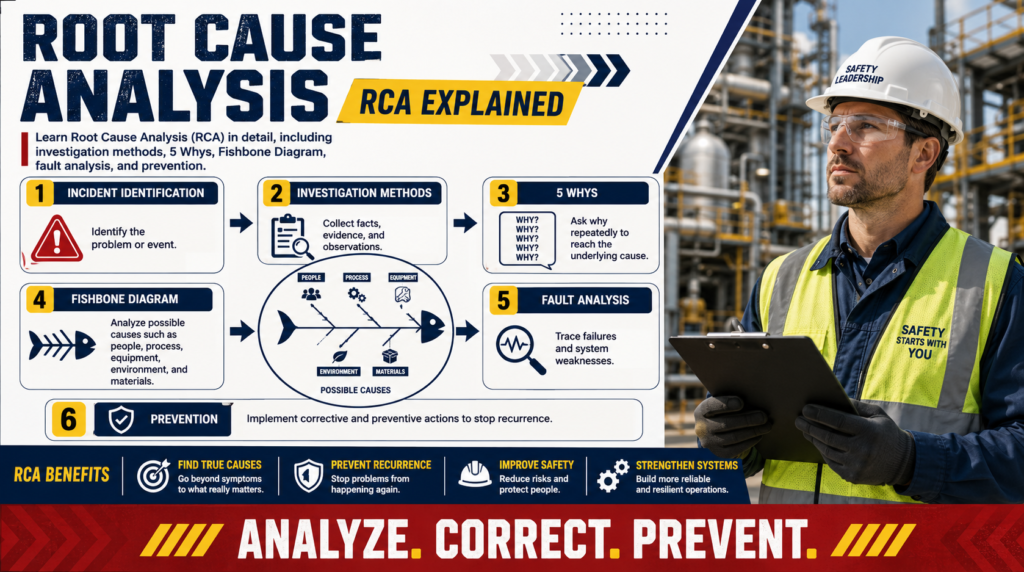
A Complete Guide to Identifying and Eliminating Workplace Problems Introduction Root Cause Analysis (RCA) is one of the most important problem-solving and incident investigation methodologies used in modern organizations. It is a systematic process designed to identify the fundamental causes of incidents, accidents, failures, defects, near misses, operational disruptions, quality issues, and safety concerns. Rather […]
Near Miss Reporting

A Comprehensive Guide to Proactive Workplace Safety Management Introduction Near miss reporting is one of the most powerful yet often underutilized tools in occupational health and safety management. A near miss is an unplanned event that did not result in injury, illness, environmental damage, or property loss but had the potential to do so. In […]
Incident Investigation Process
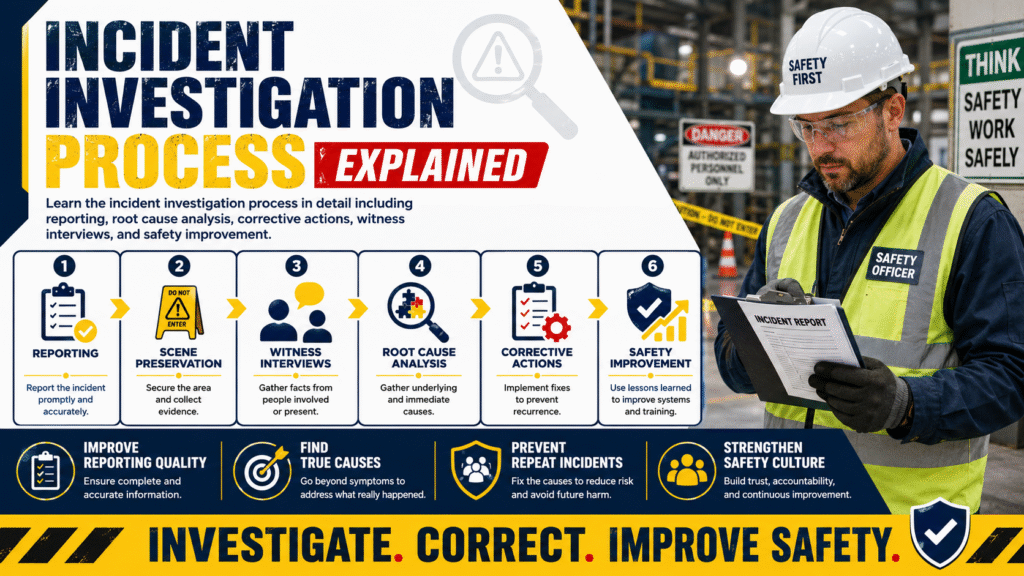
Incident Investigation Process A Complete Guide to Workplace Safety Analysis Introduction Incident investigation is a structured and systematic process used to determine the root causes of workplace accidents, near misses, injuries, illnesses, environmental incidents, and property damage events. The primary purpose of incident investigation is not to assign blame, but to identify underlying causes and […]
Risk Matrix

A Complete Guide to Risk Assessment and Risk Management Introduction A Risk Matrix is one of the most widely used tools in occupational health and safety, risk management, project management, construction, manufacturing, oil and gas, and many other industries. It helps organizations identify, evaluate, and prioritize workplace risks by considering two key factors: the likelihood […]
NFPA FIRE SAFETY CODES
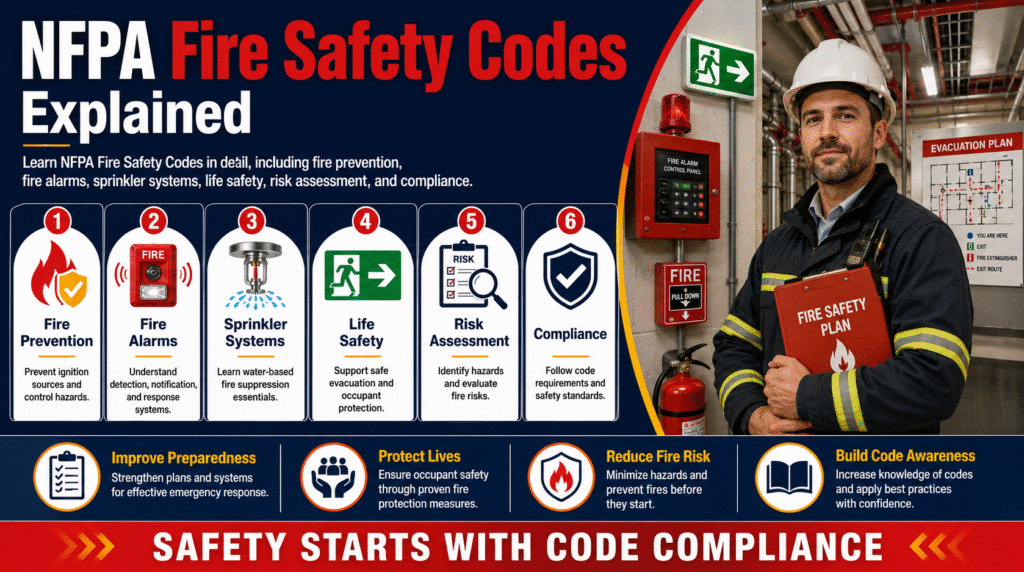
NFPA Fire Safety Codes: A Complete Guide to Fire Prevention and Life Safety Introduction Fire is one of the most dangerous hazards that can affect people, businesses, industries, and communities. Every year, thousands of fire incidents result in fatalities, severe injuries, property damage, environmental impacts, and financial losses. While many fires are preventable, they often […]
OSHA Standards

The Complete and Detailed Guide to Workplace Safety Compliance Introduction The Occupational Safety and Health Administration (OSHA) is one of the most influential workplace safety organizations in the world. Established under the Occupational Safety and Health Act of 1970, OSHA was created with a clear mission: to ensure safe and healthy working conditions for employees […]